

Collage by Tricontinental: Institute for Social Research drawing from a Dymaxion map projection and Islamic, Mesoamerican, Ethiopian, and Chinese maps made between the twelfth and seventeenth centuries.
Images sourced from: Muhammad al-Idrisi, Tabula Rogeriana, 1154, 1929 reconstruction and transliteration by Konrad Miller via Wikimedia Commons; Matteo Ricci and Li Zhizao, Kunyu Wanguo Quantu (坤輿萬國全圖), 1602, Library of Congress Geography and Map Division via Wikimedia Commons; Códice Xólotl, Lámina 1, Tetzcoco, Mexico, c. 1541 via Wikimedia Commons; Tigrayan circular map from the Māshafā Aksum (Book of Aksum), pre-eighteenth century, Bibliothèque nationale de France, Collection Antoine d’Abbadie, via Wikimedia Commons; and Justinkunimune, Blank World Map, Dymaxion Projection, 2023, Wikimedia Commons, CC0 1.0.
The maps in this dossier trace how the hegemonic world order has organised and represented the world, from colonialism, the post-World War II international order, and Cold War bipolarity to internationalised capital, the North–South divide, and US unipolarity. More than representations, they distil concepts imperial and colonial powers have used to exercise power. Every dot of ink is a choice: what sits at the centre, which countries appear at the top, and which distortions are considered acceptable. The cover gathers cartographic traditions with different centres, orientations, and cosmologies, asking how, beyond poles and blocs, we might understand the unequal social relations that constitute the world order itself.
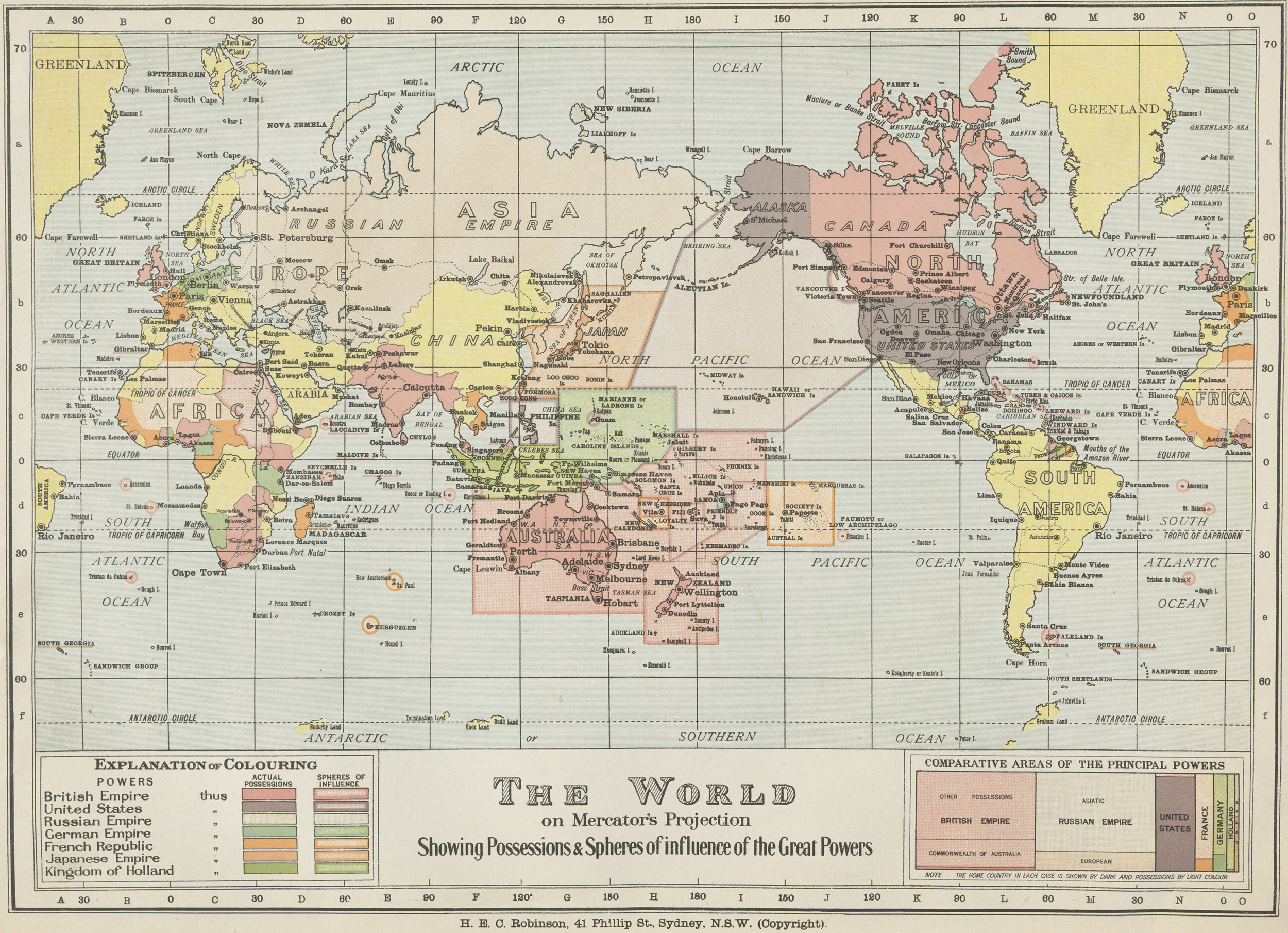
The Mercator projection was developed in 1569 for European navigation during the colonial period. During imperial expansion, it became the standard map projection, still used today.
This map, which shows the spheres of influence of the ‘great powers’ and their ‘possessions’, was created by H.E.C. Robinson in 1908. Sourced from the National Library of Australia via Wikimedia Commons.
The language of ‘unipolarity’ and ‘multipolarity’ – whether global power is concentrated in one dominant state or distributed among several major states – has become almost unavoidable in political debates. US and allied policymakers have often described the post-Cold War international system as a ‘liberal international order’ increasingly threatened by ‘revisionist powers’ such as China and Russia. Many governments and movements in the Global South, by contrast, welcome what they see as the emergence of a multipolar world in which Washington can no longer dictate the terms of international life. This aspiration is understandable. Any weakening of the United States’ capacity to impose blockades and unilateral sanctions, organise coups, and wage wars can open political space for sovereign development and for class struggles to advance.
‘Multipolarity’ may function as a slogan of resistance to US primacy and offer a rough description of how certain forms of state power are distributed. Its political appeal, however, should not be confused with explanatory power. The number of powerful states tells us little about the social relations that produce their power, the class interests organised within them, or the imperialist hierarchies that connect them. Multipolarity does not, by itself, provide a Marxist account of the world; when treated as such, it can mislead us into believing that a wider distribution of state power is inherently progressive.1
Venezuela’s former President Hugo Chávez, who had every reason to welcome a world of many centres, was dissatisfied enough with the term ‘multipolarity’ to coin ‘pluripolarity’ against it – insisting that what mattered was not the number of centres but whether popular subjects were the agents of transformation.2 The need to specify this political content was itself revealing: the number of poles alone tells us nothing about the class forces or popular subjects shaping the resulting order.
A Marxist analysis must therefore replace the arithmetic of poles with the analysis of a chain: an unevenly developed system of social formations, each internally constituted by class struggle and externally bound to the others by relations of exploitation and dependence. The question is not how many poles there are but how the chain is held together and where it is most susceptible to being broken.
The problem, then, lies in the image of the pole itself. It asks us to picture the international system as a set of sovereign states treated as its decisive units, each possessing a measurable quantity of power. Depending on how that power is distributed, the system is described as unipolar, bipolar, or multipolar. This vocabulary tells us how many great powers count as geopolitical poles. It does not tell us what kind of social order each state reproduces, how its power is produced, which class interests shape that power, or through which transnational relations it is exercised. It photographs the chessboard while hiding the social relations that made the board, carved the pieces, and decided who is permitted to play.
Polarity presents itself as a form of measurement. Measured by gross domestic product (GDP) at purchasing power parity (PPP) – which adjusts for differences in price levels between countries – the world appears economically plural: no single economy commands anything resembling the dominance that the word ‘unipolarity’ implies. Measured by military expenditure and the alliance systems organised around it, however, that same world appears far more concentrated: in 2022, the United States alone accounted for about 53.5% of global military spending, while the US-led military bloc accounted for 74.3%. The United States also maintained at least 902 foreign military bases – by far the world’s largest network.3
Measured in a third way – by control over critical markets and infrastructures that function as chokepoints in contemporary production and exchange – the world appears neither plural nor bipolar but close to monopolistic. Yet this concentration does not map neatly onto states. Four firms hold 56% of the world’s commercial seed market and 61% of the global pesticide market. One of them is Bayer, which absorbed Monsanto and its patent portfolio in 2018.4 Three firms – Eli Lilly, Novo Nordisk, and Sanofi – control more than 90% of the global insulin market by value and around 95% of the market in low- and middle-income countries.5 Palantir, a single US firm, supplies the data platform on which the US Army runs its operations and US immigration authorities track human beings.6
The same concentration appears in finance and energy. The dollar accounts for more than four-fifths of global trade finance – a predominance that far exceeds the US share of global output or trade. This is a form of monetary command that a ranking of national economic weight cannot capture.7 In energy, ownership of a resource can likewise diverge from control over the circuits through which it reaches the market. This divergence is visible in neighbouring Venezuela and Guyana. Venezuela has owned its oil outright since 1976, yet US aggression – whether military (such as the 3 January bombing), economic (over 1,000 sanctions and other unilateral coercive measures), or otherwise – continues to shape the conditions under which Venezuelan oil can be sold internationally. In neighbouring Guyana, the 2016 production-sharing agreement governing the offshore Stabroek Block restricts the government’s ability to alter its terms without the prior written consent of the ExxonMobil-led consortium.8
Three measurements, three different worlds, one reality. The disagreement between those who see unipolarity and those who see multipolarity is therefore not simply a disagreement about the facts. It is also a disagreement about which relations constitute power – and it is precisely this question, which must be settled before any counting can begin, that the vocabulary of poles leaves unanswered.
Polarity also inherits what is often called a Westphalian representation of power: a world composed primarily of sovereign territorial states treated as internally coherent units. This obscures how territorial states, capitalist markets, chartered colonial companies, and cross-border circuits of capital accumulation developed together. The Dutch East India Company, founded in 1602, possessed extensive commercial and quasi-sovereign powers – including the authority to wage war, conclude treaties, and build forts – decades before the 1648 Peace of Westphalia.9 The history of the modern capitalist world system is therefore not one in which fully formed sovereign states appeared first and corporations only later crossed their borders. Capitalist power combined territorial, commercial, and imperial forms from the beginning.
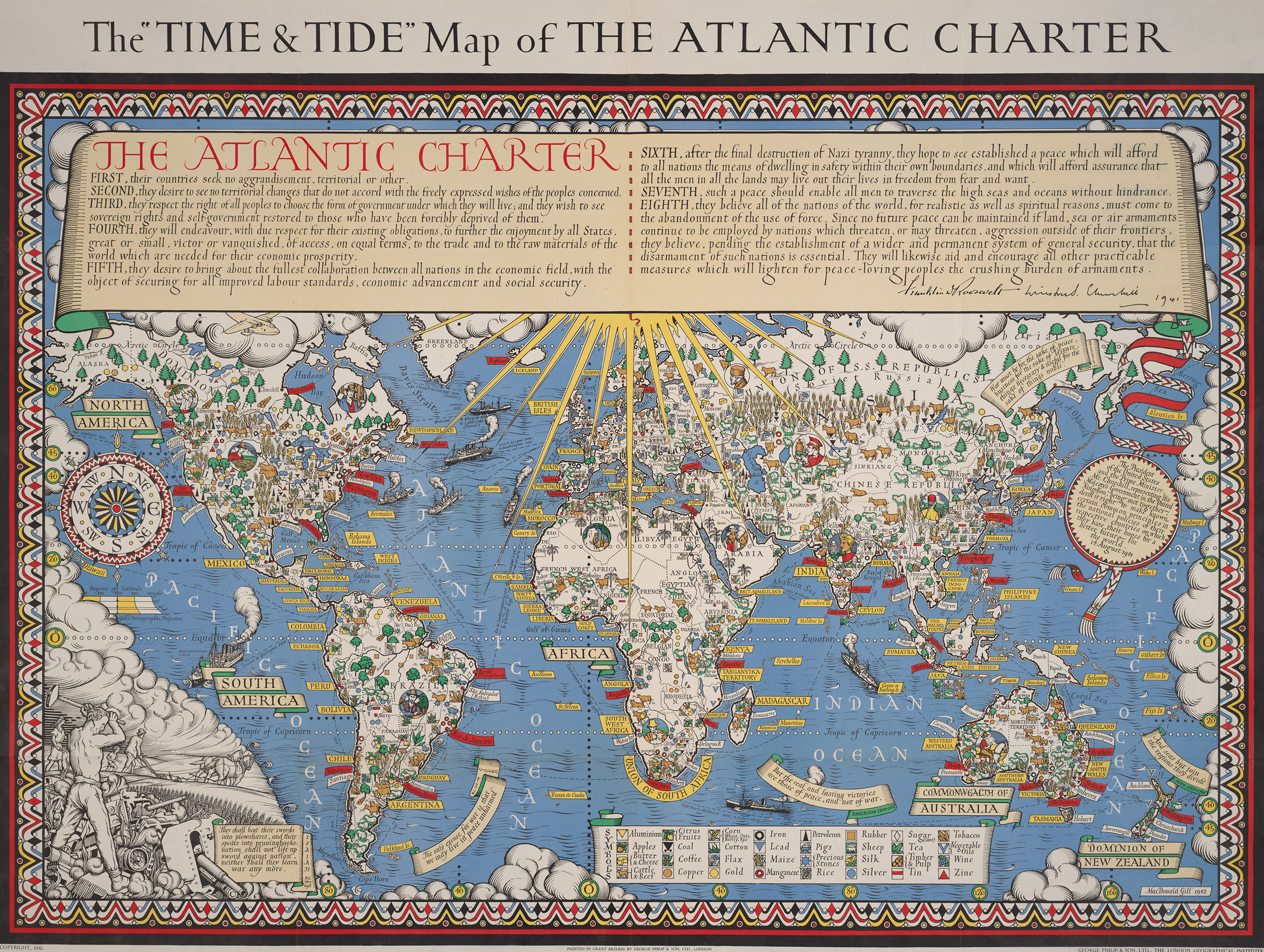
The 1941 Atlantic Charter set out an Anglo-American vision for the post-war order, affirming the right of ‘all peoples to choose the form of government under which they will live’ while Britain still ruled a vast colonial empire.
Map created by MacDonald Gill in 1942. Sourced from the PJ Mode Collection of Persuasive Cartography, Cornell University Library via Wikimedia Commons.
The US Genealogy of Polarity
The modern vocabulary of polarity emerged from the institutional and political world of post-1945 US political science. It had older antecedents in European discussions of the balance of power, as we shall see, but it was in the United States, amid the behavioural revolution, systems theory, Cold War strategy, and the rapid expansion of university-based national-security research, that ‘polarity’ came to be treated as a formal property of the international system. The central figure in the consolidation of polarity as a theory of international structure was Kenneth Waltz, the principal architect of neorealism. Rather than beginning with the internal character of states, neorealism sought to explain their behaviour through the constraints of an anarchic international system and the distribution of capabilities among its leading states.
Waltz built on the work of Morton Kaplan, whose System and Process in International Politics helped translate the diplomatic history of balances of power and alliances into abstract, rule-governed models.10 Kaplan organised international politics into six models – the balance of power, loose bipolar, tight bipolar, universal, hierarchical, and unit-veto systems – giving a systems-theory scaffolding to what had previously been studied largely through diplomatic history. Both Kaplan and Waltz studied at Columbia University under the international relations scholar William T. R. Fox, who coined the term ‘superpower’ in 1944.11 At a time when US political science increasingly sought to model political behaviour in formal, scientific terms, Kaplan and then Waltz drew on general systems theory to analyse international politics. The histories of imperialism, revolution, and class struggle were displaced by abstract interactions among formally comparable units. Class did not have to be explicitly refuted; it disappeared from the object of study itself.
Waltz gave this systems approach its canonical neorealist form. In ‘The Stability of a Bipolar World’ and more systematically in Theory of International Politics, Waltz argued that the international system was anarchic – meaning that no central authority stood above sovereign states. Within this system, states were treated as functionally similar despite differences in their political and social systems and distinguished principally by the distribution of capabilities among them.12 The domestic orders of these states could differ profoundly, but Waltz’s structural theory abstracted from those differences, and his models transcended ideology. The United States and the Soviet Union could therefore be treated as functionally comparable units occupying two poles, and their conflict could be analysed primarily through the structure of bipolarity rather than through the antagonism between their social systems. Whether capitalism or socialism organised production in each country was treated as an internal difference rather than as something that constituted the international system itself. This abstraction was not innocent. It converted a historically specific Cold War conjuncture into a general theory of international politics. Within this framework, anticolonial revolution, competing social systems, unequal exchange, and US imperialism became analytically subordinate to the number and relative weight of the strongest states. The resulting framework closely reflected the concerns of a US national-security establishment focused above all on strategic stability and the management of rivalry.
During the Cold War, Waltz argued that bipolarity was more stable than multipolarity because the two superpowers depended less upon allies and could assess one another’s capabilities more directly. As the USSR disintegrated, this same conceptual vocabulary was repurposed to describe US primacy. In his 1990 Henry M. Jackson Memorial Lecture, Charles Krauthammer argued that the apparent plurality of world power concealed the predominance of a single superpower: the United States.13 The concept soon migrated from political commentary into realist scholarship. William Wohlforth’s ‘The Stability of a Unipolar World’ (1999) argued that the scale of US preponderance made counterbalancing difficult and major-power war less likely.14 In the same year, Samuel Huntington described the emerging order as ‘uni-multipolar’: one superpower operating alongside several major powers whose cooperation it often required.15 Although these authors disagreed over the number of poles and the distribution of capabilities among them, they shared the same underlying conception of the international system: states as comparable units whose relative capabilities determined its structure.
As US predominance has eroded in some areas while remaining entrenched in others, the language of polarity has returned to the centre of debate. The categories inherited from Kaplan and Waltz are now used to ask whether China, Russia, India, Brazil, and other states constitute independent poles. The debate commonly turns on indicators such as GDP, military expenditure, population, technological capacity, and diplomatic reach. Yet ‘multipolarity’ is often used less to identify a coherent structure of world power than to describe the relative decline of US power. What often remains unquestioned across these successive descriptions – bipolarity, the unipolar moment, and now multipolarity – is the assumption that territorial states are the basic containers of power and that world order can be understood by ranking them.
The limits of this approach become clearer when we try to interpret the war in Ukraine, the expansion of BRICS+, or the different positions and policies of China, Russia, India, and Brazil. These states cannot be treated as equivalent units merely because they resist, bargain with, or operate outside particular US initiatives. Their ruling blocs, forms of property, relations to international finance, popular pressures, and positions within the imperialist chain differ sharply. Those differences help explain why governments that cooperate within BRICS+ or another multilateral institution may diverge sharply on other questions and why the same state may resist US pressure in foreign policy while reproducing exploitation domestically and relations of dependency internationally.
Judged by its own criteria, however, the predictive record of this framework after the Cold War has been uneven at best. Structural realism was never merely descriptive: its proponents used it to make concrete predictions about how the post-Cold War order would develop. In 1993, Waltz argued that balance-of-power pressures would push Germany and Japan towards full great-power status, including the acquisition of nuclear weapons.16 Working from similar realist premises, Mearsheimer argued in 1990 that if US and Soviet forces withdrew from Europe and the Cold War alliance system dissolved, Europe would return to a multipolar order more prone to instability.17 Neither prediction was borne out. Germany and Japan did not acquire nuclear weapons. The United States remained militarily embedded in Europe. NATO expanded.
A Marxist explanation for this sequence of events points instead to relations that structural realism largely sets aside. In Germany and Japan, dominant class fractions were integrated into US-centred circuits of accumulation while their state apparatuses were reshaped within the wider US-led order.18 This structure did not fail to determine outcomes; the structure was never the one Waltz described.
John Mearsheimer’s work illustrates both the strength and the limits of this tradition. His rejection of the language of ‘democracy promotion’, used to justify NATO’s eastward expansion, can illuminate the strategic pressures surrounding the war in Ukraine more clearly than accounts framed primarily in terms of liberal values. However, by treating great powers principally as functionally similar security-seeking states, realism cannot adequately explain the class forces that shape Russian, Ukrainian, European, and US policy. Nor can it explain the material interests organised through energy, finance, arms production, and property relations or the unequal imperial structures within which strategic choices are made. A critique of liberal ideology is necessary, but without a social analysis of the states and class forces involved it remains incomplete.
Paradoxically, the language that now announces the end of US predominance remains rooted in a conceptual framework developed within the US national security academy during the Cold War. The social and class relations that helped shape the post-Cold War order are precisely those which this framework tends not to register.
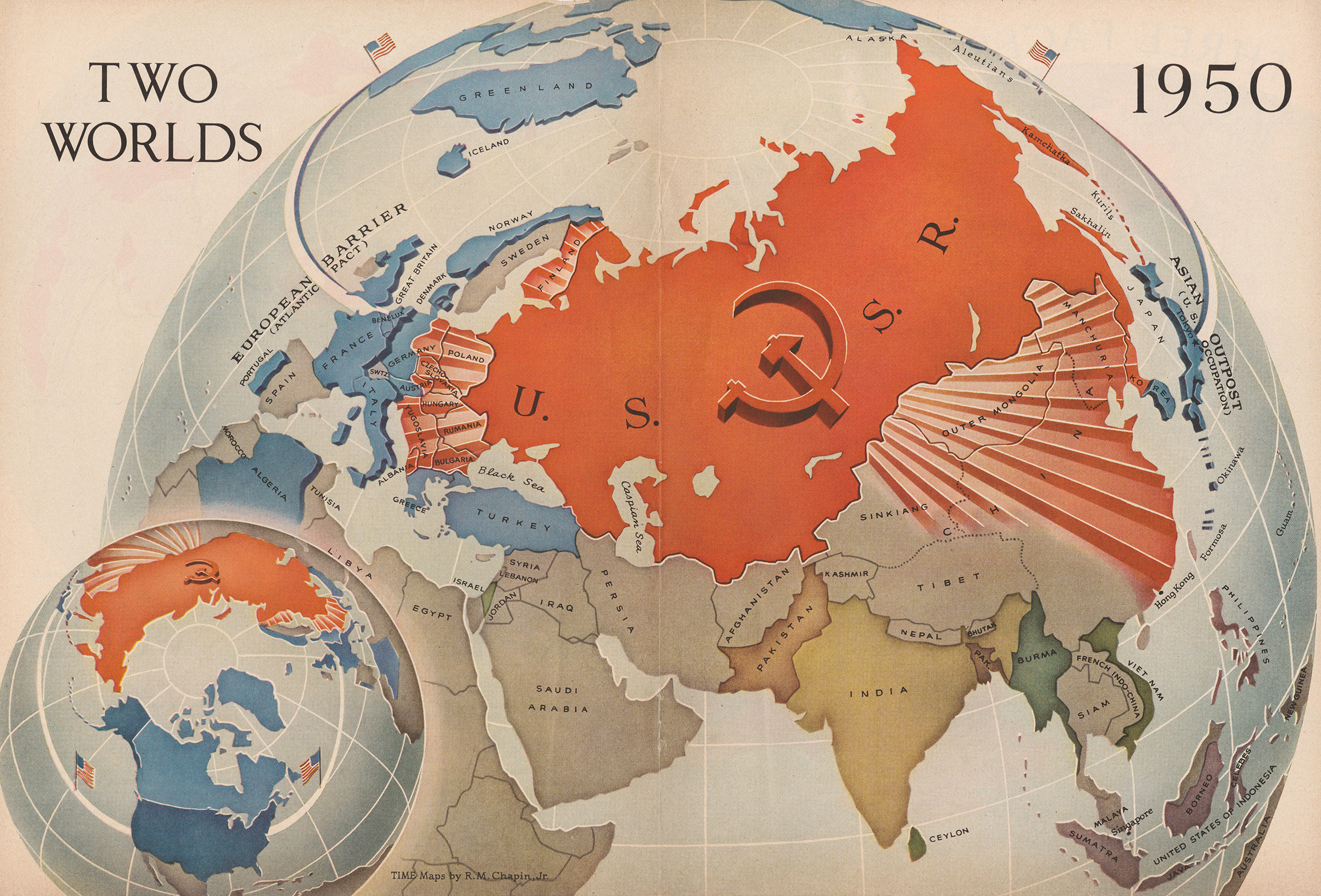
This map depicts the two antagonistic blocs of the Cold War and the geopolitical logic of bipolarity.
Robert M. Chapin, Two Worlds 1950, 1950. Source: Time, 2 January 1950, via the PJ Mode Collection of Persuasive Cartography, Cornell University Library via Wikimedia Commons.
The Westphalian Model and the World Market
The theory of polarity rests on what is often called a Westphalian representation of the international order: a world composed of territorially bounded states, each sovereign within its borders and formally equal to the others, interacting in the absence of any higher authority. The term refers to the Peace of Westphalia, the agreements concluded at Münster and Osnabrück in 1648 that ended the Thirty Years’ War – a devastating conflict in Central Europe shaped by religious divisions, dynastic rivalry, and struggles over political authority within the Holy Roman Empire – and were later treated in international relations theory as the birth of the modern sovereign-state system. Yet the 1648 treaties of Münster and Osnabrück did not suddenly invent sovereignty, nor did they produce a clean division between domestic hierarchy and international anarchy. Rather, they settled the war within a layered dynastic and imperial order in which political authority remained overlapping, unequal, and socially heterogeneous. Historians and international relations scholars have therefore challenged the ‘Westphalian myth’ – the idea that the 1648 settlements created the modern system of sovereign states.19 The importance of Westphalia lies less in what the treaties immediately created than in what they later came to symbolise in international theory: the supposed birth of a world composed of territorially bounded sovereign states.
For Waltz, Westphalia served as a useful historical boundary. In Theory of International Politics he argued that from Westphalia onward no more than eight major states had at any one time competed for mastery over the world system. Waltz used this early European example to demonstrate the structural problem of multipolarity, largely setting aside the personalities of individual rulers and the details of diplomatic manoeuvring.
A second route to thinking about multipolarity emerged from Henry Kissinger’s study of the Congress of Vienna. His 1954 Harvard dissertation, later reworked and published in 1957 as A World Restored, examined how Castlereagh and Metternich used legitimacy, restraint, and equilibrium to stabilise the post-Napoleonic settlement.20 Kissinger asked how diplomacy could manage a multipolar order. Waltz asked how the number and relative capabilities of great powers constrained diplomacy regardless of who governed them. Together, these approaches established the two dominant US conceptions of multipolarity: one centred on diplomatic management and the other on systemic structure.
Within both accounts of interstate order, economic relations remain secondary to relations among sovereign states. What recedes from view is the historical development of mercantile, industrial, and financial capital; the formation of national and international markets; and the legal and political institutions governing trade, property, labour, and investment. Waltz acknowledged that large corporations ‘and other nonstate actors are difficult to regulate and may rival some states in influence’.21 Even though the ‘importance’ of nonstate actors is ‘obvious’, he argued, it does not make the ‘state-centric conception of international politics’ obsolete. The issue, then, is not whether Waltz recognised non-state actors but whether they can be treated as secondary forces operating within a system whose basic structure is already defined by states. From a Marxist standpoint, they cannot: the capabilities attributed to states are themselves produced through relations of property, production, finance, empire, and class struggle, which cross territorial boundaries.
For Marxists, this omission matters because modern territorial states did not first develop as sealed political units and only later enter capitalist economic relations. The modern state system and the capitalist world market developed together. The consolidation of European sovereignty was bound up with enslavement, dispossession, and colonial rule abroad.22 The formal equality of sovereign states in international law has long coexisted with deep material hierarchy across the world system: colonies denied sovereignty, formally independent debtor states, occupied territories, protectorates, and states whose policy space is constrained by creditors, trade rules, sanctions, and military threats. Modern territorial sovereignty itself was produced over centuries through war-making, colonial conquest, capitalist property relations, and class struggle.
The pole metaphor converts these relations into attributes of individual states. Financial power appears as something the United States possesses rather than as a set of relationships reproduced through the international role of the dollar, central and commercial banks, debt contracts, payment systems, corporate accounting, and the constraints these arrangements place on other states. Contemporary production is organised through global value chains in which corporate control, manufacturing, logistics, data, intellectual property, and the location of profits are geographically dispersed. A corporation may own few factories yet control thousands of suppliers through standards, patents, purchasing contracts, and digital platforms. Workers across the Global South can be integrated into the same transnational production networks while remaining divided by borders, wage regimes, migration controls, and differential exposure to environmental harm. Lead firms and financial owners tend to capture disproportionate shares of value and profit while suppliers, workers, and states bear much of the risk.
A polarity framework has no convincing way to capture this kind of power. If a US-based technology firm organises production in East Asia, extracts data globally, holds intellectual property in one jurisdiction, books profits in another, depends on minerals from Africa and Latin America, and relies on US courts, diplomacy, export controls, and military protection, to which pole does its power belong? Calling it simply ‘American’ misses the transnational organisation of accumulation. Treating it as ‘stateless’ misses the state-backed legal and coercive systems that make its property claims enforceable. The Marxist point is therefore not that corporations have replaced states. Capital requires states to define and enforce property rights, discipline labour, absorb losses, build infrastructure, police borders, and defend access to markets and resources. Multinationals operate across borders yet remain dependent on territorial authority. They exploit differences among national tax, labour, and regulatory regimes while relying on powerful home states and bargaining with host states. The relation is neither a world of sovereign billiard balls nor a borderless empire of corporations. It is a differentiated unity of states and capitals – distinct forms of power that are nevertheless deeply interdependent.23
This relational understanding of power has deep roots in Marxist theories of imperialism. Vladimir Lenin’s theory of imperialism already points beyond a simple map of great powers. Lenin defined imperialism through five connected features: the concentration of production and capital into monopolies; the merging of bank and industrial capital into finance capital; the growing importance of the export of capital; the formation of international monopolist capitalist associations; and the territorial division of the world among the major capitalist powers. For Lenin, the division of the world among great powers mattered not simply because several powerful states existed but because this division was bound up with capitalist accumulation and uneven development. A contemporary theory must extend this insight to global production, dollar-centred finance, digital monopolies, the expansion of extraction into new ecological frontiers, and the legal architecture of intellectual property and investment – not retreat to counting poles.
At the Second Congress of the Communist International in 1920, the debates over the Theses on the National and Colonial Question – including Lenin’s draft theses and the supplementary theses presented by the Indian revolutionary M. N. Roy – asked how communists should distinguish the oppressed from oppressor nations, analyse the class composition of anticolonial movements, relate workers and peasants to the national bourgeoisie, and combine temporary alliances with the political independence of the proletariat. In this framework, interstate relations, national liberation, and internal class struggle formed interconnected parts of a single strategic problem.
Mao Zedong’s On Protracted War (1938) offers a masterful example of this method in the context of China’s war of resistance against Japan. Mao’s analysis began from the concrete balance of forces: China’s social and political conditions and vast geography, Japan’s military and economic strengths and weaknesses, and the changing international situation. The Vietnamese revolution likewise defeated French colonialism and US imperialism by combining an analysis of domestic classes, the social and political contradictions inside the United States, and the possibilities created by relations and divisions among states with different social systems and political alignments. Cuba’s revolutionary diplomacy – from its defence of sovereignty to its internationalist activity – has repeatedly demonstrated the same capacity to work within interstate contradictions without reducing politics to relations among states.
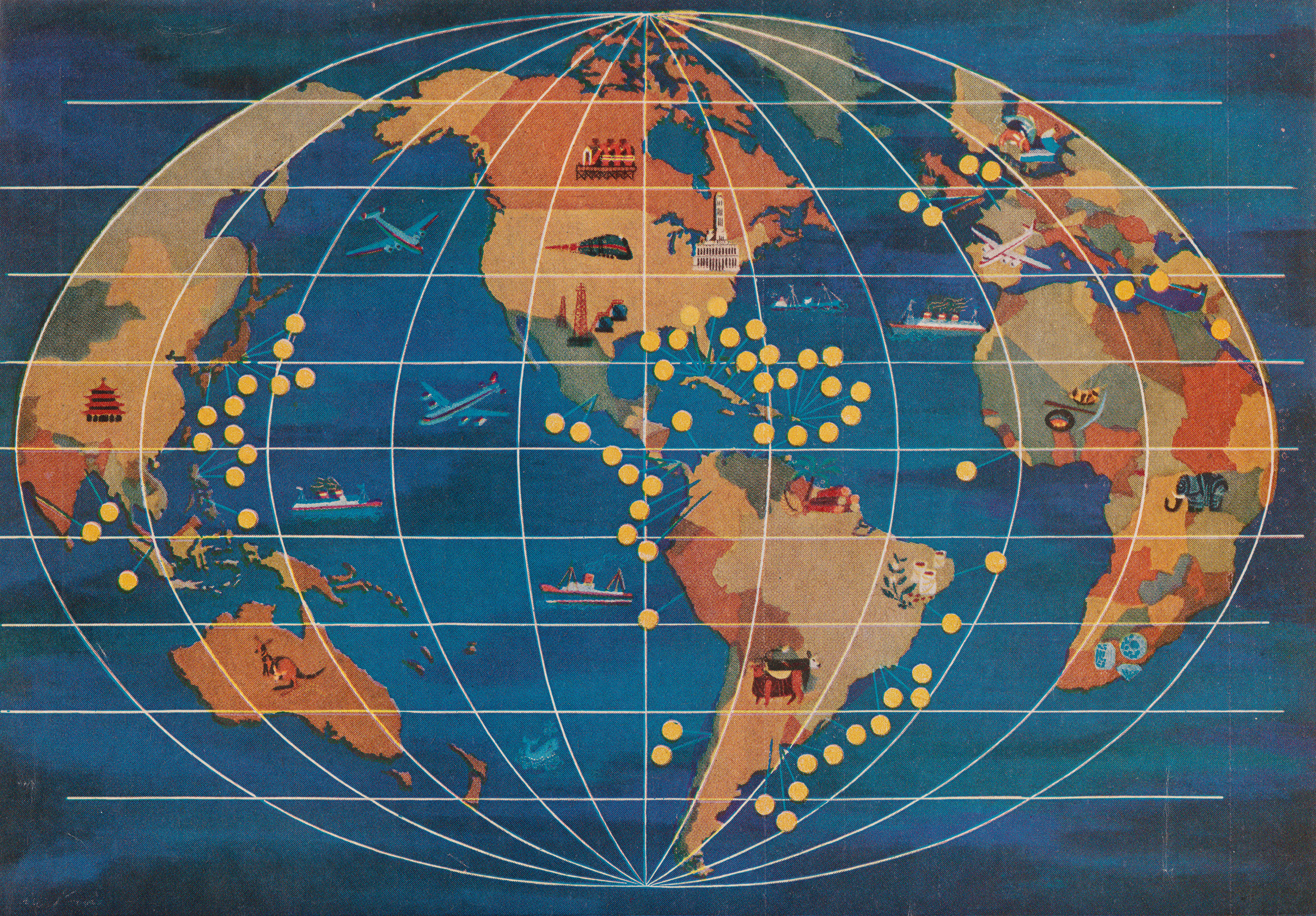
This map was created in 1956 as an advertisement by a major US bank to show its expansion overseas, especially in Latin America, Africa, and Asia, highlighting international financial circuits and capital accumulation.
Sourced from an advertisement by the First National City Bank of New York in the article ‘How Bankers “on the Scene” Make the Difference Overseas’, the PJ Mode Collection of Persuasive Cartography, Cornell University Library via Wikimedia Commons.
States, Internationalised Capital, and the Imperialist Chain
Nicos Poulantzas developed Lenin’s account of imperialism in a direction that is particularly useful for understanding the relationship between national states and internationalised capital. Although Poulantzas did not produce a separate theory of geopolitics, his writings on the capitalist state, social classes, and the internationalisation of capital provide important elements for such a theory. In State, Power, Socialism (1978), he described the state as a ‘specific material condensation of a relationship of forces among classes and class fractions’.24 For Poulantzas, the state does not stand outside of class struggle: the balance of forces among classes and competing sections within them takes material form in its institutions and policies. The state is neither a neutral actor nor simply the instrument of a unified capitalist class. Capital itself is divided into competing fractions – such as industrial, commercial, and financial capital – whose interests do not always coincide. The state consequently has a degree of ‘relative autonomy’ from any one fraction, allowing it to organise what Poulantzas called a ‘power bloc’: the alliance of dominant classes and class fractions whose competing interests are held together under the leadership of a hegemonic fraction. Foreign policy should therefore be understood neither as an automatic expression of capitalist interests nor as the pursuit of a timeless national interest. It is shaped by the changing balance of class forces expressed through the state.
In Classes in Contemporary Capitalism (1975), Poulantzas applied this approach to the internationalisation of capital. The expansion of multinational corporations, he argued, did not abolish national states or generate a single borderless capitalist state. International capital still had to be reproduced within concrete social formations and through national states, which guarantee property, regulate labour, provide infrastructure, manage crises, and organise political consent. The internationalisation of capital therefore takes place not outside or above national states but through changes within them. Foreign capital becomes embedded in domestic production, ruling-class alliances, administrative institutions, and state strategies. Imperial relations are thus reproduced not only through external pressure between states but also through the class relations and institutions within the states they connect.
Poulantzas developed the category of the ‘internal bourgeoisie’ to describe fractions of the domestic bourgeoisie whose accumulation remained nationally grounded but had become entangled with foreign capital. In post-war Europe, he argued, important sections of the bourgeoisie were neither autonomous national capitalists nor passive agents of the United States. Their capital remained rooted in their own social formations, but its reproduction had become intertwined with US corporations and international circuits of accumulation dominated by US capital. These bourgeoisies could bargain with US capital and sometimes conflict with it while remaining structurally dependent on the wider imperial order. Imperial hierarchy was consequently reproduced not only through pressure exerted by one state on another but also within the power blocs of subordinate states themselves.25
This brings us back to the Leninist conception of the imperialist chain, now understood through Poulantzas’s theory of the state. Its links are not identical sovereign states distinguished only by how much power they possess. Each link is a social formation with its own combination of classes, institutions, political struggles, and forms of dependence. The chain is marked by uneven development: states occupy different positions within global production, finance, military power, and technological control. But these positions cannot be determined by ranking states according to national capabilities alone because the relations of imperialism also run through the internal class structure of every state.
A Poulantzian analysis would therefore ask questions that the theory of polarity does not. Which class fractions constitute a state’s power bloc? Which fraction exercises hegemony within it? How is foreign capital embedded in domestic production and state institutions? Which corporations depend upon which states to protect their ownership, markets, technologies, and supply chains? How do popular struggles alter the balance of forces within the state? Such questions do not make interstate conflict irrelevant – they explain its social content.
Poulantzas helps us move beyond the false choice between a world of sovereign billiard balls and a borderless empire of multinational corporations. Capital is internationalised, but political power remains unevenly organised through a plurality of national states. States are nationally constituted, but their internal class relations are also shaped by international capital and imperial hierarchy. Geopolitics is not an autonomous contest among territorial states but the international organisation of class power through a differentiated system of states. This also helps us understand the power of transnational corporations. Global supply chains and international finance allow large monopoly firms to operate across jurisdictions, but their existence and expansion depend decisively upon states. US digital and technology monopolies rely on public research, procurement, subsidies, courts, patents, export controls, diplomatic pressure, intelligence systems, and military power. Other monopoly capitals likewise depend upon the states in which their ownership and strategic command are anchored. At the imperialist stage, the integration of state and monopoly capital does not end when finance crosses borders; it is reproduced internationally through an unequal system in which capital operates across national boundaries while retaining privileged relationships with particular state apparatuses.
The erosion of particular forms of sovereign power under the pressure of international finance must therefore not be confused with the disappearance of the state. Even a subordinate capitalist state remains a central apparatus through which the dominant classes organise exploitation, secure property, discipline labour, manage social conflict, and reproduce their power. Integration into the imperialist chain changes the balance of forces within the state and may compel its ruling bloc to cede policy space, but it also makes the struggle against imperialist subordination part of the class struggle within that state. The relationship between class power and national sovereignty is consequently concrete rather than abstract. Sovereignty exercised by a capitalist ruling class is not popular sovereignty, yet breaking or loosening mechanisms of imperial command can enlarge the terrain on which workers and other popular forces struggle.
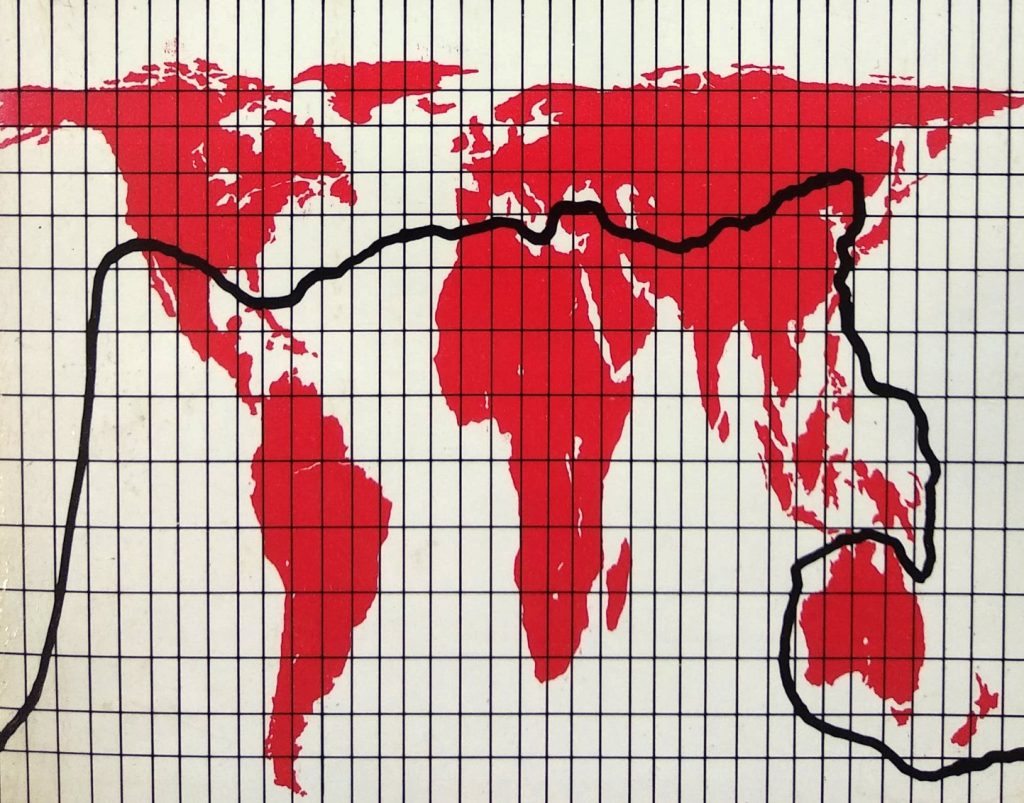
The 1980 Brandt Line, overlaid onto a Gall-Peters map projection, depicts the division between a wealthier industrialised North and a poorer, largely formerly colonised South.
Sourced from the cover of North-South: A Programme for Survival, the report of the Independent Commission on International Development Issues chaired by Willy Brandt, Pan Books, 1980.
A Contradictory World Order
Neither unipolarity nor multipolarity adequately captures the present world order. US predominance has eroded, but it has not simply disappeared. The United States remains the world’s largest military spender, sits at the centre of an unparalleled system of alliances and overseas military bases, and benefits from the dollar’s central place in reserves, trade, debt, and payments.26 Its power is institutional and relational, not merely an aggregate of national resources. At the same time, China has become a major industrial and technological centre. Russia retains formidable military capabilities and vast natural resources. States across Asia, Africa, and Latin America have widened their room for manoeuvre. The expansion of BRICS+ reflects real demands for representation, development finance, and freedom from Western tutelage in the Global South.
Yet these tendencies do not add up to several equivalent poles. Military command, industrial capacity, finance, energy, technology, natural resources, and political legitimacy are distributed in different patterns. A state may be militarily protected by the United States, industrially tied to China, dependent on Gulf energy, exposed to private creditors, and responsive to a domestic popular movement – all at once. Interdependence does not abolish hierarchy, and rivalry does not end integration. US and Chinese capital may compete over technology while firms in both countries remain connected through production and markets. The semiconductor industry illustrates this layered geography: intellectual property, chip design, fabrication, lithography (the specialised technology used to print microscopic circuits onto chips), mineral extraction, assembly, and final markets are concentrated in different territories and controlled by different combinations of corporations and states. No single national ranking captures this structure, even though state power remains decisive through subsidies, export controls, sanctions, infrastructure, and military alliances. Sanctions and so-called ‘de-risking’ policies designed to reduce strategic dependence on rival economies disrupt or redirect some economic circuits while finance and commodity exchange bind others together. Meanwhile, the climate crisis, care work, migration, and social reproduction create material pressures that no great-power ledger measures.
These different distributions of power did not emerge independently of one another: they were reshaped through a connected transformation of global capitalism. From the 1970s onward, US-based capital increasingly relocated labour-intensive production abroad while retaining or strengthening control over functions such as design, intellectual property, standards, branding, finance, and the legal and coercive infrastructures that sustained them. The industrialisation of several US-aligned East and Southeast Asian economies – including the ‘Asian Tigers’ as well as Malaysia, Thailand, and others – and the financialisation of the North American and British economies were two aspects of the same process. What appears in one register as US decline – the loss of manufacturing employment – and in another as continuing US structural power – the dollar, legal and financial institutions, export controls, and military bases – can therefore be understood as related outcomes of the same restructuring. As strategic control over production became increasingly separated from the physical location of manufacturing, major conflicts began to emerge not only over territory but also at the points where this control is exercised, such as export controls on lithography and chip design, sanctions on payment systems, the extraterritorial application of domestic law, and struggles over technical standards and data. A ranking of great powers cannot readily capture these conflicts because it converts the relations that produce them into attributes of individual states.
A Marxist theory of geopolitics should begin not with the number of powerful states but with the historically developed totality of capitalist social relations. It would ask how surplus is produced, appropriated, and transferred; how ownership and control are organised across commodity chains; how finance disciplines states and households; how race, caste, gender, and citizenship segment the global working class; and how ecological costs are displaced onto dominated regions. It would examine the changing balance of forces within each state, locate that state within the unequal relations of the imperialist chain, trace how particular blocs of capital remain nationally anchored while accumulating transnationally, and examine how state institutions pursue the conditions for accumulation, political legitimacy, and security under different historical circumstances.
Applied to the present world order, this method refuses to treat China, Russia, India, or Brazil as socially or politically equivalent simply because they participate in BRICS+ or favour a less US-dominated order. Rather, it asks in each case how each state emerged historically, which classes and class fractions make up its power bloc, how different forms of property and planning shape accumulation, how labour and peasant struggles constrain it, how domestic capital relates to international finance, and whether its external actions reproduce or weaken imperial hierarchy. Only such an analysis can explain why states align in some areas and diverge in others rather than inferring their politics from their position on a geopolitical map.
Such a theory would also distinguish among political struggles and projects too often collapsed into the category of ‘great-power competition’. These include conflicts among fractions of capital, projects of sovereign development, socialist experiments, national liberation movements, and struggles against transnational corporations by workers, peasants, women, Indigenous peoples, and other impacted sectors. Their political content cannot be deduced from whether they oppose Washington, nor can every assertion of sovereignty be treated as emancipatory.
The relevant questions are concrete: does a project weaken mechanisms of imperial domination? Does it expand popular control over production and social wealth? Does it reduce dependency and hierarchy, or does it reproduce exploitation under a new flag? A state can increase its strategic autonomy without transforming its domestic relations of exploitation. Conversely, greater sovereign control over finance, resources, technology, or infrastructure can create conditions for popular forces to pursue more fundamental transformations. Neither outcome can be deduced solely from a state’s opposition to the United States.
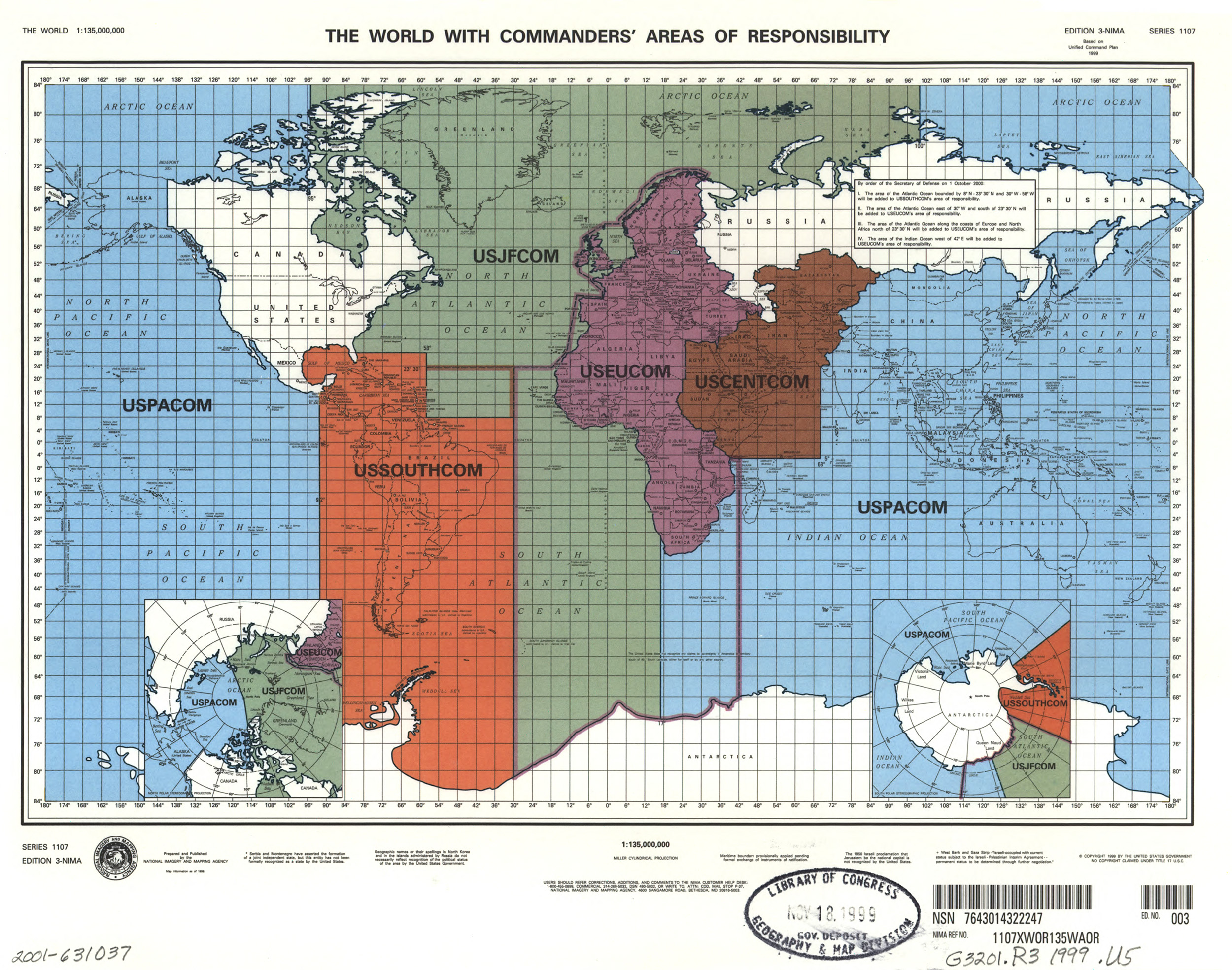
This map, created by the US government, divides the world into the geographic ‘areas of responsibility’ assigned to US military commands.
Sourced from the United States National Imagery and Mapping Agency, The World with Commanders’ Areas of Responsibility, 1999, via the Library of Congress Geography and Map Division and Wikimedia Commons.
For this reason, struggles over national sovereignty cannot be dismissed as distractions from class struggle. In states subordinated within the imperialist system, control over finance, resources, food, technology, infrastructure, and foreign policy can be indispensable to any popular programme. A loosening of links in the imperialist chain may be valuable even when initiated by a capitalist state because it can weaken external constraints and alter the conditions of domestic struggle. However, its political meaning depends on which class forces lead it, who gains control over sovereign capacities that are recovered, and whether popular organisation can convert state autonomy into social transformation.
Multipolarity, then, has a limited but real political meaning. A less concentrated interstate order can make unilateral coercion more difficult and create openings for the Global South. Those openings can assist national liberation projects and advance class struggles within capitalist states. However, alignment with other states against US primacy does not alter a state’s class character or abolish its exploitative social order. There is no automatic path from several centres of state power to equality among peoples. A world of competing capitalist powers can remain profoundly imperial, exploitative, and ecologically catastrophic.
The task is not to choose the correct number of poles. The image of a balance treats power as a set of comparable weights whose distribution can be rearranged. A chain, by contrast, is composed of unequal and interlocking relations. It is transformed not simply by rearranging its links but by breaking the relations that bind them at the points where those relations are weakest. The decisive question is therefore not where a state is strongest but where imperial relations are most vulnerable to rupture.
For Marxists, the horizon cannot be a better balance among ruling states alone. It must be the international power of working peoples: popular sovereignty against imperialism, cooperation against zero-sum rivalry, social ownership against monopoly, ecological repair against endless accumulation, and internationalism rooted in popular struggle.
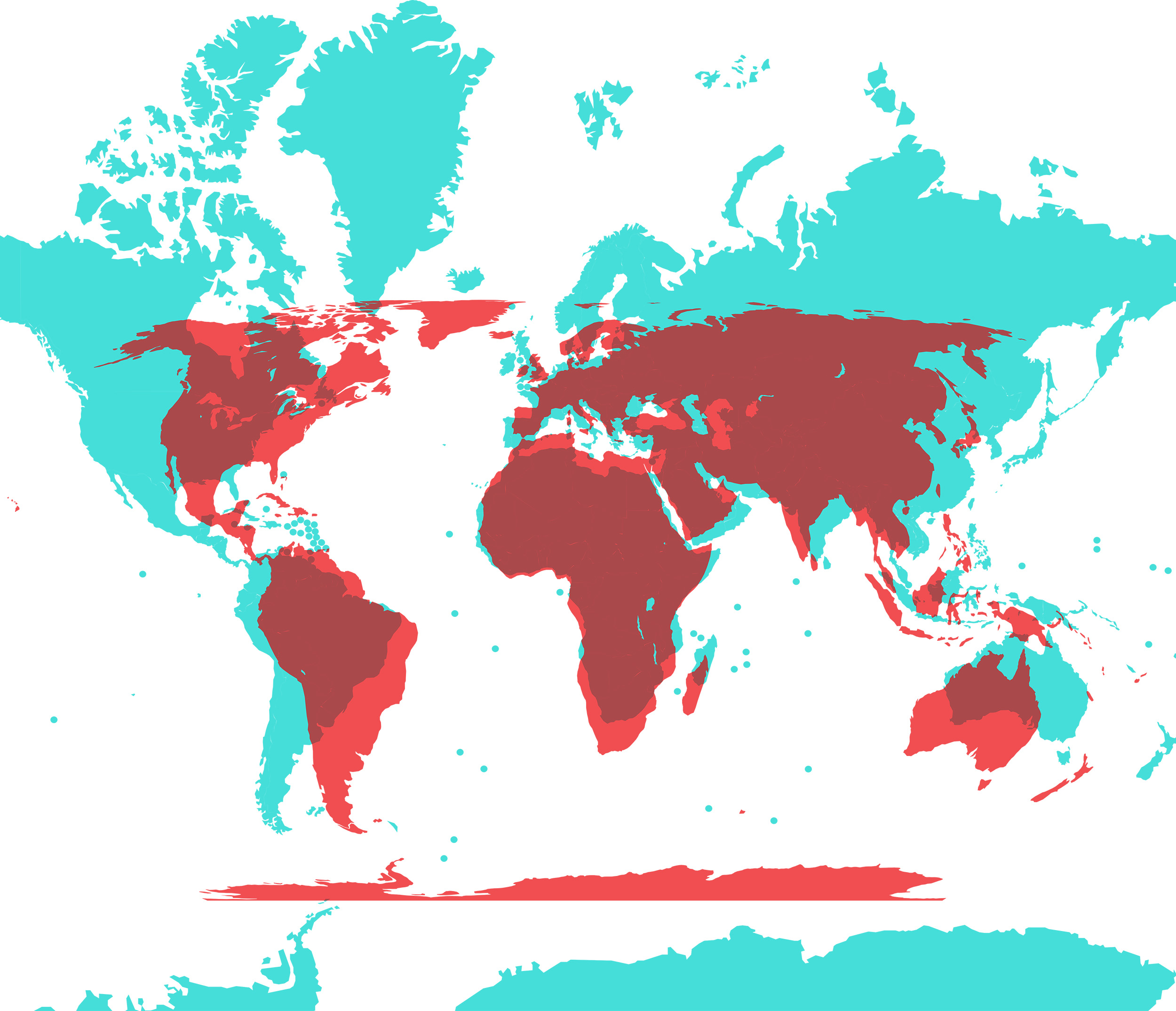
On 4 September 2026, the UN General Assembly voted 164 to 1 to promote equal-area projections (shown in red) that more accurately represent the relative size of continents, challenging distortions such as Mercator’s enlargement of northern landmasses (shown in blue). The only opposing vote was from the United States.
Mercator and Equal Earth projection comparison by Tricontinental: Institute for Social Research.
Notes
1 There is no established canon for Marxist geopolitics. The classical texts to which we refer below include Nikolai Bukharin’s Imperialism and World Economy, written largely in 1915 and completed in 1917, and Vladimir Lenin’s Imperialism, the Highest Stage of Capitalism, written in 1916 and first published in 1917. The Communist Manifesto (1848), by Karl Marx and Friedrich Engels, is foundational, as are large sections of Marx’s Capital, vol. 1 (1867). We have also drawn on Nicos Poulantzas’s Classes in Contemporary Capitalism (London: New Left Books, 1975) and State, Power, Socialism (London: New Left Books, 1978), as well as Justin Rosenberg’s The Empire of Civil Society: A Critique of the Realist Theory of International Relations (London: Verso, 1994).
2 On the distinction between Chávez’s pluripolar formulation and the more common conception of multipolarity, see Federico Fuentes and Claudio Katz, ‘Geopolitics, the Imperial System and Socialist Anti-Imperialism: An Interview with Claudio Katz’, Links: International Journal of Socialist Renewal, 24 October 2023, https://katz.lahaine.org/b2-img/Geopoliticstheimperialsystemandsocialist.pdf; Claudio Katz, Integración, soberanía y socialismo en América Latina [Integration, Sovereignty, and Socialism in Latin America], CADTM, 27 April 2023, https://www.cadtm.org/Integracion-soberania-y-socialismo-en-America-Latina. Katz distinguishes socialist pluripolarity from multipolarity by two features: a radical programme of anti-capitalist transition and the central role assigned to popular subjects in carrying out that transformation. By contrast, the multipolar view he criticises assumes that progressive change can emerge from shifts in the balance among powers or governments alone.
3 Tricontinental: Institute for Social Research, Hyper-Imperialism: A Dangerous Decadent New Stage, Studies on Contemporary Dilemmas no. 4, 23 January 2024, https://thetricontinental.org/studies-on-contemporary-dilemmas-4-hyper-imperialism/.
4 ETC Group and GRAIN, Top 10 Agribusiness Giants: Corporate Concentration in Food & Farming in 2025, June 2025, https://grain.org/en/article/7284-top-10-agribusiness-giants-corporate-concentration-in-food-farming-in-2025; Philip H. Howard, Concentration and Power in the Food System: Who Controls What We Eat?, rev. ed. (London: Bloomsbury Academic, 2021).
5 Access to Medicine Foundation, *Report on Diabetes Care: What Are Pharma Companies Doing to