

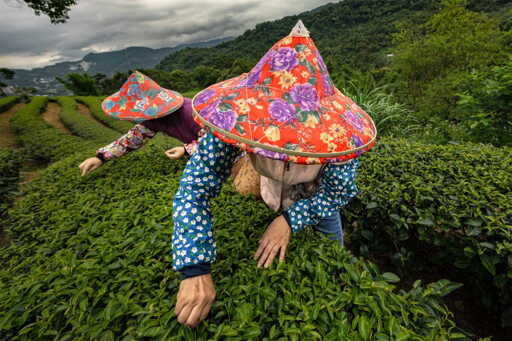
SHENKENG, Taiwan — Ten kilometers east of Taipei’s high-rises and dense traffic, the city gives way to a succession of steep, forested ridgelines sheltering villages in the valleys below. The subtropical mist that cloaks these slopes at dawn has already thinned, and by 9 a.m. the heat is climbing. Li Chao-shiang, an assistant professor in the Department of Interior Design at China University of Technology in Taipei, winds upward on a narrow stone path, pausing to wipe his brow. Rounding a bend, he stops at an opening in the brush. Half the hillside before him is covered in dark-green ribbons, the regular corduroy of cultivated land. The other half looks like something took a bite out of it. “This jungle has a secret,” Li says. “If you look closely at the hills all around us, you can still make out faint lines that run through the forest. It may not be much to look at now, but what you are seeing are stone terraces — the remnants of one of the world’s great empires of tea.” For much of the late 19th and early 20th centuries, tea made these hills valuable. By 1897, tea accounted for 22% of Taiwan’s export earnings, four times the value of sugar, with 96% of the island’s Formosa oolong sailing for New York and Chicago. Shenkeng’s own signature style, the lightly oxidized Wenshan pouchong, came on the scene around 1912 and was refined through the 1920s, becoming Taiwan’s leading export to Southeast Asia. “The soil,…This article was originally published on Mongabay
From Conservation news via This RSS Feed.