

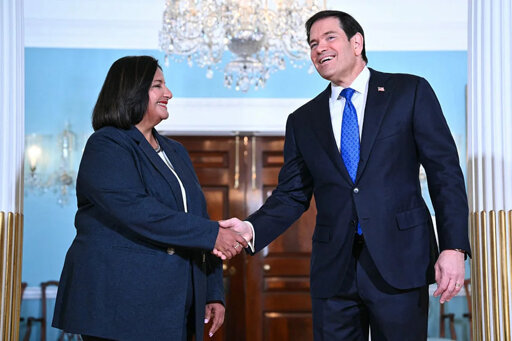
Caracas, October 12, 2026 (venezuelanalysis.com) – US Secretary of State Marco Rubio hosted Venezuelan opposition lead negotiator Dinorah Figuera on Friday at the State Department in Washington, DC, to express support for ongoing dialogue with the Venezuelan government.
“This is the best opportunity Venezuela has had in almost a generation,” Rubio told reporters, adding that the talks headed by Figuera are “a difficult process” but enjoy “100 percent support from the highest levels” of Donald Trump’s administration.
Rubio stressed that Washington’s goal goes beyond holding elections. “Our desire is not simply for Venezuela to have an election, but also to have a democracy with the institutions necessary to sustain long-term stability, prosperity, and freedom.” The Trump official has insisted on a three-phase plan culminating in a “political transition.”
For her part, Figuera, the president of the defunct 2015 Venezuelan National Assembly, praised the United States for opening a “path of hope for Venezuela” on January 3, when US forces bombed Caracas and abducted President Nicolás Maduro.
“We are committed to restoring the institutional framework of the public powers, the Supreme Court of Justice (TSJ), and the National Electoral Council (CNE). We want to bring the country toward a process that guarantees political and civil rights and creates space for reunion and reconciliation,” she said.
The opposition leader also thanked Washington for its investments in the oil sector. “The restoration of institutions and the country’s economic progress will be two fundamental pillars for building institutions and democracy,” she added. Despite its term running out in January 2021, the opposition majority parliament elected in 2015 retained US “recognition” as Venezuela’s legitimate authority.
Both officials announced that the next round of talks is scheduled to begin on October 14. Rubio explicitly called for opposition unity: “We ask all elements of the opposition, and all sectors of society, to participate in and support this process.”
Neither Rubio nor Figuera fielded questions from reporters as they left the room, including about opposition leader María Corina Machado, who continues to insist that presidential elections must be held “as soon as possible.”
This was the first time Rubio received Figuera in Washington. Since August, she has led an opposition bloc engaged in dialogue with the acting government headed by Delcy Rodríguez, a process promoted by the United States in which the far-right Machado is not participating.
So far, government and opposition delegations have completed two rounds of negotiations in Caracas. Rubio claimed that the talks thus far have resulted in the release of hundreds of people allegedly detained for political reasons, the unblocking of several pro-opposition news websites, and progress toward amending the 2017 Law Against Hatred. The agenda for this third round includes continuing the process to renew the Supreme Court.
In this regard, opposition delegation member Juan Miguel Matheus said his team is “working to ensure that the members of the Judicial Nominations Committee are appointed and sworn in by October 15.” The committee will be responsible for evaluating candidates for the 32 Supreme Court justice positions.
Following an amendment to the Organic Law of the Supreme Court of Justice negotiated at the dialogue table, it was agreed that the Judicial Nominations Committee would have a majority of 12 civil society representatives, compared with 11 lawmakers. A total of 127 citizens applied to join the body.
Once the committee has been appointed, the process of receiving applications from candidates for the Supreme Court will begin. “We invite the best men and women in Venezuelan law to apply for positions in the TSJ’s six chambers. Venezuela needs independent, competent justices of recognized integrity,” Matheus stressed.
While some opposition sectors are demanding that a date be set for presidential elections, the delegation participating in the negotiations argues that progress in transforming the justice system is a necessary prior step.
In his press statement, Rubio added that future rounds of discussions “will address reform of the National Electoral Council.”
The Venezuelan government’s delegation has not commented on the Trump administration’s express backing for the opposition negotiators.
The two sides agreed to demand the release of 31 tonnes of gold held by the Bank of England since 2019 to address post-earthquake reconstruction needs. The gold, worth more than US $4 billion, will reportedly be moved to the New York Federal Reserve, with its spending subject to US approval and international auditing.
Edited by Ricardo Vaz in Caracas.
The post Venezuela: Rubio Backs Opposition Leader Figuera, Announces Next Dialogue Steps appeared first on Venezuelanalysis.
From Venezuelanalysis via This RSS Feed.