

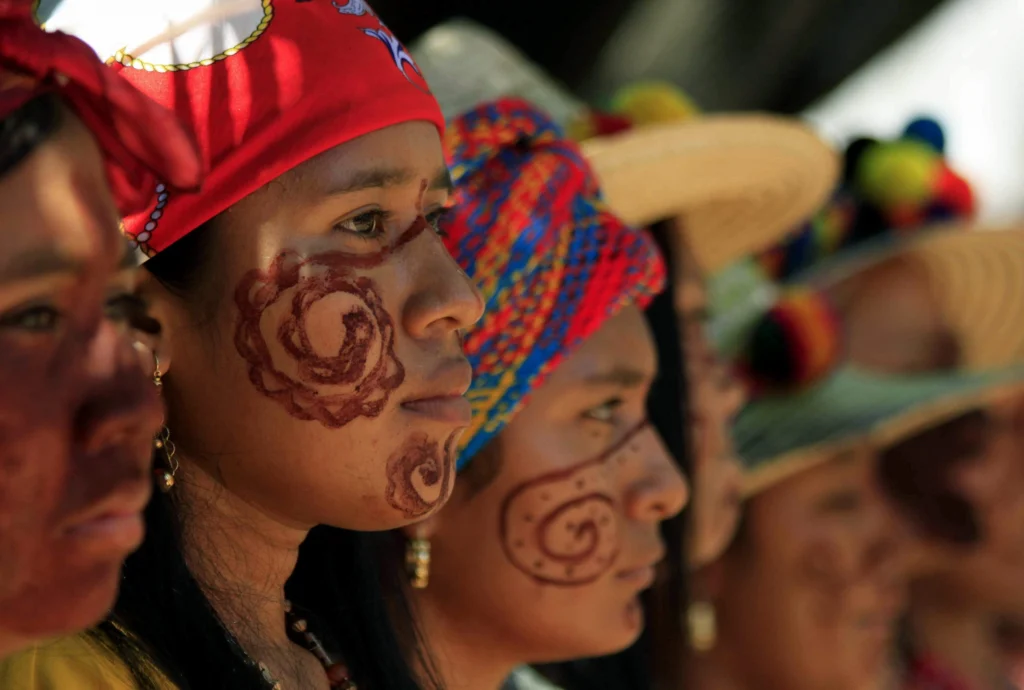
Native communities across the Americas are still confronting the legacies of invasion: stolen land, demographic collapse, and struggles for autonomy.
Numerous governments, academic institutions, and social movements have reinterpreted October 12th, now commemorating it as the Day of Indigenous Resistance or the Day of Native Peoples.
RELATED: Brazil Establishes First Indigenous Federal University
This shift reflects a deliberate effort to reframe historical narratives. Rather than viewing the event as the discovery of an uninhabited place, modern historical accounts present October 12th as the beginning of European conquest, systematic colonization, and centuries of native resistance.
Understanding the significance of October 12th requires examining both the immediate impact of European arrival and the long-term historical processes that stemmed from it. Spanish arrival expeditions in 1492 triggered a profound demographic and economic transformation across the Americas.
Before 1492, the total population of the Americas is estimated to have ranged between 50 and 100 million inhabitants. Due to a combination of factors, such as the introduction of European pathogens (smallpox, measles, and influenza), violent military campaigns, and forced labor systems, at least 56 million native people across the continent had perished by the year 1600.
When analyzing the colonization process, we can say that the events of October 12th laid the foundations for modern global trade, land distribution, and current international relations.
The Geopolitical and Economic Context of 1492
Following the fall of Constantinople to the Ottoman Empire in 1453, traditional overland trade routes between Europe and Asia became subject to heavy taxation and political restrictions.
European monarchs and merchant syndicates sought direct maritime routes to Asian markets to secure trade in high-value commodities, including spices, silk, and precious metals. The Spanish Crown, under Catholic Monarchs Isabella I of Castile and Ferdinand II of Aragon, financed the expedition led by the Genoese navigator Christopher Columbus to establish a western sea route to Asia.
Upon making landfall in the Bahamas on October 12, 1492, Columbus recorded the event in his ship log, noting the presence of native Taíno people and observing the local geography.
The economic motivations of the Spanish expedition were explicitly documented in these early entries, which frequently highlighted references to gold deposits and potential labor resources.
Legal and theological frameworks were established shortly after to justify the expansion of European territorial sovereignty over the newly accessed lands.
In 1493, Pope Alexander VI issued the papal bull Inter Caetera, which granted the Spanish Crown exclusive rights to lands not ruled by Christian monarchs. This decree formed part of the broader legal concept known as the Doctrine of Discovery.
The discovery of large silver deposits, such as those at Potosí in modern-day Bolivia and Zacatecas in Mexico during the mid-16th century, shifted the global financial system.
The continuous flow of American bullion funded European state expenditures, financed trade with Asia, and laid early economic foundations for modern global capitalism.
In 2002 Chávez declared Oct 12 as Día de la Resistencia Indígena, the Day of Indigenous Resistance. Columbus’ statue was torn down two years later and the colonizer was tried in a court of public justice. Today not a single statue of Columbus remains.pic.twitter.com/40U0Y6hXwa
— Party for Socialism and Liberation (@pslnational) October 12, 2020
Mechanics of Invasion and the Demographic Catastrophe
The European invasion of the Americas was a combination of military conquest, administrative restructuring, and forced labor systems designed to maximize resource extraction.
Following initial contact in the Caribbean, Spanish forces led by Hernán Cortés entered the Aztec capital of Tenochtitlan in 1519, while Francisco Pizarro launched the conquest of the Inca Empire in the Andes in 1532.
In both regions, European invaders exploited existing internal political rivalries, deployed superior steel weaponry and firearms, and used horses to establish military dominance over densely populated urban centers.
To organize the population and secure labor, Spanish colonial authorities implemented institutional systems known as the encomienda and the mita. Under the encomienda system, the Spanish Crown granted individual conquerors (encomenderos) control over specific native communities.
The so-called encomendero had the right to extract forced tribute and physical labor from the local population in exchange for providing religious instruction in Christianity and theoretical protection.
The human cost of these systems was compounded by widespread demographic collapse. Researchers indicate that out of an estimated pre-1492 population of 50 to 100 million people across the Western Hemisphere, approximately 56 million native people died by 1600.
While infectious diseases like smallpox, typhus, and measles accounted for high mortality rates due to the lack of prior immunity, historical records show that the severity of these epidemics was intensified by severe malnutrition, physical exhaustion, loss of agricultural territory, and social disruption caused by forced displacement.
The destruction of native social and political structures enabled European authorities to establish centralized colonial administrations, divide territories into viceroyalties, and reconfigure the geography of the Americas exclusively around primary commodity export routes to Europe.
Historical Milestones in the Struggle for Liberation
Since the beginning, native people responses to colonization included organized military defense, political revolts, and persistent social resistance.
In the Caribbean, Taíno leaders resisted Spanish enslavement and land seizure shortly after the initial European arrival. Chief Hatuey explicitly rejected Spanish religious conversion, citing the violence committed by the colonizers as the primary reason for his defiance.
Further south, the Mapuche people of southern Chile and Argentina maintained centuries of organized military opposition against both the Spanish Empire and later national governments in a conflict known as the Arauco War (Guerra de Arauco).
Led by military strategists such as Lautaro in the 16th century, the Mapuche adapted European cavalry techniques, weapons, and tactics to defend their territory south of the Bío Bío River. Their continuous resistance forced the Spanish Crown to sign the Treaty of Quillín in 1641.
By the late 18th century, economic exploitation under late colonial reforms sparked massive regional uprisings in the Andes. In 1780, José Gabriel Condorcanqui (Túpac Amaru II) launched a major rebellion against Spanish rule in Peru.
Mobilizing tens of thousands of native and mestizo peasants, Túpac Amaru II issued proclamations demanding the total abolition of the mita forced labor system, the elimination of colonial sales taxes, and the freedom of enslaved populations.
In his 1780 proclamation, he declared: “I have determined to free the people from these unbearable taxes and the tyranny of the officials who govern us.”
Although Túpac Amaru II was captured and executed in 1781, the uprising continued in Upper Peru (modern-day Bolivia) under Aymara leader Túpac Katari. Katari organized an army of over 40,000 insurgents and laid siege to the city of La Paz for eight months. Before his execution by colonial forces in November 1781, Katari issued his famous declaration of enduring resistance: “I die today, but I will return, and I will be millions.”
Today, we honour our country’s indigenous ancestors who held their ground against great odds, whose fierce resilience kept alive the traditions, histories, and ways of life that define us. 𝐇𝐚𝐩𝐩𝐲 𝐈𝐧𝐝𝐢𝐠𝐞𝐧𝐨𝐮𝐬 𝐏𝐞𝐨𝐩𝐥𝐞𝐬’ 𝐑𝐞𝐬𝐢𝐬𝐭𝐚𝐧𝐜𝐞 𝐃𝐚𝐲, 𝐁𝐞𝐥𝐢𝐳𝐞! pic.twitter.com/KgUIuvHPna
— Oceana Belize (@OceanaBelize) October 12, 2026
From Colonialism to Capitalist Extractivism
The formal end of European colonial rule across the Americas during the 19th century did not eliminate the structural marginalization of native populations. Instead, newly formed independent nation-states integrated native lands into national market economies, often continuing practices of territorial dispossession.
Throughout the late 19th and 20th centuries, legal reforms in many Latin American and North American nations abolished communal land titles in favor of private property regimes.
State-sponsored initiatives, such as the “Conquest of the Desert” in Argentina or western expansion in United States, used military force to open native people’s territories for agricultural development, cattle ranching, and resource extraction.
Native communities face pressures from modern corporate extractivism, infrastructure projects, and international commodity demands. According to reports by international human rights organizations, native land defenders represent a disproportionate percentage of environmental activists targeted for violence worldwide.
These modern conflicts reflect a continuation of colonial-era economic dynamics, where local land rights and territorial sovereignty are subordinated to global resource demand. Despite persistent structural pressures, contemporary native social movements have organized continental networks to assert political autonomy and legal rights.
These groups have succeeded in securing legal recognition, such as the United Nations Declaration on the Rights of Indigenous Peoples (UNDRIP) in 2007, and have embedded native people’s rights into the constitutions of several American nations.
Spain lost the indigenous support of the Viceroyalty of Peru from the moment it refused to show mercy toward the natives who were enslaved in the mines through the MITA, triggering “the Rebellion of Túpac Amaru II” thanks to those who aided in the fall of the Spanish Empire. 🇵🇪👍 pic.twitter.com/qtcq8KKqU3
— Eren (@Eren15453289846) August 25, 2026
The Unfinished Decolonization
Re-evaluating October 12 as the Day of Indigenous Resistance contextualizes these events within a broader historical continuum rather than isolating them as single historical moments.
1492 remains an active process rather than a closed chapter of history. Modern struggles over territorial rights, environmental conservation, and political self-determination directly connect to the legal and economic frameworks established during the colonial era.
Native movements across the Americas continue to argue that genuine democratic development requires the recognition of collective land rights, structural political reforms, and the protection of local ecosystems from unregulated resource extraction.
Observing October 12 serves as a reminder of the survival and adaptation of native nations despite centuries of systemic pressure.
#Venezuela | Indigenous communities gathered in Caracas to mark the Day of Indigenous Resistance, honoring centuries of anti-colonial struggle through traditional music, floral tributes and cultural ceremonies.#IndigenousRights #Decolonization #teleSUREnglish pic.twitter.com/7MFZ45i0d3
— teleSUR English (@telesurenglish) October 12, 2026
Sources: Alexander Koch – Proclamations of Túpac Amaru II – Declarations of Túpac Katari – The Treaty of Quillín – United Nations Declaration on the Rights of Indigenous Peoples – Britannica – La Radio del Sur
From teleSUR English via This RSS Feed.