


Palestine’s long-awaited legislative elections have once again been postponed. The polls that were scheduled for November 28, have been pushed for one year, according to reports, through an agreement between Palestinian factions, including Fatah and Hamas.
According to the report, the postponement aims to give time to rebuild the Palestinian political system in a way that allows all components to take part.
Read more: Will a new political alliance unseat the Abbas-led Palestinian Authority?
Meanwhile, Reuters reported on Friday, October 9 that Palestinian Vice President Hussein al-Sheikh informed France that the elections will be delayed possibly until September 2027, citing the deteriorating conditions throughout the occupied Palestinian territories as a reason.
On Saturday, October 10, Palestinian President Mahmoud Abbas issued a decree, setting September 11, 2027 for simultaneous presidential and legislative elections.
The reactions of Palestinian factions varied. Hamas and Palestinian Islamic Jihad welcomed the decision due to immense infrastructural, logistical, and political hurdles in Gaza, the West Bank, and East Jerusalem, which make the voting process impossible.
However, the Democratic Reform Current led by Mohammed Dahlan criticized it as “a crime against democracy”, accusing the PA’s leadership of monopolizing national institutions.
The move came amid the continuation of Israel’s genocidal aggression on Gaza, and its refusal to proceed to phase two of the US-brokered ceasefire deal.
In tandem, the Israeli forces and illegal settlers have escalated their attacks on Palestinians across the occupied West Bank, mainly focusing on the central governorate of Ramallah and Al-Bireh in the last couple of weeks.
Read more: Three years of genocide in Gaza, the Palestinian people remain steadfast
Ramallah is becoming a flashpoint for Israeli violence
The Palestinian Authority (PA) has designated Ramallah and Al-Bireh as a de facto administrative capital since its establishment in 1994, following the 1993 Oslo Accords.
Therefore, many believe that destabilizing the governorate reveals Israel’s plans to further sideline the PA and undermine its power in a bid to ultimately dismantle it.
In late September, media reports surfaced indicating the Israeli government’s intention to reopen a route in the governorate for settler traffic, dividing its northern and southern halves.
The two weeks that followed saw a spiral in settler violence and raids carried out by the Israeli forces across Ramallah and Al-Bireh.
Friday, October 9, saw a notable increase in Israeli assaults across different parts of the governorate, coinciding with the onset of the olive harvest season.
A video circulated from Yabrud village east of Ramallah, showing a group of Israeli colonists attacking a Palestinian man and his son in their car. The settlers stole the vehicle after the man and his son ran away to survive.
Simultaneously, dozens of settlers stormed the northern town of Surda, wandering in its streets in an attempt to terrorize its people. They also destroyed the memorial of Muhannad Al-Halabi, one of the town’s martyrs.
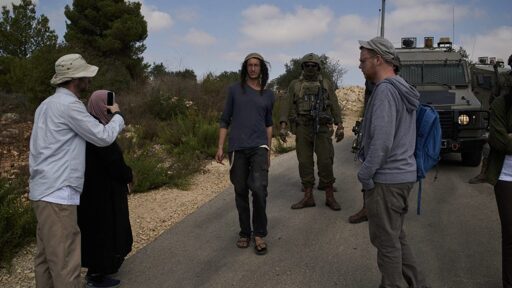
Escorted by Israeli soldiers, settlers attacked international activists, who were protecting Palestinian farmers during the olive harvest in the town of Deir Ibzi, west of Ramallah. They also verbally abused journalists on site and tried to prevent them from covering the offensive.
On Friday evening, the Israeli army stormed Al-Bireh city, firing live ammunition and stun grenades, according to local media outlets.
Over the weekend and through Monday, October 12, settler attacks as well as military raids carried out by Israeli forces continued to take place in different parts of the governorate. The colonists also released a new video encouraging each other to continue storming Ramallah, and even the neighborhood where the Palestinian President resides in Al-Bireh city:
“You too can reach a point close to the house of Mahmoud Abbas and Ramallah,” the caption on the video noted.
From BT News via This RSS Feed.