

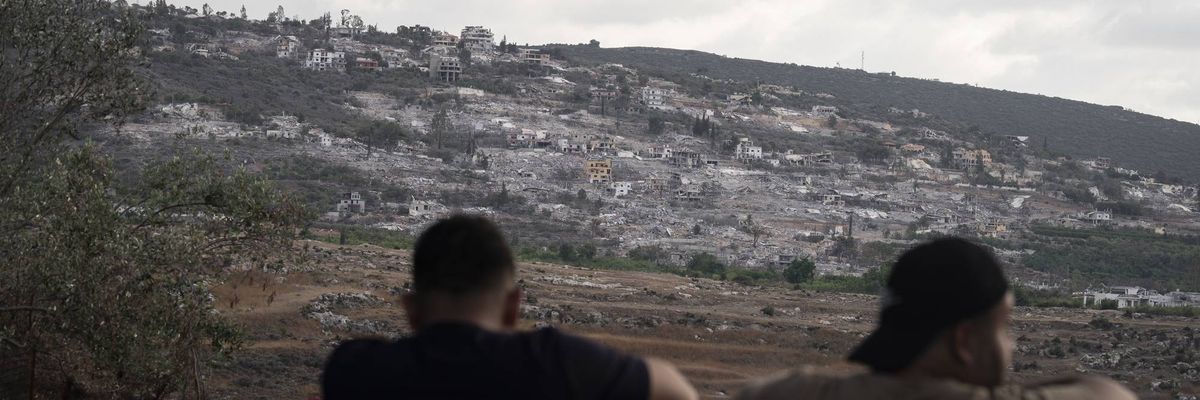
When Israel and Lebanon reached a ceasefire in April, the Israel Defense Forces’ systematic destruction of villages in southern Lebanon was supposed to halt. Instead, it was just getting started.
Israeli forces have largely leveled 48 of the roughly 60 villages and towns in occupied southern Lebanon, a New York Times investigation published Monday revealed, fueling fears that Israel intends to permanently prevent displaced residents from returning.
Rather than collateral damage from military attacks, the razing of Lebanese villages since April has largely been carried out through controlled demolitions by Israeli forces.
Nearly all the villages destroyed have been majority Shia—the sect from which Hezbollah draws much of its support—while those containing Christian, Druze, and Sunni Muslims have largely been spared.
In July, Israeli Defense Minister Israel Katz acknowledged that Israel had destroyed at least 24 historic Lebanese villages, describing it as punishment for their residents.
“Twenty-four Lebanese villages that were hundreds of years old—with Shiite residents who acted as enemies [of Israel] on behalf of Hezbollah and threatened our borders and our residents—we destroyed all of the buildings.”
“Not one house at a time," he emphasized. "The entirety of those villages—their demolition has been completed.”
Since March, Israel’s military campaign has displaced at least 1.1 million Lebanese civilians, while its forces have entrenched themselves in an occupied swath of southern Lebanon extending as far as eight miles from the border.
Roughly 270,000 people remain barred from returning home. Many have no homes to return to. In many villages, homes, roads, utilities, and public facilities no longer function.
The Times found that Israeli forces have also burned about 16,500 acres of land—roughly 11% of the total occupied area—since the April ceasefire, including farmland and olive groves. Meanwhile, thousands of trees have been bulldozed.
As this life-sustaining infrastructure has come down, Israel has erected what appear to be the fixtures of a long-term military occupation: satellite imagery shows at least three new Israeli military outposts have been at least partially built since the ceasefire began, alongside new roads connecting them to Israeli territory.
The US-brokered ceasefire expressly prohibited “offensive military operations against Lebanese targets, including civilian, military, and other state targets, in the territory of Lebanon” except in cases where it was necessary to take defensive measures against planned, imminent, or ongoing attacks.
Israel’s military told the Times it received no directive “to carry out widespread damage to structures or to demolish villages" in southern Lebanon. “The IDF operates in the security zone in southern Lebanon with the aim of removing threats posed by the Hezbollah terrorist organization to the residents of Israel and to IDF troops," it added.
Israeli officials have suggested that the occupation of southern Lebanon will continue indefinitely. Katz said last month that Israel “will not withdraw from the security zone” until Hezbollah disarms.
Prime Minister Benjamin Netanyahu has suggested that some of the Christian villages would like to be annexed into Israeli territory. Finance Minister Bezalel Smotrich, meanwhile, renewed his call last month for Israel to extend its borders north to the Litani River, which encompasses most of the Lebanese territory it currently occupies.
Israel has said it has razed entire villages to destroy Hezbollah military infrastructure and prevent fighters from returning to the area near the Israeli border.
Janina Dill, a professor of global security at the University of Oxford, has said using mass destruction to carry out this objective was “manifestly illegal” under international law, which says that destroying civilian property without an imperative military necessity can constitute a war crime.
“It’s deeply implausible that imperative military necessity applies to every house in a particular village,” she told the Financial Times in August.
Volker Türk, the United Nations high commissioner for human rights, said in July that Israel was engaging in the “wholesale destruction” of civilian homes, adding that "demolition of this type raises huge flags about compliance with international humanitarian law.”
“In large parts of southern Lebanon, Israel’s ‘everybody-leave’ orders were followed by ‘don’t-come-back’ orders,” said Kristine Beckerle, Amnesty International’s deputy regional director for the Middle East and North Africa in June. “Israel’s forced displacement and prevention of return of tens of thousands of civilians from southern Lebanon amounts to unlawful transfer, which is a grave breach of the Fourth Geneva Convention and thus a war crime.”
From Common Dreams via This RSS Feed.