

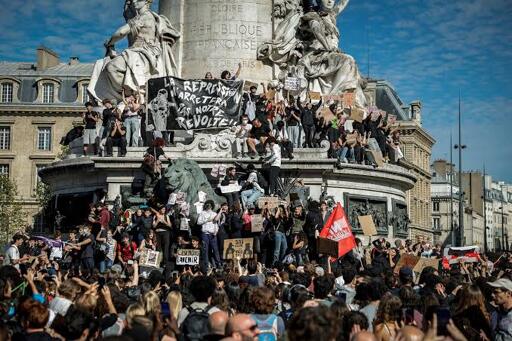
A brutal crackdown is being unleashed on France’s high school student movement.
The number of arrests of minors is reaching historic highs. Horrific images are flooding social media and the news: a 14-year-old maimed by a Cougar round fired at point-blank range; two high school students blinded, the first by a rubber bullet, the second likely by a grenade; a teenager whose hand was torn off after a grenade exploded; ram-car attacks in Troyes and Dunkirk carried out by the national police, who charged at high speed into groups of high school students; a helicopter deployed in Toulouse; a police commander accused by a high school student of attempting to drown him.
A veritable reign of police terror is descending upon the movement, using fear to pressure parents into reining in their high school students and to prevent the coalition of anger from forming, as October 17 approaches. Confronting this politically is therefore a central challenge. What if self-organization were the key to confronting repression?
This may be what the recent struggle in Minneapolis in January 2026 suggests. Faced with a police crackdown even more violent than in France, the city’s residents decided to resist ICE, which stormed the city. And they won on February 12, forcing ICE forces to partially withdraw from the city.
From Minneapolis to French High Schools: Mass Outrage Against Repression
Barely a year after returning to power, Trump decided to make Minneapolis an example: deploying thousands of ICE agents in the Twin Cities — a shock force that recruits its forces from the ranks of the U.S. Far Right — to carry out his plan for the mass deportation of immigrant workers or those presumed to be.
But Operation “Metro Surge,” launched in December 2025, did not go as planned. Police brutality and the murders of two activists — Renée Nicole Good in early January and Alex Pretti on January 24 — sparked a wave of mobilization unseen in the United States in decades.
A resident of the Twin Cities described the general mood among the population in words that echo the fears of some French parents: “The idea of ICE engaging with your children, or anyone’s children, at school or near a school is something that sits in your body.” But the fear of child abductions, racist roundups, and raids on entire neighborhoods — carried out by a shock militia that has never hesitated to shed blood and whose budget alone equals what countries spend on maintaining a professional army — quickly gave way to an admirable fighting spirit. One activist teacher summed it up in a single sentence: “We don’t want [ICE] to go to other places; we want to defeat them here so they don’t do it elsewhere.”
But this resistance did not come out of nowhere. Minneapolis was the epicenter of the Black Lives Matter movement in 2020, after police killed George Floyd, and the solidarity networks that formed in the heat of that struggle were reactivated and expanded on an unprecedented scale, thanks to the conscious involvement of workers, particularly education workers, for whom the way had been paved by the massive teachers’ strike in March 2022. The example of Minneapolis thus shows that the politicization of repression, traditions of struggle against state racism, outrage over police violence, and solidarity amplified by grassroots self-organization can push back against repression.
In France, a mood of shock, anger, and outrage reminiscent of the atmosphere in Minneapolis is beginning to emerge. Scenes that would have been unimaginable just a few years ago are becoming more common. In Metz, on Monday, October 5, a woman silently held up a sign — “Does France really love its children?” — in front of a line of CRS riot police who had just fired tear gas at high school students. In Rennes, on Friday, October 3, a mother broke down in tears as she pleaded with lines of riot police not to charge the children. The officer replied coldly: “Guys, don’t listen to her. These aren’t children.” A parent of a student in Aubervilliers, a working-class suburb north of Paris, expressed the same concern:
A tear gas canister landed in their playground. There’s a law that prohibits parents from hitting our children, and that’s great. Why do the police have the right to hit our children? And do they go home at night saying to themselves, “I beat up 15 of them” or “I fired my LBD [rubber-bullet launcher] like that”? That’s completely abnormal.
The use of such methods, some of which undeniably amount to state-sanctioned terror, is thus beginning to polarize society. Whether or not they are actually carried out, the calls issued by La France Insoumise to stand between the police and young people attest to the extent of the outrage over the repression. Furthermore, the high degree of politicization surrounding police violence in the working-class neighborhoods where the movement began, and the widespread practice of filming police interventions, have played a central role in its spread across the country, with many high schools in city centers joining the movement out of solidarity with their peers in the working-class neighborhoods targeted by the crackdown.
At the same time, the human chains formed by workers and students at Paul Éluard High School in Le Havre, at INSA, an engineering school in Strasbourg, and at Cours de Vincennes street, along with the success of the October 6 demonstration, bear witness to a transformation, still in its early stages, in the public’s relationship with the police. At that demonstration, workers’ security teams joined forces with high school students to defend their right to free speech, following the example of railroad workers and education workers in Paris. This sentiment is reinforced by the fact that the violence of “French-style law enforcement” and the police arsenal that the Minister of the Interior called for using “without restraint” against high school students have caused widespread outrage internationally.
Faced with this massive solidarity, Macron himself now seems to be kicking himself for having launched a police “blitzkrieg” in an attempt to crush the movement, without calling into question the state’s strategy of extreme violence. At the same time, the sheer scale of the movement is forcing some politicians to question the use of LBDs and has prompted Interior Minister Laurent Nuñez to nominally suspend the use of stun grenades, which have maimed several people. With more than 72 percent of the population supporting the high school students’ demands, there is no shortage of public support to help the mobilization grow.
Self-Organization Is the Only Solution
This is where the example of Minneapolis offers a second line of thought. While the Intersyndicale, the alliance of France’s major unions, bypassed October 17 by calling for action only on November 5 — leaving high school students vulnerable to repression in the meantime, despite a new call for mobilization from the CGT, one of France’s largest union confederations, on October 13 — the methods employed by the residents of Minneapolis can serve as an alternative to the union leaderships’ wait-and-see approach.
The response that routed the Trumpist militias was incredibly effective. Faced with the first attacks by federal agents, the residents of Minneapolis began organizing to protect their neighbors, their children, and the city’s immigrant workers. Each neighborhood set up its own Signal group and began to take action. As Sou Mi summarized:
Neighborhood patrols have become a fixture of daily life. They’re at every street corner, especially in immigrant and residential areas, whether in groups of two or three on foot, or circling the area in cars or on bikes. Whistles are a part of the uniform of the city, ready to be blown at a moment’s notice to activate the network and alert the community to ICE’s presence. There are streets where they’ve set up barricades, checking cars to make sure they’re not ICE.
Within a matter of days, a vast network took shape. As residents organized security teams to protect schools, set up patrols, and establish a powerful grassroots communication network to track the movements of the enforcement forces in real time, ICE lost its freedom of movement. As ICE agents passed through, entire neighborhoods mobilized, and every arrest attempt drew crowds that surrounded the agents, with residents filming and documenting each arrest. ICE agents operated in a hostile environment, woven from working-class and grassroots solidarity and the bonds that unite the communities that had transformed the city into a collective brain, attuned to the slightest sensation in the city’s body, from its center to its outskirts.
One resident explained that working-class communities had developed a mental map of risk points for children and teenagers in Minneapolis, which they set out to protect: “Lunch periods. Bell changes. Crosswalks. Bus shelters. The ordinary choreography of a school day becomes a map of risk. ICE doesn’t need spectacle anymore. During a surge, they adjust. They pass slowly. They wait. They take. That knowledge changes how you look at a street.”
Faced with the intensifying ICE crackdown, residents began coordinating their actions citywide. The first local assemblies were held, bringing together workers and parents from several districts. As a Whittier resident explains:
Public assemblies became a powerful avenue to educate the public and disseminate information about the occupation widely, quickly, and through trusted sources. For example, in my neighborhood, on January 14th, a neighborhood organization called the Whittier Alliance hosted a public assembly at the Whittier Elementary School that drew over 800 people. … The assembly sparked a neighborhood-level movement to build on existing Cop and ICE Watch practices and trainings … A decentralized, community defense infrastructure emerged. People divided the neighborhood into over a dozen semi-local groups to create a fractal of neighborhood organizing groups.
In the Uptown and Whittier neighborhoods alone, nearly 6,000 residents were actively organizing on a daily basis — roughly 30 percent of the population. The same thing happened in other neighborhoods across the city. This momentum expanded further with the formation of a Workers’ Assembly on February 15, which brought together workers from across the city to organize actions denouncing ICE and, later, the war in Iran and the power of billionaires. But this qualitative leap would have been unthinkable without the January 23 strike.
At the call of certain unions and neighborhood groups, 50,000 people marched through the city on that bitterly cold day, under the slogan: “No Work, No School, No Shopping.” With nearly 700 workplaces shut down, wildcat strikes at several companies, and an impressive grassroots mobilization, the January 23 strike significantly shifted the balance of power. It initially served a defensive purpose by forcing the city government and local police — who were collaborating with ICE — to back down. The very next day, City Hall announced that the Minneapolis Police Department would no longer provide backup to federal agents when they found themselves in difficulty.
Furthermore, by bringing together residents of working-class neighborhoods; workers in health care, education, logistics, and services; bus drivers; and high school and college students in downtown Minneapolis, the strike played a decisive role in expanding the movement and unifying the sectors involved in the struggle. In the wake of January 23, student organizations joined the fight by calling for another day of mobilization the following Friday — a call that union leadership, however, ignored, adopting a passive, spectator-like stance. Finally, the strike gave the population much greater freedom of action. When ICE killed nurse Alex Pretti the very next day, thousands of people immediately took to the streets to drive federal agents away from the scene of the murder and regain control of the neighborhood. In short, the organization of a permanent popular mobilization across the entire city turned Minneapolis into a trap for ICE.
Although the agency was created in 2003 as part of the war on terror, it underwent a significant transformation during Trump’s second term, as he attempted to organize from above the far-right forces he was unable to mobilize from below. Recruited hastily and with no experience in class struggle, ICE 2.0 relied on lightning-fast raids to achieve Trump’s deportation goals, a tactic known as “turn and burn.” But in Minneapolis, this militia — capable only of a particularly haphazard form of mobile warfare — found itself overwhelmed by a coherent and methodical opposition that deprived it of both its element of surprise and its freedom of action.
Its morale crumbled in the face of popular resistance. Residents developed innovative tactics to break the will of the repressive forces. As Sou Mi explains:
For months, protesters have been going to the places from which ICE deploys every morning to protest against their presence, and have surrounded the hotels housing immigration officers every night with cacophony to make sure that those who terrorize their streets by day, know no peace by night.
Faced with constant mass opposition — which makes even the most routine operation extremely difficult — and the loss of their power to intimidate, the morale of ICE agents began to wane, as the New York Times reported, while the agency’s leadership grew concerned about the possibility of a permanent breakdown in trust between the agents and the public. ICE ended its operation and withdrew the bulk of its forces from Minnesota.
Self-organization and the strike enabled Minneapolis to drive back one of the most repressive and brutal forces on the planet, and that lesson matters for the French movement. Union leaderships are eager to sidestep the October 17 protests. Meanwhile, the badly weakened government of Prime Minister Sébastien Lecornu is trying to stall and defuse the movement. Its tool is a “period of internal democracy”: classes are suspended so that each school can hold a structured discussion with students, run by its own administration. This is a farce coming from a government of oppressors, and its failure will likely bring an intensified resurgence of police crackdowns. Self-organization appears decisive to our ability to defend high school students, and general assemblies at universities and in the education sector are essential points of support.
On this point, the example of Minneapolis offers another valuable lesson. In the Twin Cities, this work of coordinating the various sectors engaged in struggle was carried out largely by education workers, whose strategic strength stems less from their ability to block operations than from their central position in the daily life of working-class and low-income neighborhoods and their ability to bring together diverse groups, acting as a catalyst for dynamics of self-organization. In Minneapolis, as Sou Mi describes,
What began as largely weekly deliveries of groceries and other necessities for these families, quickly grew into much more. They drive students and parents not just to and from school, but also to appointments and events. When parents have been unable to work, teachers and parents have fundraised for rental assistance so they don’t face further precariousness and eviction.
A similar dynamic was evident in Spain, where strikes in the education sector led to the emergence of self-organized and democratic structures in response to the successive betrayals by union bureaucracies. In France, the convergence of high school students, school staff, and teachers is thus strategic: it could serve as the foundation for a local adaptation of the Minneapolis model of self-organization.
The potential for a symbiosis between certain sectors of the working class and young people, along with the spread of a popular culture of resistance to repression — supported by lawyers who, since the movement began, have worked to free those arrested from the unsanitary holding cells in police stations and courthouses — would represent strategic gains with repercussions far beyond the current movement.
Two Preliminary Reflections
From these lines of thought, we might draw a twofold lesson. Faced with a brutal police force that threatens the lives of tens of thousands of mobilized high school students, Minneapolis stands as a call to channel both the anxiety and the deep anger of the population against repression and to rely on the exemplary solidarity of certain sectors of the working class to strengthen the balance of power.
In France, this situation is all the more critical because the forces of repression do not suffer from the weaknesses of ICE: they are more disciplined and also better able to sustain a presence on the ground. They excel at maintaining order, with more than ten years of experience repressing the class struggle and a century of internationally recognized expertise in this area. While the goal in Minneapolis was to defend a city under siege by state-sponsored guerrilla warfare, the goal in France is to channel the anger — that of high school students, college students, and workers plagued by inflation and austerity — to create a broad front against an oppressive government.
Self-organization will thus be vital in all sectors engaged in struggle. The development of assemblies linking universities, high schools, and workplaces could make bold solidarity tactics possible: worker delegations at high school blockades; rapid-response solidarity networks capable of defending young people’s right to free speech; opening universities to young people whose schools are closed; and popular oversight of police actions. The strike will be just as crucial to stopping repression and helping the movement gain ground and momentum. To protect high school blockades and student demonstrations, secure the release of the more than 5,000 young people who have been arrested, and force a militarized police force into retreat, we must strike at the very heart of the material foundations of state power: the interests of the bosses, who are behind austerity and the ongoing deterioration of people’s living conditions — and, first and foremost, the dilapidation of schools and working-class neighborhoods. Through the strike, it is possible to shield the struggling youth with a workers’ shield.
But the main lesson Minneapolis offers us is above all a matter of mindset. It bears witness to the emergence of a combativeness and determination unseen in the United States for decades, and to a will to resist the decaying world bequeathed to us by waning neoliberalism, with its trail of wars, crises, and genocides. In a way, this mindset in open defiance of authoritarian neoliberalism did not wait for Minneapolis to materialize; one need only think of the mobilization of Gen Z in Morocco, Nepal, or Madagascar. But in Minneapolis it encountered workers and working-class communities who were especially receptive to the idea that it is time to stop enduring a despicable present and start fighting for a better future — and that an unfavorable balance of power calls not for inaction but for mass self-organization. This energy is embodied today by the high school students in the movement, who are holding their heads high, and even maintaining their sense of humor, in the face of brutal repression, at the high school blockades in France, as well as in Belgium and Spain. Young people are leading the way; the labor movement must join them and learn from the example set in Minneapolis.
Originally published in French on October 9 in Révolution Permanente
The post From Minneapolis to French High Schools: How Self-Organization Can Beat Repression appeared first on Left Voice.
From Left Voice via This RSS Feed.