

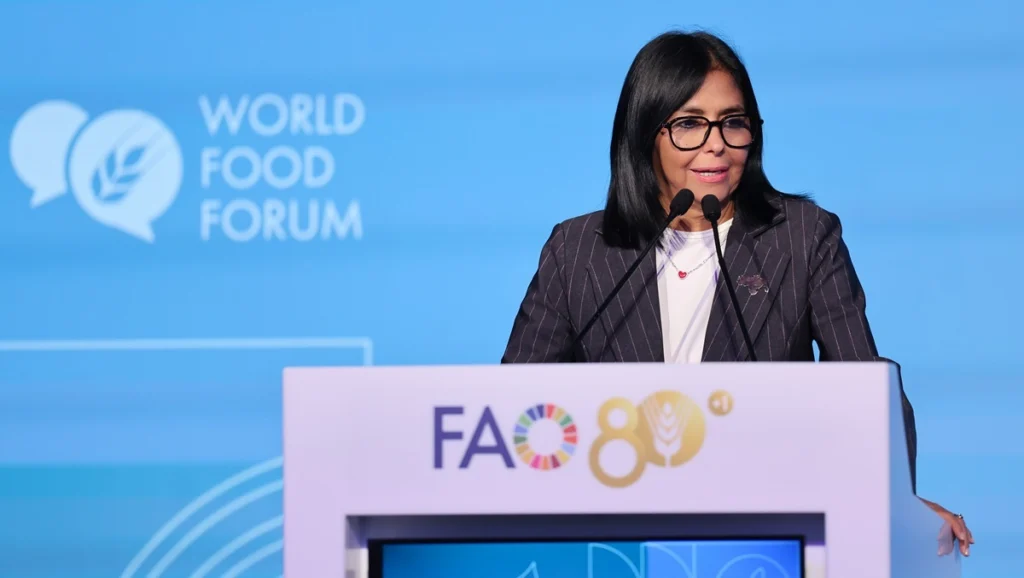
The ‘Venezuela Feeds’ plan also seeks agro-industrial sovereignty, Acting President Rodriguez pointed out.
On Monday, Venezuelan Acting President Delcy Rodriguez announced before the 2026 World Food Forum (WFF) the launch of “Venezuela Feeds plan” and a new local economy law to achieve the “Zero Hunger” goal.
RELATED:
Venezuelan Acting President Rodriguez Attends 2026 World Food Forum
“Our aspiration is clear: that Venezuela once again reaches levels compatible with zero hunger before the year 2030,” she said in her speech at the headquarters of the Food and Agriculture Organization of the United Nations (FAO) in Rome, Italy.
Rodriguez explained that Venezuela Feeds plan will serve “to engage all food production processes in the pursuit” of eradicating hunger, to which a new law on local economy will be added that she will present in a few days to the Venezuelan Parliament.
“Venezuela arrives at this World Food Forum with a deep conviction: food is an inalienable right, directly linked to life, dignity and the integral development of people,” she stated.
“Guaranteeing that right requires inclusive and sustained public policies, but it also requires production, investment, science, technology, financing and cooperation. It requires peace and it requires an international system capable of cooperating even above our differences,” the Venezuelan Acting President emphasized.
Rodriguez defended that food should not be an instrument of pressure or political confrontation: “There, where differences exist between states, dialogue and diplomacy must prevail. And there, where hunger exists, our common responsibility must be to find solutions.” For this reason, the Venezuelan Acting President called for an end to the application of coercive measures that violate international law and have negative implications for the realization of the right to food.
She recalled that Venezuela, after important progress in the fight against hunger in the first decades of the century, later faced “a profound internal political confrontation that caused a strong contraction of our economy, a situation that was worsened starting in 2017 with the progressive imposition of unilateral coercive measures.”
“But we have begun to reverse that reality. National dialogue with opposition factors, as well as diplomatic dialogue with the United States, has added the political stability necessary to produce and grow,” Rodriguez asserted.
She defended that “Venezuela has undertaken a process of orderly, institutional and verifiable transformation” that will also have an impact on a new agri-food policy, “because no modern food system prospers without legal security over land and property, so that those who work the land can invest in it with certainty.”
Venezuela also aspires to use its energy strength to build the productive capacities of the future, Rodriguez said, who wants “to convert part of our energy income into permanent productive capacity.”
“Energy wealth can and must become a lever to guarantee agricultural production, that people can afford quality food and that the processes of nature are respected through regenerative agriculture,” she added.
“I come from Venezuela, a country that has known adversity in all its dimensions and that today is going through one of the most decisive moments of its history, but that has never renounced hope. Today we have decided to build our future with work, dialogue, knowledge and in a process of democratic transformation that guarantees coexistence and peace,” the Venezuelan Acting President emphasized.
teleSUR/ JF
Source: EFE
From teleSUR English via This RSS Feed.