

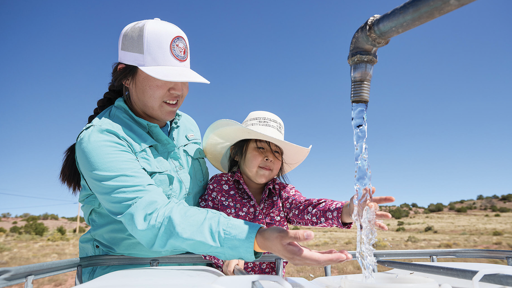
On Indigenous Peoples Day, let’s honor the leadership and contributions of Indigenous women in water. Women – and particularly Indigenous women – are underrepresented in the water workforce and make up less than one in three voices in water governance. Yet, the water sector has much to learn from women’s leadership. Women have always led, and women get things done. Across the water community, women bring people together, build partnerships, solve problems, and move important work forward every day. Their leadership takes many forms. Some lead through community engagement and relationship building. Others advance technical solutions, policy, research, infrastructure, public health, or education. Many do all of these things at once. Different perspectives help turn vision into action. Women lead in complementary ways, and that collaboration often drives meaningful progress. Indigenous women and girls gather stones to make water filters to provide their community with safe water in Ecuador. Image courtesy of Yachana Foundation. In working alongside Indigenous leaders such as Emma Robbins and Crystal Tulley-Cordova, I have seen how community knowledge, technical expertise, and relationship-building complement one another. Throughout this work, women continue to champion Indigenous knowledge, environmental stewardship, water justice, and community resilience. They advance conversations about water rights, water hauling, universal access to clean water, public health, policy, research, and infrastructure. They also recognize that solving water challenges requires more than technical expertise: Real progress happens when communities, researchers, educators, advocates, and decision-makers come together around shared goals. Women play a leading role in creating and sustaining…This article was originally published on Mongabay
From Conservation news via This RSS Feed.