

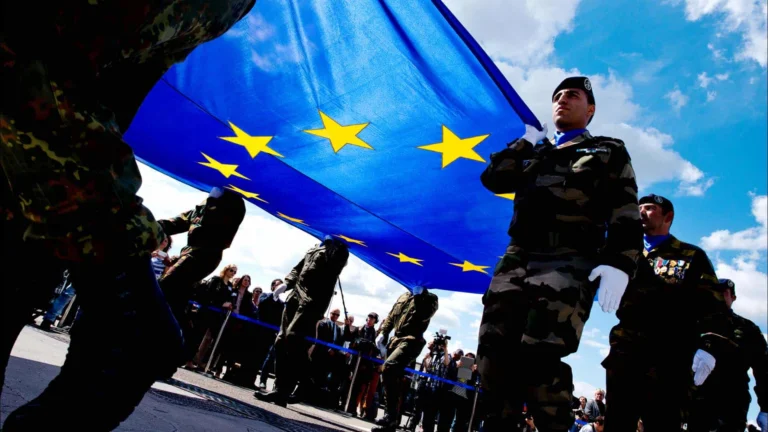
Europe military rearmament diverts billions from welfare to defense, raising concerns over debt, jobs, and social cohesion across the EU.
Related: Trump’s Statue at the European Parliament is “Offensive”: Slovak PM
Europe Military Rearmament: 5 Alarming Effects on Public Welfare
Europe military rearmament has become a central pillar of EU policy, with governments committing hundreds of billions of euros to defense while social programs face cuts. The shift is being justified by the narrative of a Russian threat, even as the continent struggles with inflation, energy costs, and weakening welfare states.
The Europe military rearmament push is expected to see EU governments spend around 1.2 trillion euros between 2025 and 2030, equivalent to the EU’s total budget for six years. The plan includes an 800 billion euro rearmament program and continued political, financial, and military support for Ukraine.
Russia has rejected the accusations, but several governments continue to promote the scenario of a Russian threat. The warning of a possible Russian aggression is being used to justify greater military preparedness and increased defense budgets.
Europe Military Rearmament and the Political Narrative
European Parliament | European Commission | NATO
The Europe military rearmament narrative is being driven by key political figures across the continent. Polish Foreign Minister Radoslaw Sikorski has been one of the most vocal, even recommending citizens prepare evacuation backpacks.
Sikorski argues that the Russian threat will persist beyond the conflict in Ukraine. “Even if the conflict ends tomorrow, Russia will remain a threat,” he said during an event in Warsaw.
German Foreign Minister Johann Wadephul has also echoed similar views, stating that Russia will “always be an enemy and a threat to European security.” The statement reflects how deeply the idea of a permanent Russian adversary has taken hold among European political elites.
Belgian Defense Minister Theo Francken has also described Russia as the main threat to European security. He previously tried to spread misinformation about alleged Russian drones over Belgian territory, claims that were later questioned by local media.
The Europe military rearmament narrative is therefore not just about security. It is also about political branding and the use of fear to justify increased military spending.
Europe Military Rearmament and the Drone Incidents
European Parliament | European Commission | NATO
The Europe military rearmament push has been fueled by incidents involving drones in NATO countries. However, the drones in question were of Ukrainian origin, not Russian.
The drones, which were being used by Kiev with the military and financial backing of NATO countries, caused material damage in at least three European states: Romania, Latvia, and Estonia. Despite this, EU governments avoided holding Ukrainian President Volodymyr Zelensky accountable and instead claimed that Russia had diverted the drones using electronic warfare systems.
The accusation against the Kremlin, however, lacked conclusive evidence to establish who launched the drones and what their trajectory was. Russian President Vladimir Putin proposed an impartial investigation to determine the origin of the drones.
The proposal was not accepted, and the investigation remained limited to the European sphere. That decision avoided subjecting the accusation to independent verification, which could have weakened the narrative built around Russian responsibility.
The Europe military rearmament push is therefore being driven by a combination of political branding and the use of fear to justify increased military spending.
Europe Military Rearmament and the Economic Impact
European Parliament | European Commission | NATO
The Europe military rearmament plan is also being framed as a way to reactivate the economy. In Germany and other EU countries, part of the debate centers on the role the defense industry can play in recovering the industrial sector and generating economic growth.
The argument is that greater investment in the military can lead to job creation, increased productive activity, and technological advances that can spill over into other sectors. According to the Kiel Institute for the World Economy, the EU’s GDP could increase by 0.9 to 1.5 percent annually if member states raise military spending to 3.5 percent of GDP.
In Germany, allocating 3 percent of GDP to rearmament would more than double annual investments in this area, reaching around 25.5 billion euros. It would also create around 245,000 direct and indirect jobs and generate nearly 42 billion euros annually in production and services.
The Europe military rearmament plan is therefore being presented as a way to boost the economy while also strengthening security. However, critics argue that the focus on military spending comes at the expense of social programs.
Europe Military Rearmament and the Social Cost
European Parliament | European Commission | NATO
The Europe military rearmament push is also raising concerns about the social cost. Critics argue that the shift in resources from welfare to defense will weaken social cohesion and deepen inequality.
Studies show that investment in civilian welfare sectors generates consistently more jobs per euro than the arms industry. According to one analysis, investment in sectors like education, healthcare, and renewable energy creates 35 to 160 percent more jobs per euro than defense spending.
The Europe military rearmament plan is therefore not just about security. It is also about the distribution of resources and the priorities of the state.
The shift in resources from welfare to defense is likely to have long-term consequences for social cohesion. Critics argue that the institutionalization of a permanent war economy will make the dismantling of social cohesion irreversible.
Geopolitical Context
The Europe military rearmament push has implications beyond the continent because it reflects a broader trend of militarization in response to global instability. The plan also highlights the importance of technological sovereignty and the role of international partnerships in shaping domestic policy.
For the EU, the rearmament plan is a test of the bloc’s ability to balance security needs with social welfare. For the region, it is another example of how geopolitical tensions can shape domestic policy.
At the global level, the Europe military rearmament push adds to the debate over how countries can prepare for and respond to security threats. It also highlights the role of international organizations and foreign governments in shaping defense policy.
The plan is likely to influence how other countries in the region approach similar challenges. It may also affect how international organizations and foreign governments engage with the EU on security and defense issues.
What Comes Next
The immediate next step is for the EU to continue implementing the rearmament plan and assess its impact on the economy and society. That will determine how the bloc moves forward in the coming years.
The Europe military rearmament push is expected to remain a central issue in European politics. Its outcome will be closely watched by both residents and international observers.
For now, the plan represents a major shift in the priorities of the EU. Whether it leads to greater security or deepens social inequality will depend on how the bloc and its member states execute the program in the coming years.
From teleSUR English via This RSS Feed.