

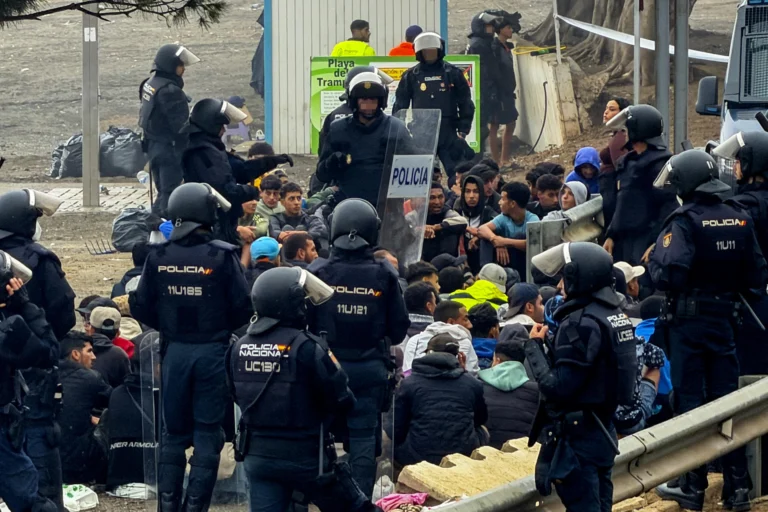
Ceuta migrant camp evacuation begins as Spanish forces remove 400 migrants from Guano beach and transfer them to the CATE center.
Related: Spanish Police Begin Clearing Migrant Settlement in Ceuta
Ceuta Migrant Camp Evacuation: 5 Key Facts on Spain’s Latest Operation
Ceuta migrant camp evacuation began on Sunday morning as Spanish security forces moved to dismantle a camp on Guano Beach, where around 400 migrants had been staying since the wave of irregular entries in late July. The operation is part of a broader effort to manage the ongoing migrant crisis in the enclave.
The evacuation, which started shortly after 8:00 a.m., involved agents from the National Police, Intervention Police Units (UIP), and Immigration, in coordination with the Civil Guard and Local Police. The operation followed the same protocol used in previous evacuations at Tarajal and Trampolín beaches.
The Ceuta migrant camp evacuation saw migrants grouped and transported by bus to the Temporary Center for Foreigners (CATE) to complete their identification process. After that, they were to be relocated to designated facilities, including the port camp.
Unlike earlier operations, where some migrants fled to mountain areas, many in this case collected their belongings and left the area on their own before security forces arrived.
Ceuta Migrant Camp Evacuation and the Response
Spain Ministry of Interior | UNHCR Spain | Spanish Red Cross
The Ceuta migrant camp evacuation has drawn attention to the broader migrant crisis in the enclave. The operation follows weeks of tension and comes amid ongoing efforts to manage the flow of people crossing from Morocco.
During the intervention, agents located several minors, who were separated and taken to specific points for processing. Many of them carried signs asking to be placed in protection centers after evading previous identification processes.
The Ceuta migrant camp evacuation also included cleanup crews dismantling tents and removing waste. Environmental technicians are assessing the ecological impact of weeks of occupation.
The evacuation of the camp comes amid ongoing criticism from human rights organizations over the treatment of migrants and the rise of hate speech toward minority groups. Activists and support groups have also faced attempts to criminalize their work.
The Ceuta migrant camp evacuation is taking place just 48 hours before the scheduled visit of Spain’s King Felipe VI and Queen Letizia on Tuesday, October 13. The royal couple will preside over a tribute to victims who died at sea during the Tarajal border events.
The visit is historic, as Felipe VI will become the first Spanish monarch to spend the night in the autonomous city since the official trips by King Alfonso XIII in 1904 and 1927. The king will then continue his institutional agenda to Melilla.
Geopolitical Context
The Ceuta migrant camp evacuation has implications beyond Spain’s borders because it reflects the broader migrant crisis affecting the southern border of the European Union. The operation highlights the ongoing tension between border control and human rights obligations.
For Spain, the evacuation is a test of the state’s capacity to manage migration and protect vulnerable populations. For the region, it is a reminder that migration remains a central issue in EU policy.
At the global level, the Ceuta migrant camp evacuation adds to the debate over how countries can manage migration in a way that is both effective and lawful. It also highlights the role of international organizations and foreign governments in providing support during crises.
The evacuation is likely to influence how other countries in the region approach similar challenges. It may also affect how international organizations and foreign governments engage with Spain on migration and border issues.
What Comes Next
The immediate next step is for authorities to continue processing the migrants and assess the full extent of the situation. That will determine how the country moves forward in the coming days.
The Ceuta migrant camp evacuation is expected to remain a central issue in national politics. Its outcome will be closely watched by both residents and international observers.
For now, the evacuation represents a major challenge to the status quo. Whether it leads to a fair resolution or deepens the conflict will depend on how the government and emergency teams respond in the coming days.
From teleSUR English via This RSS Feed.