

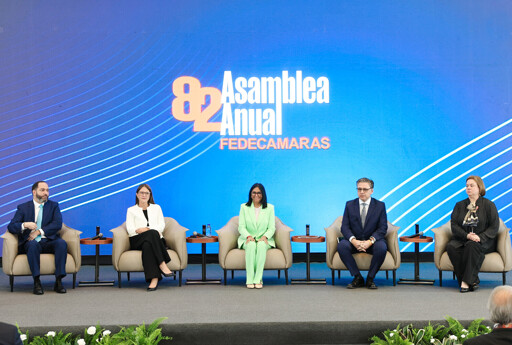
Venezuelan Acting President Delcy Rodríguez highlighted slowing inflation, a reduced exchange rate gap, and rising national consumption in her speech at the inaugural ceremony of the 82nd Annual Assembly of Fedecámaras, the country’s largest business association.
At the event on Thursday, October 8, Rodríguez stated that Venezuela has had 22 consecutive quarters of economic growth, with the third quarter (July-September) showing a growth of 6.5%.
She noted that in the period following the double earthquake of June 24, “we are seeing an exchange rate gap that has decreased from what it was in January, 65.7%, to 11.7% that we are seeing this month.”
“How did this happen? This is the result of effort, coordinated policy, a dialogue through the National Economic Council that has led us to agree on what the solution should be for Venezuela to overcome its challenges and to steer toward a definitive process of sustained growth, consolidated growth, and a model of social development with distributive justice,” she said.
Growth in national consumption
Rodríguez reported that national consumption has increased by 21.3% so far this year, an indicator that directly corresponds to the growth in national production.
“This year, we have experienced growth in consumption. But if there is growth in consumption, it is because there is also growth in production,” she stressed. “Growth in food production and consumption go hand in hand. There, the agro-industry, the productive processes of both entrepreneurs and the communal economy have gone hand in hand in all the processes.”
Gas agreements have been vital
Rodríguez referred to the agreements signed in the gas industry to ensure national consumption. “35% of the gas consumption in the country comes from the Perla field, which is operated jointly by the company Repsol from Spain, the company ENI from Italy, and PDVSA.”
She reported the signing of 61 agreements in oil and gas to boost productive linkages and strengthen the national petrochemical industry.
“What do we want? We want to boost the petrochemicals industry, ensure national consumption, export gas, but also to give a boost to the petrochemical industry that is present in the daily lives of Venezuelans, and in the lives of the country’s industrialists,” she stated.
She emphasized that strengthening the national petrochemical industry aims to generate added value and invigorate strategic sectors. She further stated that, in addition to generating fertilizers, it must create productive chains for the entire national industry.
In that context, she acknowledged the process of recovering installed capacities. “There is still a lot of way to go, and that is why we are on this path of ensuring gas production for the industry, for the electrical system, so that we can have a true boost in an industry that will generate a lot of jobs and foreign exchange. It would be the third source of foreign exchange income, just like petrochemicals,” she explained.
Increase in oil production
Rodríguez specified that oil production has increased 8% this year. “You know that, in January, the blockade not only prevented exports but also reduced our production, which had reached 1,200,000 in December [2025] and dropped to 900,000 barrels. If it were not for that, the growth would have been even greater; the impact would have been tremendous, but we will see the impact on oil production starting next year,” she hoped.
She said that the oil agreements signed, including the one with the United States, will give a significant boost to the oil sector.
She added that 60 agreements have been signed with different countries. “For what? To convert the oil and gas reserves into development for the Venezuelan people, to translate them into jobs,” she emphasized.
“In addition to the 61 agreements that PDVSA has already signed, 44 are being negotiated,” she added. “In total, 105 agreements. In less than a year, 18 agreements in mining, which is also an important sector for the country, and all of this will translate into national development, benefiting the working class and entrepreneurs.”
320,000 jobs in the next four years
“We are envisioning around 320,000 jobs in the next four years, including direct, indirect, and derived jobs, which will have a significant impact on Venezuela’s regional and national development,” Rodríguez said.
“The first thing that gets a boost is the country’s restaurants, because all these engineers, all the people in these new jobs would go to restaurants,” she continued. “Secondly, the hospitality industry in the oil-producing regions, those who arrive in Caracas, those who go to Maracaibo, to the East, to the Belt. Third, the supply of primary goods. The oil sector has already been activated in these agreements, because there will be a provision of services and of capital goods that are produced in Venezuela, which is why the connection with the country’s basic industries is so important to guarantee the supply of iron for the industry, for the products that will be required, the aluminum that will be required for oil production.”
Salaries increased in the private sector
Rodríguez noted that according to data from Fedecámaras, workers’ salaries in the private sector grew 32.8% this year. “Meanwhile, in the public sector, it was 50%, as we raised the minimum comprehensive income from $160 to the equivalent of $240.”
“I have asked the economic team that, starting next year, any increase in workers’ salaries must be above the GDP, the country’s economic growth, so that the workers of Venezuela can directly feel the benefits that all these agreements, all these efforts will bring,” she added.
Venezuela in the international financial system
“Another important development has been Venezuela’s return to the international financial system,” the acting president said. “We have resumed relations with the IMF, the World Bank, the Inter-American Development Bank. With the CAF [Development Bank of Latin America and the Caribbean], we already had and maintained relations, but we are now estimating that Venezuela will receive public and private financing projected at $12 billion in the next two years.”
She reported that the National Economic Council held a meeting with the Inter-American Development Bank Fest and the Inter-American Lab Bank “regarding mechanisms for financing the private sector, large enterprises, medium-sized enterprises, small industry, and the country’s entrepreneurs.”
“We want these financing mechanisms to permeate all strata of Venezuela’s economic activity,” she said.
Central Bank of Venezuela Reports 8.4% Inflation in September 2026
Tax reform
“A tax reform is coming in Venezuela. This tax reform—listening to all sectors of Venezuela—intends to harmonize the tax burden, so that this tax burden would serve economic growth and the productive processes of the private sector and also permit a reorganization of labor responsibilities in the private and public sectors,” she announced.
“May the tax harmonization serve to consolidate and support the rights of workers!” she added.
Ot was reported that non-oil tax revenue has increased by 22.6% this year
Increase in production of raw materials
The production of raw materials has increased by 38%, and imports of finished products have decreased by 34% in Venezuela this year. “It is a policy of support for the country’s industrial productive sectors, and it is being carried out through economic dialogue,” Rodríguez said.
(Diario Vea) by Yuleidys Hernández Toledo
Translation: Orinoco Tribune
OT/SC/SF
From Orinoco Tribune via This RSS Feed.