

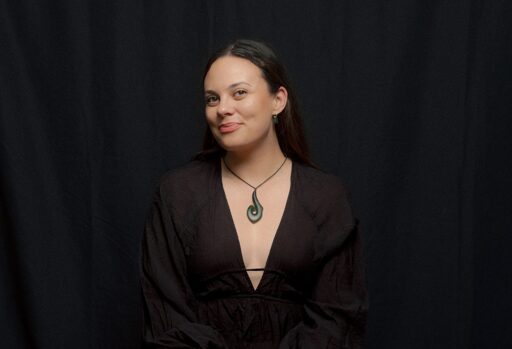

Madison Nonoa plays Léïla in New Zealand Opera’s production of The Pearl Fishers. (Photo: Ben Reason)
Soprano Madison Nonoa is home to perform in New Zealand Opera’s production of Bizet’s The Pearl Fishers*, which opens in Christchurch next week after a run in Auckland last month.*NZ Opera’s general director, Brad Cohen, says she’s an extraordinary talent whose vocal artistry is world-class.
Here she is talking with Dale about the challenges of singing on the international stage, and why she feels she was born to be on stage.
Thanks so much for joining us on E-Tangata, Madison. We celebrate Māori and Pacific effort, and it’s neat to have a kōrero with you today. I always start with names and villages as a mark of respect to our old people. Should I call you Madison or Maddie? How do you roll?
Maddie is great.
Okay. Can you tell us a little bit about the Nonoa clan, and your village connections and whakapapa? I hear you’re a Waikato kid.
I am a Waikato kid, but my grandparents were both from Sāmoa, with roots in American Sāmoa, Western Sāmoa (as it was known back then), and Niue. My grandmother came from the village of Lufilufi, and my grandfather came from Apia. As far as I know, the main parts of my Sāmoan family come from those two areas, which are both on Upolu. That’s my Nonoa clan.
I was born in the Waikato in Kirikiriroa (Hamilton), and I’m actually the only one in my family to have been born there. I think everyone else was from Wellington, but I’m proud to be from Waikato.
Mum is Rebecca Nonoa, and dad is Eliot Horsefield. I use Nonoa for singing, but my full surname is Nonoa-Horsefield, and I’m very proud of both names.
Have you managed to go home to Sāmoa and to sing there?
I’ve never sung in Sāmoa. I’ve actually never been, and I would really love to go.
There was a trauma in my family in that my grandfather and many of my Nonoa relatives died in one of Sāmoa’s biggest aviation disasters in April 1978. So I think for my generation, a lot of us haven’t gone to Sāmoa yet because it’s painful, and we don’t have a lot of family left in Sāmoa.
But it’s something that I feel is very important for me, so I’m trying to find the right moment to make that trip.
You describe growing up in a musical family. Where’s the music from, and what sort of music are we talking about?
My mother’s older brothers all taught themselves to play instruments, and they had a band. They are phenomenal musicians. When you hear them play together, it’s incredible to think they never had any formal teaching.
My mum, being the younger sister, always wanted to join in. And they used to give her a microphone that they didn’t plug in, because she can’t sing at all. But it’s kind of funny that it’s her daughter who is the only professional musician in the family. My mum’s very proud of that.
My dad can sing. He’s a very good singer. He will never admit it, but there’s a lot of music on both sides, and a lot of music appreciation.

Madison with her mother Rebecca Nonoa (top) and Aunt Rachael. (Supplied)
Did you go to school in Hamilton as well, Maddie?
Yeah, I went to Hamilton West Primary and Hamilton Girls’ High School.
Were you drawn to musical endeavours within the school settings? I mean, did you join the choir?
Oh yeah, I was in everything. I was in all the orchestras, all the choirs, all the barbershops, everything. When I look back, I think it’s quite cool that I never went through any period when I was thinking: “What would I like to be when I grow up?”
I just knew I would be a singer. It was a fact of my life.
And when you were 13, who were you listening to that you thought: “I’m going to be a singer?” Because I’m picking it might not have been opera you were listening to as a young teenager.
No, no, no. I was like most other girls my age. I loved Beyoncé. I thought she was just the coolest thing in the entire world. I loved Stan Walker, too. We all loved him and Dane Rumble. There’s that song that has the line “How could she be so cruel to me” that came up the other day. That was one of my favourite songs.
I liked a lot of New Zealand artists. Brooke Fraser, Lady Six, Aaradhna and the Adeaze boys. They were super cool. Actually, my first ever solo in a school choir was singing “Getting Stronger” by Aaradhna and Adeaze.
So, you and your three mates from Hamilton Girls’ High pulled together a barbershop quartet, right?
We did, and it was one of the coolest things I’ve ever done in my whole life. We were four best friends, totally inseparable. We competed one year in the barbershop competitions, and we didn’t get anywhere. So we thought: “Okay, our goal is to get to the top three in the country next year.”
It was this obsession we had. We came to school every single morning to practise at, like, 7 o’clock in the morning till school started. It felt to our 16-year-old brains that no one believed in us, no one thought we could do it. We were just this barbershop quartet from Hamilton Girls’ High, and all the really great barbershop quartets were from Wellington, so it was this big thing in our minds.
We got into the nationals, and after we performed, we all thought: “Ah, we blew it. That didn’t go well.” So we left and went to McDonald’s or something, and we got all these calls when they were announcing the place-getters. Our teacher’s like: “You guys came third. You got in the top three!”
We were like: “Oh my God!” It was the best moment of my life, honestly. Really peaked.

Maddie (right) with her barbershop friends. (Photo supplied)
Your natural voice is soprano, isn’t it?
Yeah, always floaty bird. I can sing “Queen of the Night,” which is one of the highest soprano roles. It’s like a top F sharp. It’s not as high as Mariah Carey’s, but it sits up there.
What was your first operatic experience?
It was Carmen, and it was in the Waikato when I was nine. I was in the children’s choir.
And you got the bug for performance?
Yes.
Performing can be quite intimidating, especially when you’re doing solo work with an orchestra. You know, all these grey-haired violinists with 50 years of experience, and on strolls Maddie and everyone’s looking at you. How do you cope with that reality?
That is the million-dollar question, and it’s actually a question I ask myself every single time. I think of an experience I had last year where I was performing with a conductor named Sir Simon Rattle, who’s one of the most famous conductors of our time. When I walked out on stage for the first time to sing with him and his orchestra, I was petrified. I’ve honestly never felt that scared in my whole life, because you’re so aware that you’re standing in front of someone who is one of the gods of this industry.
It’s such a balancing act. You’ve got to back yourself and go: “I’ve worked really hard. I’m not just a newbie to this. I’m here. I’m doing this.” But you’ve also got the other side of you that’s going: “If you make a mistake, you’re not going to die. If this doesn’t go that well, you’ve got whānau who you can ring and who are going to remind you that they love you. If you have a great singing night, they love you. If you have a bad singing night, they love you.”
And having that sense of tethered-ness, you’re able to go: “Okay, I’ve got to be real with myself. This is a really high-pressure environment, but I’m still Maddie at the end of the day, and I’m still going to walk off the stage and be Maddie. And there’s nothing that can happen here that will change that.”
But it’s still terrifying. Every single time I do it, I have to talk myself into the room. A really good lesson I’ve learned is that everybody has imposter syndrome. I don’t know a single person who doesn’t sometimes think to themselves: “Am I good enough to do this? Am I ready to do this?”
What I’ve learned about bravery is that brave people are often afraid. There’s no one who has been brave who wasn’t scared. They’re scared, and they do it anyway. And there are times when it goes really well, and there are times when it doesn’t. You’ve just got to keep doing it.
Do you ever feel your old people, your village, your whānau riding with you in these moments?
I do, especially my mum’s mum, who I called Mama, and my other grandmother. Those are my two angels that I always carry with me. I remember when I was really little, and I used to have quite bad nightmares. One of the things that I used to think to myself was that if there is such a thing as bad ghosts or bad things in the world, then there’s also such a thing as my grandmother protecting me. Like, there’s no way she’s letting that bad stuff come to me.
And I feel that on stage, especially when I’m scared. I have some mantras that I say to myself out loud, and quite often I’ll say: “Mama, please come with me. Just come with me right now.”

Baby Maddie, right, and her cousin Olivia Nonoa, with their grandmother, Matikuliva Nonoa (Mama). (Photo supplied)
Lovely. I want to acknowledge your efforts at Auckland University. You chose music, you got your ticket, and to have come through with first-class honours is a testament to your attitude and work ethic. How did you maintain your focus during that time?
I was always so sure that it was what I wanted to do. Plus, we had amazing teachers and mentors, such as Morag Atchison and Francis Wilson. I’ve lived overseas now for a long time, and I studied in London, but it was the training that I had in Auckland that set me up for the rest of the time that I’ve been away.
We were so lucky, and we didn’t even know how lucky we were when we were there. We had no way to compare it, I guess.
But studying music, at the end of the day, is honing a skill. You’re constantly having to chip away at something — otherwise, it doesn’t emerge. I just knew that I had to keep doing it.
When you say honing your skills, was it hitting notes that you thought you weren’t capable of, or was it producing a clarity that existed within you but you had to refine your ability to bring it out when you needed it? How would you describe how you grew as a performer and an artist during that period?
Definitely both things that you just said, but a lot of the training was about physically building the instrument, making sure that I was able to have stamina. It was like athletes’ training, really. Working to make sure that the muscles were strong enough to get through an opera, for example. Strong enough to sing over an orchestra.
If you think of an athlete participating in an Olympic sprint race, we only see the final race. People can only see the opera that I’m in. But you don’t see all the warm-up, all the daily exercise, all the other things they have to do, and all the many ways that they’re treating their body to be able to pull off that feat. We do stuff in our studies and in our everyday lives that are constantly making sure that this tiny little part of our body is working at the best level it possibly can.

With her paternal grandparents, Don and Carole Horsefield. (Photo supplied)

Madison with her brothers, Jericho, Jalen, and Jacob.
It’s one thing for voice abilities, but what about acting and the thespian side of operatic performance? Is that something that took more time for you to develop confidence in?
Honestly, no. That was something I took to when I was really young. And I think it was because, every night of my life when I was growing up, my grandfather read stories to me. From when I was born until I was about 12 years old, he would read to me. From this education, I became obsessed with stories. And so, being on stage telling a story felt really natural to me, and it felt very, very fun. And it’s something I still find very fun. I love that side of it.
The best part is when you’re on stage and, as a performer, you can feel the audience. You know when they’re with you. There’s a strange, invisible thread that comes from the audience to you, and it’s so magnificent when it’s there, because it’s that intangible X-Factor that no one seems to be able to describe because it’s human connection. Live theatre gives you that.
It’s so powerful, and you can feel it when it’s not happening, too. As a performer, when I feel like I’m not doing my job very well, or I’m a bit all over the place and not concentrating, I know that I haven’t established that connection, and I know that people aren’t necessarily with me. But it’s what gives me energy. I feel like I was born to be on stage.

Performing in Don Giovanni with Andre Schuen, in Aix-en-Provence production.
Can you speak about voice projection? At a time when people are mic’d up all over the place, part of the operatic experience is the ability to control volume and create something unique without microphones.
It’s really important. It’s a skill to be able to sing over an orchestra, and an orchestra can be like 60 people playing their instruments really loudly. You have to be able to get your voice over that without a microphone, and I think part of the thrilling aspect for an audience is that it’s such a physical effort to make that much sound. The audience can feel it in their bodies too, and it’s something microphones can’t replicate.
Likewise, when you hear a singer who’s able to pull their voice back to be very intimate and very soft, it evokes a totally different reaction in an audience’s body.
I like to listen to birds everywhere I go in the world, because I think you can learn so much about singing from birds. I know that sounds insane now that I’m actually saying that out loud, but it’s true. I always stop and listen to tūī birds when I’m home. They are such small creatures, but boy, you can hear them from far away, and they’re a really good lesson in the power of naturalness.
How do you handle rejection, such as not getting gigs that you auditioned for?
Probably still quite badly. I hate rejection. It sucks. I think I handle it more efficiently than I used to when I was young. When I was young, every single bad audition, or every single “Thank you so much for your email. But we have decided . . .”. Every single time I got one of those, it was like the end of the world.
And I used to read into it that it meant: “This is never going to happen for me.” That was an immaturity thing that, thankfully, I’ve got rid of. I still hate it, but I have a process where I’ll feel really down about it for half an hour, then I’ll ring one of my friends and we’ll complain about it, and then I move on. Unfortunately, it’s an ever-present part of the job.
My dad always says: “Everybody has their day in the sun, and you can’t begrudge another person for having their day in the sun. If it’s not your turn, it’s not your turn.” I always try to remember that it’s all just making you a better person.

Maddie with her father, Eliot Horsefield, on her graduation day from Guildhall School of Music & Drama in London, 2019. (Supplied)
We’d better touch on Dame Kiri Te Kanawa and Dame Malvina Majors, both very prominent in New Zealand operatic history. How important has their support been?
With both Dame Kiri and Dame Malvina, I wouldn’t be here without them, like 100 percent. Dame Kiri has a foundation that gave me and a lot of other singers a huge boost when we were in New Zealand. They gave us coaching support, and we had psychology classes for performance. They made sure we understood what the job was, and what we needed to achieve to get there. And they were always checking in with us.
During the pandemic, Dame Kiri’s foundation stepped in for those of us who were living away from home and who had lost all our work, and they provided financial assistance to help us pay our rent and stuff like that. For so many of us, especially during that Covid time, Dame Kiri stepped into the breach and was like: “The story doesn’t end here. You guys have all worked really, really hard.”
She had this huge career, and she knows exactly how hard it is, and how hard it is to be away from home for so long. She would come on Zoom and talk to us, and try to make us feel like she was really there with us. That was amazing.
Dame Malvina was my teacher for a few years when I was at Waikato, and she’s one of the most wonderful people in the world. Her foundation has given me a huge amount of help. I was the recipient of the Dame Malvina Major Award a few years ago, which supports people who are already in their careers.
There’s this odd thing that when you’re a student singer, you need help, and then you go into the workforce, and you start getting work, but it’s actually very expensive. Suddenly, you’ve got loads of visas to deal with, accommodation, coaching. All this stuff happens, and you haven’t been paid yet. That scholarship comes in to help you navigate that time.
These two women really did plant the seeds of trees that others could sit beneath and be shaded by. I really think I would have had to stop singing a long time ago had they not been around to understand the difficulties and plan for them and make the financial burden so much lighter.
Something that is very true in the classical music world is that most of the people I studied with came from extremely privileged backgrounds. They’d all gone to Oxford or Cambridge. They’d come from this very specific kind of milieu, and I was not from that, and neither were the other singers from New Zealand. We all had a completely different context, and I think without the foundation’s help, a lot of us would have had to stop because of how high the costs are.
Take New Zealand Opera’s current production of The Pearl Fishers, for instance. I was recently awarded the Ryman Healthcare Dame Malvina Major Foundation Mina Foley Award, which was created to help with travel costs for New Zealand artists like me so we can return home and perform principal roles in Aotearoa. Most of us in this industry end up living overseas, so having that support to come back and sing for audiences at home means everything.
Perhaps we should also pay tribute to a woman named Yvonne Kenny, who I know nothing about. What are the skills that she shared with you?
Yvonne is like the Kiri of Australia. She was my teacher at the Guildhall for two or three years. She took me from this very young, very enthusiastic but inexperienced woman and moulded me into being a bit more self-assured, more ready to step into international waters. She was really great at teaching you how to be a swan on the lake, as I see it. She’s all about working really hard beneath the surface, so you can look serene and effortless. That was her legacy for me.

Performing in Australia for the Governor of New South Wales. (Photo supplied)
We’ve got a lot of beautiful Polynesian voices coming out of struggle street back home here, and then finding themselves on operatic stages around the world. What are you making of our Pasifika-Māori inroads not just in opera, but in all sorts of musically creative areas?
I think it’s amazing. When I was really young, I was in the New Zealand secondary students choir, and there was a group of us there who were all Sāmoan, and I remember looking around and thinking: “Oh, this is cool. I didn’t know other Sāmoan kids liked classical music like I did.”
And that’s grown more and more. Sāmoans and other Pasifika and Māori singers are everywhere, and I see it as a natural thing because music is so much a part of our cultures.

Madison Nonoa with tenor Filipe Manu, in The Pearl Fishers, playing in Christchurch this week. (Photo: Andi Crown)
You’re here for The Pearl Fishers, as you mentioned, working with our senior musos. What does it feel like to be a returnee but with an even better skill set than you left here with?
It’s quite a surreal experience, because I do still feel like this young girl, and I can’t quite believe she’s on stage with New Zealand Opera. I can remember so vividly being a university student, going to see New Zealand Opera productions, and watching the singers and thinking: “Oh, I wonder when that would ever be me.”
But I do feel like now I have something to offer, and I’m so glad that I’ve had the time away to now be able to come back and give something back in terms of how I can communicate musically and what I can contribute.
There’s a young woman in The Pearl Fishers chorus whose name is Jasmine, and I knew her mother, who’s an amazing Sāmoan opera singer. Jasmine was a young child when I last saw her, and now she’s in her early 20s. I look across at her when we’re on stage, and I think: “That was me. That is exactly who I was when I was young.” It’s such a wonderful thing for me to be able to be an example for her. We’ve had a few conversations backstage, and I think because of our shared heritage and because I knew her mother, there’s a bit of a little-sister, older-sister thing. It’s a beautiful thing.
That’s what I don’t get overseas. I don’t have that tangible sense of being able to go: “Hey, Jasmine, this is a stage for people like us. We can do this, and I’m here to show you that you can do this, and you can absolutely be exactly where I am in a few years.”
Out of curiosity, what else do you do to keep yourself enthused about life?
This is going to sound really boring, but I’m a massive baker. If anyone ever needs a brownie, I am the brownie queen.

(Photo: Ben Reason)
(This interview has been edited for clarity and length.)
Madison Nonoa plays Léïla in New Zealand Opera’s The Pearl Fishers in Christchurch at Isaac Theatre Royal on October 14, 16 and 18. Tickets here.
The post Madison Nonoa: Born to be on stage appeared first on E-Tangata.
From E-Tangata via This RSS Feed.