

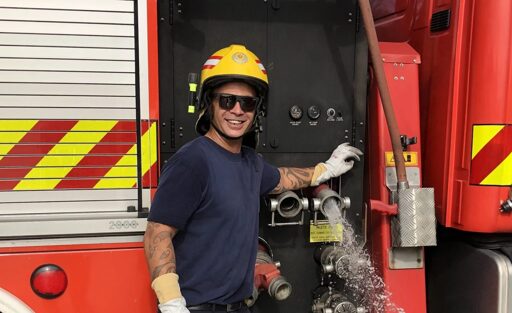

Jemarl Paerata: “I realised that the common denominator in all of my problems was me.”
Former firefighter Jemarl Paerata, 53, is giving rangatahi the guidance he wishes he’d had during a tumultuous time in his life. Here he is telling his story to Atakohu Middleton to mark Mental Health Awareness Week, which begins tomorrow.
What was your childhood like, Jemarl?
I’m one of three kids. My upbringing was good, and whānau was pretty big for us in my early years. We had a big family. My father, Ernest, was one of 12 or 13 kids, so I had lots of cousins. Dad was a prison officer at Waikeria Prison near Te Awamutu, so we grew up at Waikeria village. I was immersed in rugby.
We shifted to Fremantle for Dad’s work when I was 15. That’s where I started surfing, which I loved. Surfing has been everything for me. I played league and rugby, too.
Then my parents separated, and my mum, Georgina, came home. That was tough. It was just me and my dad over in Australia, and I was pretty much left to my own devices.
I was 16 when my dad went to prison. I’m a bit cautious about speaking about my dad out of respect for his privacy, but he now lives in Kihikihi in a retirement village, and I have a lot to do with him.
With Dad gone, I had to come home, and that was when things really fell apart for me. Lots of shame, lots of questions from people. I stayed with my mum in Taranaki, and my uncle Ray Tito got me into a news and documentary course there. He helped me a lot when I was a young fulla, because I was pretty lost when I got back. If it wasn’t for surfing during that time down in Taranaki, I probably would’ve been worse.
After that, I needed to get away, so I ran down to my mum’s family on Rēkohu, and worked on fishing and dive boats for a while.
I used to hold on to things and be resentful. I had a lot of anger building up as I moved through adolescence into manhood, because I didn’t really understand a lot of things about life. I realise now that I needed guidance — someone to show me that calmness of mind is one of the most powerful attributes that you can possess.

Jemarl Paerata learned to surf while living with his family in Western Australia and it has been a passion since: “It’s been everything for me, surfing.”
When did you become a professional firefighter?
I worked in the film industry in rigging and lighting for six or seven years. When my son Elliot came along, I needed a job that didn’t require long periods away from home — I was missing out on seeing him grow. Being a fireman was a meaningful job that offered security, and with the shift system, I had four to six days off every week to go surfing at Piha, where I’ve lived for 25 years. I couldn’t think of anything better to do.
For the first 15 years, I loved being a firefighter. Then there were changes at work, and overnight, rather than just fighting fires or cutting people out of cars, we were also assisting the ambulance service at medical events.
We were going to cardiac arrests just about every shift, and they were tough on everyone. You’re up close and personal, administering compressions, putting the oxygen on. You’ve got a family around you in a tight space. It’s a completely different job from being a fireman. I might be cutting someone out of a vehicle, but I’m focused on standard operating procedures, and the patient is in the hands of ambulance staff.
We used a lot of black humour to deal with the heavy stuff. You definitely didn’t want to be showing vulnerability. I dealt with all the hard stuff in my life and in the fire service by just putting it to the back of my mind.
When did the cracks start to show?
We got called to a cardiac arrest and arrived before the ambos. We went into this house where an elderly lady was sitting on a seat with her head down. My boss pulled her head up and it was immediately clear she’d been gone for a while. Oh, it wasn’t a nice sight, and I’ve seen a lot of dead bodies. We got such a shock. I tried to put that to the back of my mind, but every now and then it would come back.
At the same time, I was running away from my personal troubles. I was drinking heavily, partying hard, waking up hungover, getting depressed and disconnected, making lots of bad decisions. I was also sleep-deprived for years. I didn’t realise at the time that although I slept at the station on night shifts, the sleep wasn’t good quality.
I was deeply unhappy. I think people looking in from the outside would have thought: “Oh, he’s got it together. He’s helping people.” We talk about firemen going towards the fire to put it out and be that strong presence, but there was no one coming to put this fire out.
In late 2020, when I was 47, I had a breakdown. It was the year of Covid-19 lockdowns, and it all came to a head when I couldn’t actually travel to escape. Things were pretty dark for me at that point. I was hit by a wave of depression. I don’t know if I was suicidal, but I didn’t really feel like waking up.
Then I had this vision of my son as a toddler. He was in my arms, clutching the pounamu I was wearing. He looked me in the eyes and said: “Dad, I love you.” And that was it. I could see my behaviour. I could see I wasn’t dealing with stuff, that I was burying my feelings deep down. I needed to be better for him.
I realised that the common denominator in all of my problems was me. I decided that night to give up drinking. One day sober led to two, two days led to a week, and the weeks led to months. But at first it was painful, and I spent the first three months self-loathing, crying, and super depressed.
I got counselling, and I would take the odd day off, but no one at work really knew what was going on because I put on a show when I went to work.

Jemarl spent nearly 20 years as a professional firefighter, working in various west Auckland stations.
How did you manage to find your way out?
I had to fill that void with something positive, and for me that was learning. I listened to podcasts by Jay Shetty every day. He’s a former monk who now helps people find their purpose. He interviews people whose lives have fallen apart and finds out how they got back on their feet.
I also learned about self-development and meditation. How to control my emotions. Personal development. I learned about the fundamentals of health — adequate diet, hydration, sleep and movement — and I started moving the needle on those.
I started learning my reo under the wing of a kaumātua, and I began to learn about my whakapapa and te ao Māori. I got a mentor.
I reconnected with te taiao (nature) by going on big walks in the ngahere (bush). I’d sit out there and do some meditations, ask for some guidance from some higher power. From wherever. I feel calm in the bush. I feel like I’m at home. I feel like there’s a higher power out there that I’m connected to. And I feel even more connected to te taiao when I’m under the water, when I’m out in the moana (ocean).
Doing that, I started to lift out of that fog pretty quickly. When I changed my mindset, I started to have a brighter outlook. Not only was I feeling uplifted and looking at the world differently, but my interactions with people at work improved.
I could think clearly. I asked myself: “What is my purpose? What do I want to do with my life?”
You were still a firefighter then — when did you decide to give that up?
I resigned in September 2021. I wanted to take the leap, share the things that had worked for me, and help people reconnect with themselves through the amazing moana and ngahere at Piha. I started to see that future, meditate on it, see it playing out, then figured out what I needed to do each day to move in that direction. And then I started doing it.
Piha’s a pretty small place, and most people thought I’d gone crazy for resigning from my job to help people. I’d gone from propping up the bar at the RSA to posting on social media about the benefits of getting into te taiao.
But you only need one person to believe in you. That person was Dave Wood, who also lives at Piha. He has a background as a paramedic and ocean lifeguard and runs a company, Integrated Training, that teaches mental skills.
He heard the talk about me at the RSA and invited me to his house to talk about what was going on. I told him the changes I’d made and the vision I had to uplift and inspire as many people as I could.
He was about to launch human performance workshops for corporates and athletes and asked me to help, and we still work together. Without Dave, I don’t know if I would’ve been able to achieve all that I have.
Another important person is Tiaki Coates, a youth worker at Poutama Rites of Passage in Whāingaroa who runs camps for rangatahi rooted in te ao Māori. I’ve done a lot of training with him. The other is Cameo Stavers, a youth worker and surf instructor, who works with me to deliver a range of mentoring and reconnection workshops at Piha.
Rangatahi come to Piha through a range of social agencies such as the Ministry of Education, Lifewise, Waitakere Alternative Education Consortium, and Mā te Huruhuru, which helps rangatahi get jobs and housing.
I work with a lot of kids who are facing challenges. They may have been kicked out of school, or they’re disengaged and disconnected. They come out to Piha and learn about breath work, learn about self-regulation, set some goals, get into the ngahere and go surfing.
We ask for feedback from the organisations and we also get messages from the rangatahi. Our poster boy was a ram-raider. We talked about goal-setting and creating some sort of vision for a brighter outlook and taking little steps to head in that direction. He said in his family group conference that coming out to Piha had inspired him to head in another direction. And he did — he got a job. He messages me quite a lot.

Jermarl (right) with rangatahi at Piha: “One of the most powerful ways to find calmness is to reconnect with te taiao (nature).”
In your experience, why are a lot of people struggling?
I think the fundamental problem many people have is an inability to regulate their emotions. A lot of people, especially our rangatahi, are inundated with stress.
With rangatahi, we talk about the red brain and blue brain. Red brain is getting angry and upset, reacting and losing the plot. The red zone is when we’re stressed — what we call “upregulated” — ready to fight, flee or freeze. When we’re constantly in that state for long periods, we can burn out.
Being upregulated isn’t always a bad thing — we have to put ourselves under some pressure to achieve goals. But it’s about knowing how you can regulate and get into the blue zone. This means staying calm, going with the flow, and using your breath to get to that state where you can think creatively and clearly. One of the most powerful ways to find calmness is to reconnect with te taiao.

Rangatahi learn to surf at Piha: “We share a few things about embracing challenges, and we encourage them to step forward and embrace that challenge.”
How do you use surfing to help them learn about regulating their emotions?
We’ve got big soft-top surfboards, and we take them into the white water, the foamy part of the wave after it’s already broken. Before we do that, we share a few things about embracing challenges, and we encourage them to step forward and embrace that challenge. That’s where you learn, that’s where you grow. You’re in the red zone, and you’re upregulated, but you’re learning.
The next thing we encourage is to shift the self-talk from negative to positive. Rather than saying: “I don’t want to go, it’s too cold, I’m no good at this,” we get them to turn it around to: “This could be quite an adventure, this is my first time, I might learn something.”
And then we get them to take a breath. Let go of any tension in their body and be grateful that they’re able to be challenged, that they’re at the beach, that they can go for a swim and learn these new things.
We use surfing and surfing metaphors to teach rangatahi about the red and the blue. Let’s say you wipe out. If you stay in the red — angry, upset, reacting — you’ll use more energy, and it’ll be harder to succeed next time. But if you relax, you can find that calm blue state, reset, and try again.
The rangatahi learn that they can regulate their own emotions. It’s okay to be angry, but what matters is how you take the next step forward. Take a breath. Move into the blue, think clearly and creatively, and then respond in a way that helps you hold your dignity.
All the stuff that’s helped me are the things that I share with them. I hope that when rangatahi leave us, they have a better understanding of who they are. They’ve connected with te taiao: lain on the black sand, felt the wind, and smelled the salt.
They have a sense of where they belong, or they feel at the very least that they belonged with us. And they have some idea of where they want to go and some skills to take away with them to help them set a goal, even a small one. It might be to clean their room. It might be to turn up for their driver’s licence test or apply for a job.

Jemarl’s son Elliot, 30, right, inherited his dad’s passion for surfing and is now a pro surfer. Here, Elliot and girlfriend Lilliana Bowrey celebrate winning the men’s and women’s Māori surfing champs at Ōwae Marae, Waitara, in March 2026.
What simple tips can you pass on to people who want to make a change?
Get clear on what you want. You can do that by getting out into nature. Go for a walk in the park. Sit down and close your eyes. Get into a calm state and think about what your life would look like with no restrictions. What do you want to achieve?
Think about the fundamentals of health. Good nutrition, adequate hydration, enough sleep, a positive mindset, movement, meditation, conscious breathing, and connecting with nature and people.
Mark yourself out of 10 on how you’re doing on each one. Be honest with yourself, and hopefully, at the end of that exercise, you’ll have a better understanding of where you can improve.
Then choose something easy that you can practise each day to help address whatever is lacking. It could be getting a water bottle or going to bed earlier without your phone. The better we feel mentally, physically, and spiritually, the better we can face life. I believe everyone has the ability to move the needle every day on their mental health and wellbeing.
I don’t think any of us really tap into what we’re fully capable of, and I know I certainly didn’t until I was 47. I’m still trying to figure out what’s possible for me. I still face challenges, but I feel I’m much better equipped to get through them. I’ve got a new lease on life. I’ve got purpose, and I’m having fun.
Jemarl Paerata (Ngāti Tūwharetoa, Ngāti Mutunga) founded Te Kaiārahi, a Piha-based community organisation that helps people develop emotional adaptability, clarity of purpose and connection through experiences grounded in Māori values and nature. He’s telling his story as part of Mental Health Awareness Week 2026, which runs from October 12-18. This year’s theme is “Belonging Matters”.
The post Jemarl Paerata: I was pretty lost, but now I have purpose appeared first on E-Tangata.
From E-Tangata via This RSS Feed.