

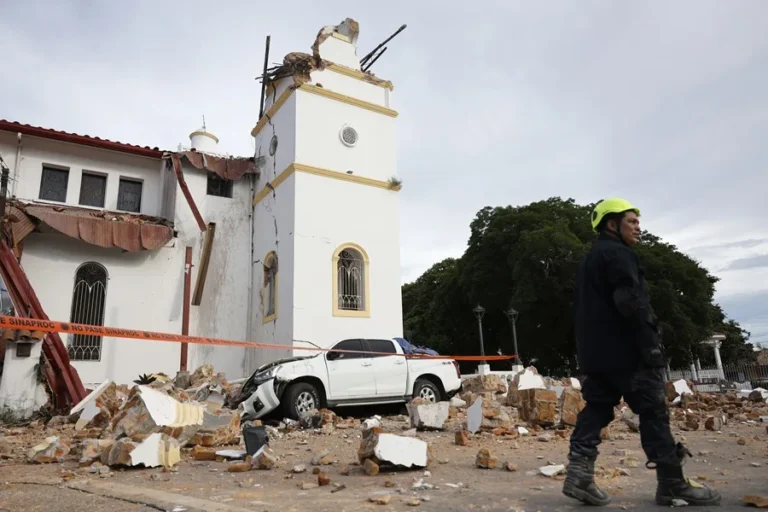
Panama earthquake of 7.7 magnitude injures 26 and damages hundreds of buildings, with no deaths reported as inspections continue.
Related: Venezuela Offers Assistance to Panama Following Magnitude 7.7 Earthquake
Panama Earthquake: 7.7 Magnitude Quake Leaves 26 Injured, No Deaths
Panama earthquake of 7.7 magnitude struck the country on Friday, October 9, at midday, leaving a preliminary total of 26 people injured and widespread damage to public and private infrastructure. The Social Security Fund (CSS) confirmed on Saturday that no deaths or serious injuries have been reported.
The epicenter was located 39 kilometers northwest of Tonosí, in the province of Los Santos, at a depth of 10 kilometers. The quake was felt strongly in nearby provinces and forced evacuations of buildings across the country. The earth shook again at 11:12 p.m. local time, with a 6.3 magnitude aftershock.
That nighttime shake added to a sequence of more than 100 tremors during the day, several of which registered above 6 on the Richter scale.
Emergency committees and teams from the National Civil Protection System (Sinaproc) are maintaining constant monitoring due to the continued seismic activity.
Información importante sobre los protocolos de seguridad en el aeropuerto. pic.twitter.com/0V1f5aIIvz
— Aeropuerto Internacional de Tocumen (@tocumenaero) October 10, 2026
Panama Earthquake and the Damage
Sinaproc | Panama Ministry of Health | Panama Civil Protection System
The preliminary damage count includes 136 homes with structural damage and 188 schools with damage to their facilities. The total number of affected infrastructure also includes 14 hospitals and health units, 30 government buildings, 20 churches, and 11 hotels.
Among the affected health facilities are the Tonosí Hospital and the Los Pozos Hospital. Airports across the country activated preventive safety protocols to inspect runways and control towers.
The lack of potable water and the pending review of backup equipment led the CSS to temporarily halt hemodialysis and renal replacement treatments nationwide. The institution expects to resume them on Sunday, October 11, provided conditions are fully safe.
Polyclinics are keeping emergency and laboratory services open 24 hours during the emergency. The figures are preliminary and could rise as technical inspections advance. Correspondents and emergency agencies agree that the number of injured from the earthquake is around 26 people, with no serious cases.
The emergency comes two days before the commemoration of the Third National Evacuation Drill, scheduled for Monday, October 12, under the motto “Resilience begins at home.” Specialists from the Institute of Geosciences at the University of Panama expect tremors to continue in the coming hours.
Technical evaluations will continue on Sunday to assess the full extent of the damage, verify the safety of buildings, and define the repair schedule. The sequence of aftershocks keeps local relief committees on alert.
Panama Earthquake and the Response
Sinaproc | Panama Ministry of Health | Panama Civil Protection System
The Panama earthquake has triggered a coordinated response from emergency teams and government agencies. Sinaproc is leading the monitoring and evacuation efforts, while the CSS is managing medical services and temporary shelters.
The government has deployed teams to assess the damage and provide assistance to affected communities. The priority is to ensure the safety of residents and restore essential services as quickly as possible.
The Panama earthquake has also highlighted the importance of preparedness and resilience in the face of natural disasters. The country’s emergency protocols are being tested, and authorities are working to minimize the impact on the population.
The response includes setting up temporary shelters and medical tents to accommodate patients and displaced residents. The government is also coordinating with international partners to secure additional support if needed.
Geopolitical Context
The Panama earthquake has implications beyond the country’s borders because it highlights the vulnerability of Central America to natural disasters. The region is prone to seismic activity, and events like this one underscore the need for stronger disaster preparedness and regional cooperation.
For Panama, the earthquake is a test of the state’s capacity to respond to emergencies and protect its citizens. For the region, it is a reminder that natural disasters can have far-reaching consequences and require coordinated responses.
At the global level, the Panama earthquake adds to the debate over how countries can prepare for and respond to natural disasters. It also highlights the role of international organizations and foreign governments in providing support during emergencies.
The earthquake is likely to influence how other countries in the region approach disaster preparedness. It may also affect how international organizations and foreign governments engage with Panama on emergency response and recovery issues.
What Comes Next
The immediate next step is for authorities to continue monitoring seismic activity and assess the full extent of the damage. That will determine how the country moves forward in the coming days.
The Panama earthquake is expected to remain a central issue in national politics. Its outcome will be closely watched by both residents and international observers.
For now, the earthquake represents a major challenge to the country. Whether it leads to a swift recovery or prolonged disruption will depend on how the government and emergency teams respond in the coming days.
From teleSUR English via This RSS Feed.