

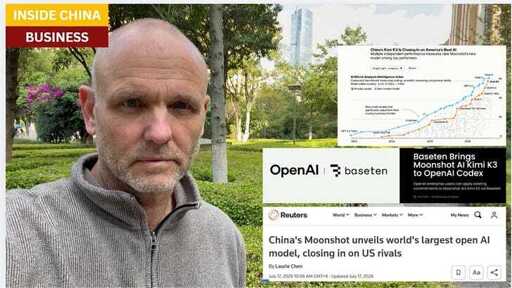
Bullets:
Kimi K3 is the latest release from Moonshot, a Chinese AI company.
Kimi is comparable in performance with Anthropic and ChatGPT, but at a far lower cost to enterprise users and developers.
OpenAI recently added K3 to their platform via Baseten, and allows their existing business customers to use Kimi as a foundation model.
This arrangement keeps OpenAI’s most valuable customers on the platform, while burning up the last of the tokens contracted for.
But switching to Kimi is a very simple coding change, and the risk to OpenAI is that users will just migrate to low-cost open-source models immediately after their tokens are used up.
Inside China / Business is a reader-supported publication. To receive new posts and support my work, consider becoming a free or paid subscriber.
Report:
Good morning.
From the very beginning, the position of Inside China Business is that China’s efforts in Artificial Intelligence are being ignored by Western media, and by Western investors. We are relentlessly on-message in that theme, that the most important advances in AI are happening here, in China.
Silicon Valley and Wall Street are just a side show, in comparison. All the circular financing deals. All the data centers that cannot be built because of supply chain problems, and now because of deep opposition from local communities. All the IPO plans for the tech companies, who aren’t making any money. Artificial Intelligence is a bubble, in Western markets, and it will pop as all bubbles do, and it will probably sooner rather than later, and then it will just stop.
But here in China, it is not a bubble, and it will not stop. It is a whole-of-government effort, from Beijing on down through the provinces, and down further to cities and towns and industrial clusters. And it’s because for China, these AI tools are being used in countless industrial and commercial applications, by hundreds of millions of people in tens of millions of businesses and factories.
Artificial Intelligence in China is a completely different industry, than what passes for AI in the West. And there are other major differences, which we’ve reported on before. The Chinese LLM’s—large language models—are at least as good, and cost a lot less money to build and train, compared to the closed models developed by Silicon Valley.
What’s more, they are far less expensive to use. The chips cost less. They are engineered and configured differently. Electricity in China a fraction of the cost to power data centers anywhere else, so the energy cost constraints don’t exist.
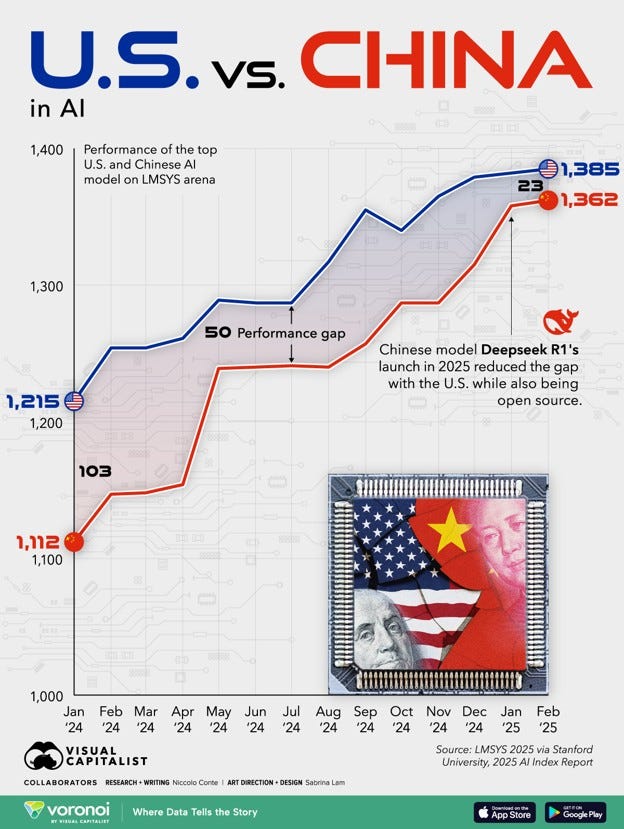
Just two years ago, it was conventional wisdom that the Chinese were a generation or two behind in AI. But when DeepSeek came out, it was a shock to Wall Street and to Silicon Valley—briefly. We had been using systems like DeepSeek for months and assumed that Wall Street knew something we didn’t, but we were wrong about that.
Turns out that nobody in this industry back home was paying attention at all. Then investors just shrugged it off, and we concluded that that must be because Chinese models would simply be banned, and just like in other industries that big US firms find themselves unable to compete against China, they’ll just ring up their lobbyists and write the rules to keep Chinese suppliers out of their markets.
But that didn’t happen either. And fast forward a few short months, we found that most of the companies in Silicon Valley itself were using Chinese AI to do most of their work. Because, again, the Chinese models cost less, are just as good, and are open source so they’re easier for developers to work with.
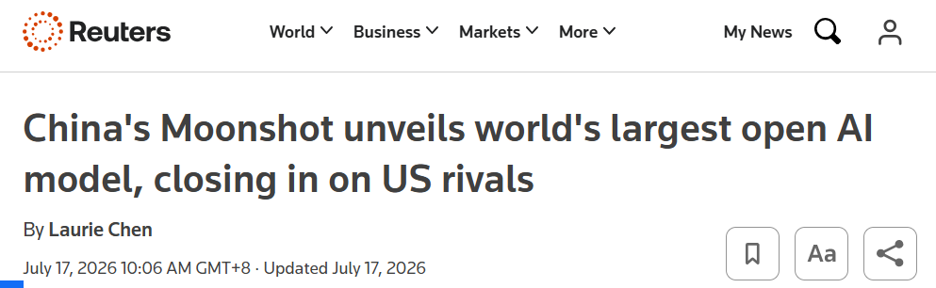
All that in mind, we’re looking at these three headlines and trying to make sense of them. First is from July: Moonshot is a Chinese tech company, which released Kimi 3. Kimi comparable to the top models from Anthropic and OpenAI.
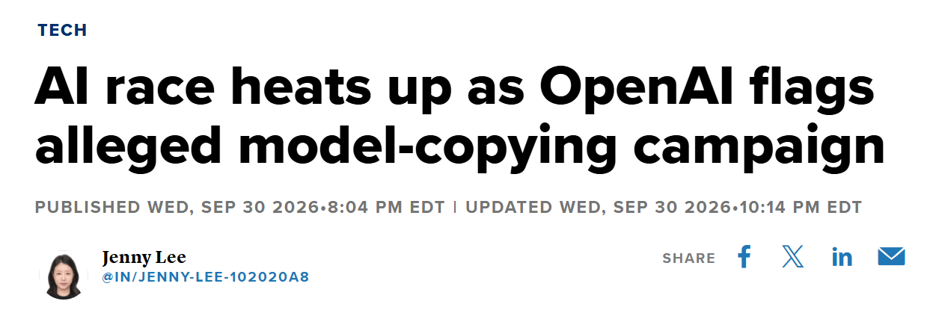
September 30: OpenAI is accusing Moonshot of IP theft in the training of Kimi 3.
Also on September 30: OpenAI is offering Kimi for its enterprise customers.
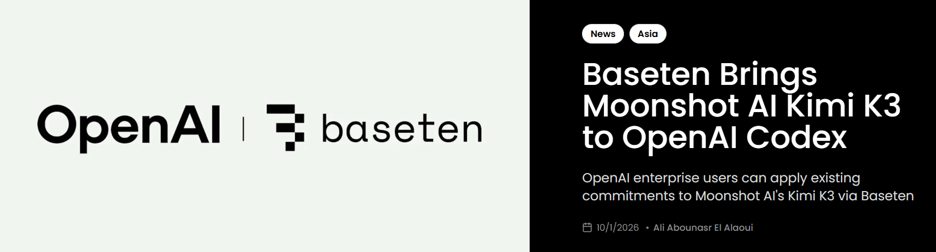
We’ll be in the deep end of the pool for some of the tech stuff, but it’s important to understand how desperate OpenAI is to keep their business customers, and how hard it will be for them to do so.
What is happening here, is that enterprise users who already have a contract to use OpenAI models, can use Kimi3 instead—a much less expensive model—without negotiating new vendor agreements. And most importantly, they will remain under contract with OpenAI.
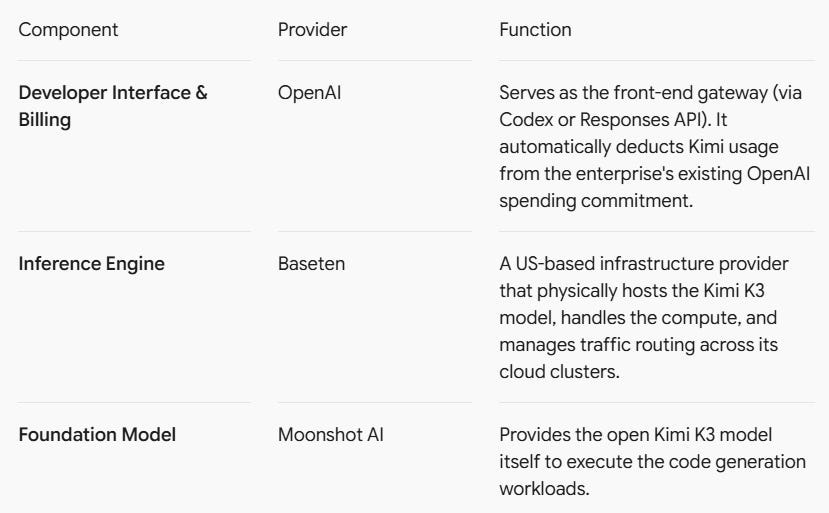
OpenAI is the gateway, and Baseten hosts the Kimi model, and manages traffic and the inference compute. Users now have the option to use Kimi as the foundation model.
Engineering teams making the switch probably will use Kimi for the repetitive coding tasks that chew up tokens, at a far lower cost than they are paying now. They can switch immediately to Kimi and enjoy lower token costs, while keeping their contract with OpenAI.
This is the first time a Chinese LLM has been embedded in the enterprise systems of an American AI developer.
If we wonder why OpenAI would open its system to a Chinese LLM they are accusing of IP violations, there are three good reasons they cannot afford not to. Developers are inclined to make the switch away from OpenAI anyway, to save money. And developers who do stay in the system are still dependent on OpenAI’s infrastructure. And they’re earning money on the third-party services, revenues that would otherwise just go away.
For US and European enterprise users with government contracts, they would be legally prohibited from working directly with a Chinese large language model, no matter the cost savings or ease of use. But this is a good work-around for those restrictions.
Baseten and OpenAI make all the money. They are using Moonshot and Kimi for free, basically, and charging their customers for the right to use Moonshot, which they also accuse of stealing their own IP. By setting up Moonshot on Baseten, OpenAI is making a bet that they can keep their moat around their enterprise customers, who would otherwise just plug in directly to Moonshot. Again—Moonshot Kimi probably won’t see a dime.
OpenAI and Baseten will use Moonshot and Kimi to drain what’s left of the tokens in the existing enterprise contracts. But then OpenAI has another problem, which involves how ridiculously simple it is for developers to leave OpenAI and plug in directly to Kimi. This is a guide for developers, currently on OpenAI, to migrate their work flows to Kimi. All they need to do is swap two single lines of code, and swap the API keys on OpenAI for their password on Kimi. Now the developer apps are working with Kimi, instead of OpenAI:

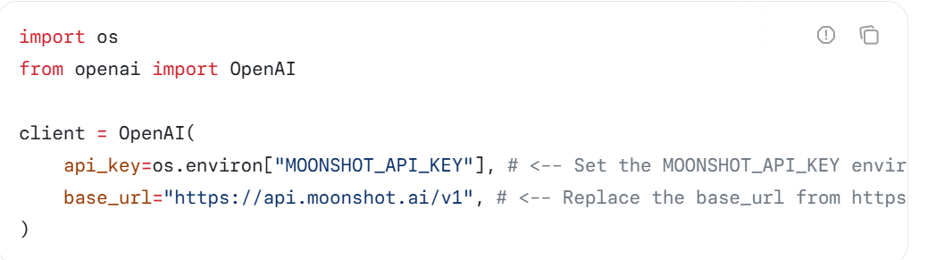
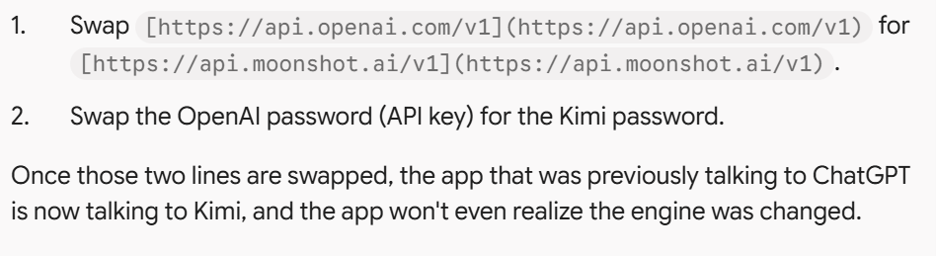
By taking three seconds to cut and paste a few lines and putting in a new password, the average enterprise user will save thousands of dollars a month, without burning another token from their budgets with OpenAI. Those savings come from the context caching problem—there is typically a large discount from providers, to users, when the AI reads the same text multiple times.
At [OpenAI there is a 50% discount for cached re-reads](https://openai.com/api/pricing/](https://openai.com/api/pricing/), which is about $1.25. Moonshot’s discount is 90%, for a net cost of just 30 cents. So consider a tech company running 5,000 automated coding tasks in a month, and a typical case for reads, loops, and outputs, or writes. Using ChatGPT, that tech firm will spend $14,000 for the month:
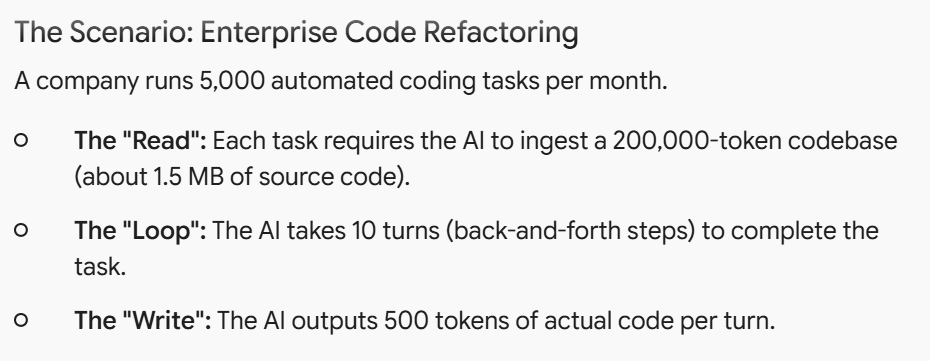
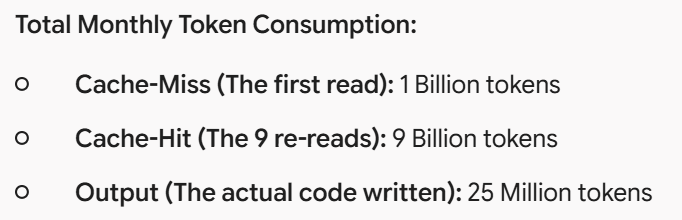
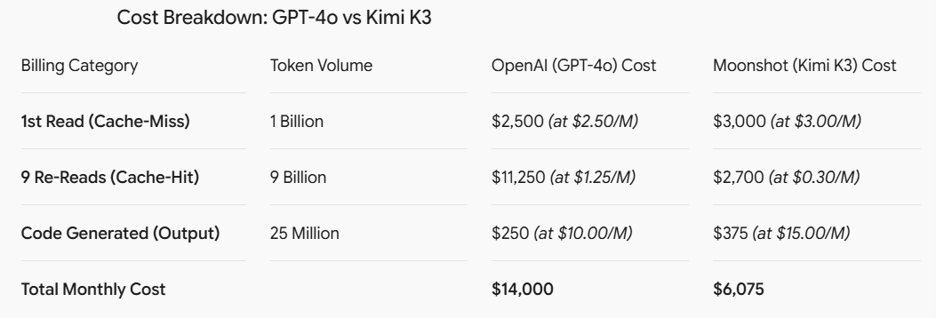
Plugging into Moonshot is just over $6,000 per month. Simply copy-pasting two lines of code means an immediate 56% savings in compute costs.
These savings are well known in the tech industry, which is moving to Chinese LLM’s as quickly as they burn through their tokens already contracted for.
This is not a “partnership” between OpenAI and a high-quality, low-cost model from China. Rather it’s a desperate move by OpenAI to keep their enterprise users on their platform for as long as possible. But it is a very short-term fix to a long-term, structural problem for OpenAI. They still have moats around their enterprise users who have Pentagon contracts, or who for national security reasons are restricted from just contracting directly with lower-cost open-source models.
But for everyone else, they’re leaving as soon as their contracts are up.
Be Good.
Resources and links:
Chinese AI Startup Moonshot Unveils Kimi K3 Model—Will It Challenge OpenAI And Anthropic?
China’s Moonshot AI claims Kimi K3 can rival OpenAI and Anthropic
https://www.bbc.com/news/articles/cy9w4q8pgp0o
OpenAI Accuses Kimi Operator China’s Moonshot AI Of Copying AI Model Reasoning
https://finance.yahoo.com/technology/ai/articles/openai-accuses-kimi-operator-china-031602762.html
AI race heats up as OpenAI flags alleged model-copying campaign
https://www.cnbc.com/2026/10/01/openai-chinas-moonshot-ai-kimi.html 30 september
Baseten Brings Moonshot AI Kimi K3 to OpenAI Codex
https://www.startupresearcher.com/news/baseten-brings-moonshot-ai-kimi-k3-to-openai-codex
Kimi K3 enters OpenAI’s enterprise Codex channel and billing system
https://technode.com/2026/09/30/kimi-k3-enters-openais-enterprise-codex-channel-and-billing-system/
Compatibility with OpenAI API
https://platform.kimi.ai/docs/guide/migrating-from-openai-to-kimi
The AI industry in the US is doomed. Now China owns it all.
Forget DeepSeek, OpenAI, and Claude: for business users, Alibaba’s Qwen beats them all
Long before DeepSeek blew up Wall Street, it was in China’s top hospitals
Another week, another DeepSeek, and another insane valuation for OpenAI
Supply chain constraints are curbing US data center development
Across the US, local revolts grow as AI data center boom expands
China’s Drive to Dominate the AI Race
https://atlasinstitute.org/chinas-drive-to-dominate-the-ai-race/
AI Bubble Teetering on the Brink as OpenAI Admits to Massive Financial Failure in Leaked Documents
https://futurism.com/future-society/ai-financial-bubble-openai-billions-failure
Google And Amazon Are The Reason For Anthropic’s Eye-Watering $42 Billion Loss
OpenAI’s Losses Surge to $21 Billion: Here’s What’s Keeping the AI Bubble Afloat
https://marketwise.com/investing/openai-losses-surge-to-21-billion-as-ai-bubble-grows-bigger/
DeepSeek will be banned: it’s good, it’s fast, and it’s free. So it cannot be allowed.
More of Silicon Valley is building on free Chinese AI
https://www.nbcnews.com/tech/innovation/silicon-valley-building-free-chinese-ai-rcna242430
China’s Moonshot unveils world’s largest open AI model, closing in on US rivals
China’s Kimi K3 Is Closing In on America’s Best AI
https://www.bloomberg.com/graphics/2026-us-china-ai-race/
Kimi K3接入OpenAI Codex企业通道,中国大模型首次进入OpenAI企业付费结算体系
https://wap.cj.sina.cn/pc/7x24/5120756
Token pricing comparisons, OpenAI and Kimi:
[https://openai.com/api/pricing/](https://openai.com/api/pricing/](https://openai.com/business/pricing/#api)
Why Airbnb switched from OpenAI to Chinese AI (and what it means for your budget)
US Companies Are Realizing That Chinese AI Models Are Way Cheaper, Ditch American Ones
https://futurism.com/artificial-intelligence/us-realizing-chinese-ai-models-way-cheaper
Understanding the difference between context caching or prompt caching and semantic caching: A step toward optimizing RAG-based projects
Inside China / Business is a reader-supported publication. To receive new posts and support my work, consider becoming a free or paid subscriber.
From Inside China / Business via This RSS Feed.