

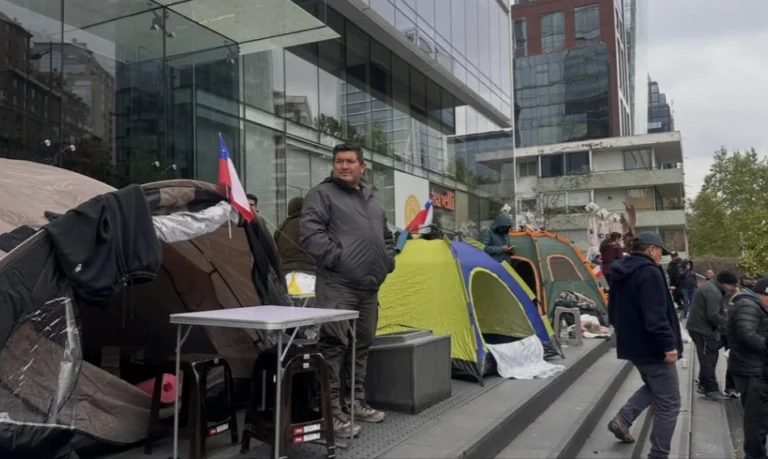
Centinela mine strike intensifies as 709 Chilean workers demand equal pay and launch a hunger strike against Antofagasta Plc.
Related: Chilean University Rectors Reject Education Cuts in 2027 Budget Bill
Centinela Mine Strike: 5 Key Changes After Mariaca’s Arrest
Centinela mine strike has intensified in Chile as workers at the Centinela copper mine escalated their protests and launched a hunger strike to pressure Antofagasta Plc into negotiations. The action comes amid rising labor tensions in the country’s mining sector, where copper prices have reached record highs.
The strike, which began on October 7, involves 709 workers, or about 22 percent of the mine’s direct workforce. Two unions, Minera Esperanza and Distrito Centinela, rejected the company’s contract offer and decided to strike after government-mediated talks failed to produce a deal.[reuters]
The Centinela mine strike is one of the most significant labor disputes in Chile’s mining sector in recent years. It reflects broader discontent among workers who say they are not receiving a fair share of the extraordinary profits generated by high copper prices.
During a demonstration in front of Antofagasta’s corporate offices in Santiago, the president of Chile’s main labor federation, José Manuel Díaz, called on the Luksic family to open a respectful dialogue. He urged the company to address the concerns of workers and negotiate in good faith.
The Centinela mine strike has drawn attention because of its unusual tactics. Hunger strikes are rare in Chilean mining disputes, though they have occurred before at mines operated by Codelco in 2020 and BHP in 2015.
The unions say the hunger strike is intended to draw attention to their demand for equal treatment and to pressure the company to resume negotiations. They argue that the company has refused to discuss equalizing benefits for workers regardless of union affiliation.[reuters]
Centinela Mine Strike and the Pay Gap
Antofagasta Plc official site | Reuters coverage of Centinela strike | Chilean Ministry of Labor
The core issue in the Centinela mine strike is the demand to end wage and benefit gaps between employees performing the same functions under different collective contracts. The unions argue that workers doing identical jobs should receive equal pay and benefits, regardless of which union they belong to.
Antofagasta has rejected accusations of discrimination. The company says the differences are the result of past negotiations and has offered a 2 percent wage increase and a $23,000 bonus to resolve the dispute.
The Centinela mine strike has exposed a deeper issue in Chile’s mining sector: the tension between workers seeking a greater share of profits and companies trying to control costs. With copper prices near record highs, workers argue that they deserve a larger share of the gains.
The company maintains that its offer is competitive and that it is willing to continue talks. However, the unions say the proposal does not go far enough and have rejected it.
The Centinela mine strike is also significant because of its potential impact on production. The unions warn that the effects will worsen over time and could lead to a 50 percent drop in copper production by November 2026.
The company, however, has refused to comment on the hunger strike and has maintained its official production forecasts. It says that despite the strike, projected output remains unchanged.
Centinela Mine Strike and the Broader Mining Tension
BHP Escondida mediation update | Chilean Copper Commission | International Labour Organization
The Centinela mine strike is not happening in isolation. At the same time, supervisors at BHP’s Escondida mine have entered a mandatory mediation process to avoid a strike scheduled to begin on Tuesday.
The Escondida dispute reflects a similar pattern of labor unrest in Chile’s mining sector. Supervisors rejected the company’s contract offer and are demanding better conditions and a greater share of the sector’s extraordinary profits.
The Centinela mine strike and the Escondida mediation are part of a broader wave of labor activism in Chile’s mining industry. Workers across the sector are pushing for better wages, benefits, and working conditions in light of high copper prices.
The strikes are also putting pressure on Chile’s economy. Copper is a major export for the country, and any disruption in production could affect national revenues and global supply.
The Centinela mine strike is therefore not just a local labor dispute. It is part of a wider struggle over how the benefits of high copper prices are distributed between workers and companies.
Geopolitical Context
The Centinela mine strike has implications beyond Chile’s borders because it reflects a broader trend in Latin America where workers are seeking a greater share of the profits generated by high commodity prices. The strike also highlights the tension between labor rights and corporate interests in the mining sector.
For Chile, the strike is a test of whether the state can balance the need for economic stability with the protection of workers’ rights. For the region, it is another example of how commodity booms can create social and political tensions.
At the global level, the Centinela mine strike adds to the debate over how mining companies should respond to high prices without undermining labor rights. It also highlights the role of unions in shaping the distribution of wealth in the mining sector.
The strike is likely to influence how other countries in the region approach similar challenges. It may also affect how international organizations and foreign governments engage with Chile on labor and mining issues.
What Comes Next
The immediate next step is for Antofagasta to respond to the hunger strike and resume negotiations with the unions. That decision will determine how the conflict unfolds in the coming days.
The Centinela mine strike is expected to remain a central issue in Chile’s mining sector. Its outcome will be closely watched by both workers and companies across the region.
For now, the strike represents a major challenge to the status quo. Whether it leads to a fair resolution or deepens the conflict will depend on how the company and the unions engage in the coming days.
From teleSUR English via This RSS Feed.