

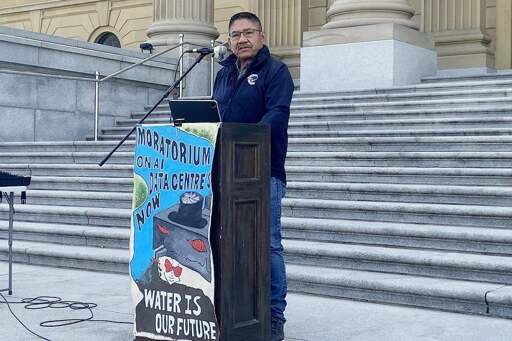

Chief Sheldon Sunshine of Sturgeon Lake Cree Nation speaks at an Oct. 3 rally against data centres outside the ‘Alberta’ legislature building in amiskwacîwâskahikan (Edmonton). Photo by Jeremy Appel
This story was originally published in Alberta Native News on Oct. 6, and appears here with permission and style edits, with added context from the author’s earlier article from May 14.
More than 100 people gathered outside the Legislative Assembly building in amiskwacîwâskahikan (Edmonton) on Oct. 3 to protest the provincial and federal governments’ permissive approach towards building artificial intelligence data centres.
Elder Taz Bouchier opened the rally with a land acknowledgement before tying the proposed 7.5-gigawatt Wonder Valley data centre near Grande Prairie’s potential water usage to the oil industry’s plans to release treated tailings fluids into the Athabasca watershed.
“When did people lose sight of how valuable water is to living? When money came into play. That’s all these data centers are about,” said Bouchier.
Sturgeon Lake Cree Nation is challenging the province’s decision to award a water license of 24-million cubic metres to the Municipal District of Greenview for Wonder Valley without consulting the Treaty 8 First Nation, which relies on the Smoky River for its water.
At the protest, Chief Sheldon Sunshine outlined a series of “very basic questions” he has for data centre proponents, including whether existing rules are sufficient “for the size and scale of what is being proposed” and whether there are sufficient water protections.

READ MORE: AI data centers are booming. Indigenous People want help protecting their lands and knowledge
“What happens to our communities when these projects operate for decades?” Sunshine asked. “What happens to the land? What happens to the water? What happens to the wildlife? What happens to the air quality? What happens when multiple projects are operating in the same region? And perhaps most importantly, where is the assessment of the cumulative impacts?
“We can’t look at every project at one time and pretend the others don’t exist. We have to look at the whole picture.”
As first reported by online news outlet Canada’s National Observer, Environment Alberta has exempted Wonder Valley from an environmental assessment.
“Why are governments creating pathways to accelerate these developments before the public has confidence that the rules are strong enough? Why is the push happening so fast? What concessions are being made to attract these projects? Who negotiated those concessions?” asked Chief Sunshine.
“Those are reasonable questions. Asking them does not make us anti-development. It makes us responsible.”
He emphasized that he understands the government’s “economic strategy behind these projects,” in terms of attempting to create a new market for the province’s substantial natural gas resources.
“But economic development cannot come at any cost,” said Sunshine. “You cannot build a new economy by putting the foundation of that economy on water that communities depend on, land that cannot be replaced, or an electrical system that people already rely on.
“You cannot call something responsible development simply because it creates jobs. Responsible development means understanding the consequences before you build.”
Edmonton-Strathcona NDP MP Heather McPherson opened her remarks by “acknowledging that Indigenous people in this country are on the front lines of this fight, and on the front lines of so many fights that we are being asked to fight as citizens right now,” referring to First Nations’ opposition to the province’s separatist movement.
“We all owe Indigenous people in this province a debt of gratitude,” she added, “for being on the front line, protecting our sovereignty, protecting our climate, protecting our water and our land.”

READ MORE: After court win, First Nations denounce ‘Alberta’ premier’s separation referendum plan
McPherson called it greatly “frustrating” that data centres are being fast-tracked while crucial community needs are being unmet.
“We can’t build the homes that people need in this community, but we can build a data centre,” she said. “We can’t build clean water facilities for people in this country, but we can build a data center.
“The priority here for this government is to make billionaires wealthy at the expense of every single one of us here.”
McPherson stressed that the consequences of AI are not just environmental, referring explicitly to its use to reduce jobs and as a weapon of war.
“We’re being told it’s going to make our life better,” she said. “You tell that to the tens of thousands of public servants who are losing their jobs because [Prime Minister] Mark Carney thinks AI can do that job for them.
“You tell that to the Iranian schoolchildren who were bombed because AI made a mistake.”
None of the opponents of AI data centres are “against technology” or construction jobs, added McPherson.
“We’re against getting ripped off,” she said.
“We’re against our rights being subservient to the wealthy and the corporate people that are getting all [the benefits].”
‘Data is the new bison’

A panel on ‘AI and Indigenous Economic Reconciliation: Powering Communities in the Digital Economy’ discusses the promises and perils of Indigenous involvement in AI, at the Forward Summit in otôskwanihk (Calgary) on May 13. From left, Erin Creegan-Dougherty, Mick Elliott, Jason Carter and moderator Jorge Aviles. Photo by Jeremy Appel
The data centre issue is of growing concern for Indigenous people in the province.
A panel at the Forward Summit in otôskwanihk (Calgary) in May discussed the promises and perils of Indigenous involvement in AI.
Panelists contrasted the environmental and data security perils of the widespread adoption of artificial intelligence with the promises of Indigenous participation in the booming industry.
The roundtable — entitled “AI and Indigenous Economic Reconciliation” — featured Métis entrepreneur and consultant Erin Creegan-Dougherty, AI entrepreneur Jason Carter of Onion Lake Cree Nation in Treaty 6, and Mick Elliott of Okanese First Nation in Treaty 4, the first Indigenous business PhD student at the University of Calgary.
The annual summit brings together Indigenous leaders, industry, government and entrepreneurs to facilitate partnerships that advance reconciliation.
Creegan-Dougherty noted that the outputs users receive from AI large language models, such as ChatGPT and Claude, are “directly correlated to the inputs” that algorithms are trained on.
“In Canada and the U.S., we’re often training it on what a lot of Western norms deem as the correct input for what they want as a business model, so they’re very much trained for one way of thinking,” she said.
“If you see there’s more diverse perspectives training a model, the answers are incredibly different.”
Carter criticized Big Tech’s “colonial harvesting” of user data from the everyday products they use to feed AI algorithms, which are then sold back to users in the form of subscriptions for AI products.
He said this underscores a need to “Indigenize” AI.
“Data is the new bison,” said Carter, referencing how the near-extinction of Turtle Island’s bison population preceded the loss of Indigenous lands and culture.
“However, we have this new economy. It’s called ‘data,’ and we need to embrace that power … and use it for good the way our ancestors taught us.”

READ MORE: AI is a double-edged sword for Indigenous stewardship, say UN experts
Elliott, a former lobbyist for Imperial Oil, noted that Big Tech companies are actively lobbying against privacy safeguards that would limit their ability to collect data to feed their algorithms.
“There’s a lot of money to be made from data,” he said, “so implementing data privacy means that these corporations aren’t going to make as much.”
Elliott added that it’s in Indigenous people’s interest to advocate for restrictions on data collection of the sort that exist in Europe.
“We need to demand legislation moving forward, because this transactional, capitalist way of doing business is disadvantaging us as an entire population, Indigenous and non-Indigenous, and protections must come in place,” he said.
Creegan-Dougherty said the problem isn’t AI’s mass collection of data itself, which could serve as a “leveller” for smaller businesses for whom collecting large volumes of data on potential customers was previously cost prohibitive.
“If that data was able to be collected and it is not being used for extortion profit from lobbyists, then it would all be good. Unfortunately, that’s not the world we live in,” she said.
For Carter, “Indigenous people hold the key” to a less predatory form of AI that isn’t dominated by ‘U.S.’-based Big Tech interests.
He cited Telus’s recently announced plans to build “sovereign” AI data centres in Vancouver as an opportunity for Indigenous entrepreneurs to help shape its algorithms with traditional Indigenous knowledge and Indigenous scholarship.
“We need to have that kind of program training in our AI models for business for the future, so we’re not going to rely on dirty data from Google or all these large language models,” said Carter.
He likened AI to a “superpower,” which can either be used “for good, or we’re going to use it for bad.”
Carter acknowledged the risks of AI data centres’ water and energy intensiveness.
“We’re going to leave our next seven generations with a water crisis, and their cell phone bills are going to probably triple. Your power bill is going to double, and the gas is going to keep going up,” he said.
“We need to use the superpower to actually create more business and to create solutions so our children don’t have to go hungry.”
Elliott cautioned against the risks of “mimicking capitalist ways of being,” with companies taking advantage of poverty in First Nations communities to build data centres that are being rejected in non-Indigenous communities for their environmental impacts.
Creegan-Dougherty suggested incorporating local Indigenous leaders in building and operating data centres to mitigate their environmental harms.
“Maybe we can have a data center that puts out a little bit less output, but is sustainable and doesn’t destroy the land,” she said.
Carter, the CEO of Star Nations Space Company, posed a novel solution to this problem.
“Data centres should be in space, not on land,” he said, urging attendees to look up “orbital data centres.”
Proponents, which include Google and SpaceX, as well as smaller companies such as Carter’s, argue that these solar-powered satellites are a way around the scarcity of land and energy on Earth that is driving local opposition to data centres.
Because space is naturally cold, the satellites wouldn’t need massive amounts of water for cooling as they do on Earth.
“Water is for life, not machines,” said Carter. “We have to remember that all of this is great, but it’s at a huge cost.”
The post Indigenous rights at forefront of anti-AI data centre rally in ‘Edmonton’ appeared first on Indiginews.
From Indiginews via This RSS Feed.