


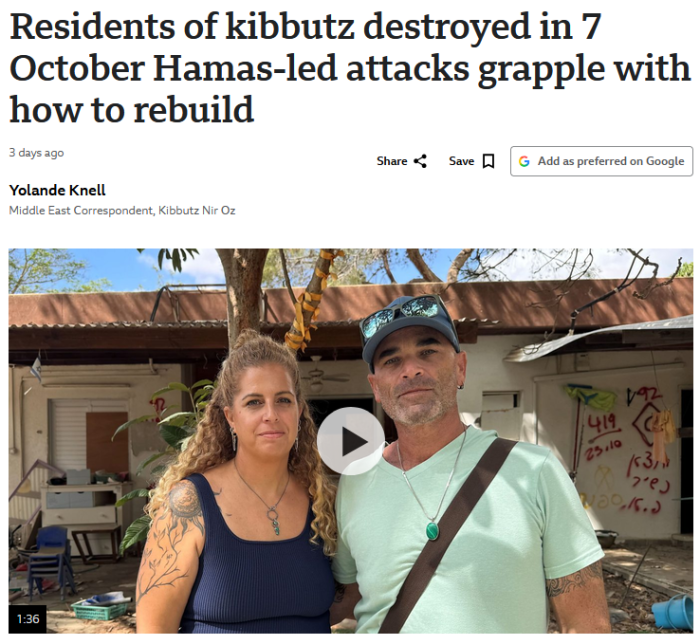
Since October 7, 2023, 1.2 million Gazans—almost 60% of the population—have lost their homes, according to the UN (4/20/26). The BBC (10/7/26) focused on the rebuilding of a kibbutz in Israel.
October 7 marked three years since the Hamas attacks on Israel that left some 1,200 people dead and 251 taken hostage. It also marks three years since Israel launched its genocide of Palestinians in the Gaza Strip with material and moral support from the United States, with an official death toll surpassing 74,000—including more than 20,000 children.
The official death toll is no doubt an underestimate, given the large number of missing and disappeared persons. (When Western corporate media outlets cite this toll, they often feel compelled to qualify it—e.g., as the BBC [10/7/26] had it, the “war between Israel and Hamas has killed more than 74,200 people in Gaza, according to the Hamas-run health ministry, whose overall figures are seen as accurate by the UN”—lest, presumably, they be seen as taking Hamas’s word for it that the figure is so high.)
The killing spree continues in spite of an alleged ceasefire implemented last year, although the Jerusalem Post (10/5/26) charitably reckons that “less than 50%” of the casualties have been civilians.
The genocide was not, of course, a sudden violent outburst that came out of nowhere. Rather, it was a climax of genocidal momentum that had been building since the founding of the state of Israel in 1948, which was itself achieved via the destruction of some 530 Palestinian villages, the killing of 15,000 Palestinians, and the expulsion of three-quarters of a million more.
Now, three years later, the corporate media still can’t bring themselves to refer to the genocide of Palestinians as such—notwithstanding it being a pretty textbook case of the phenomenon. Predictably, then, the third anniversary of the commencement of mass slaughter and devastation in Gaza has been cast in corporate media as an afterthought to the anniversary of the Hamas attacks.
‘Palestinians languish in ruins’
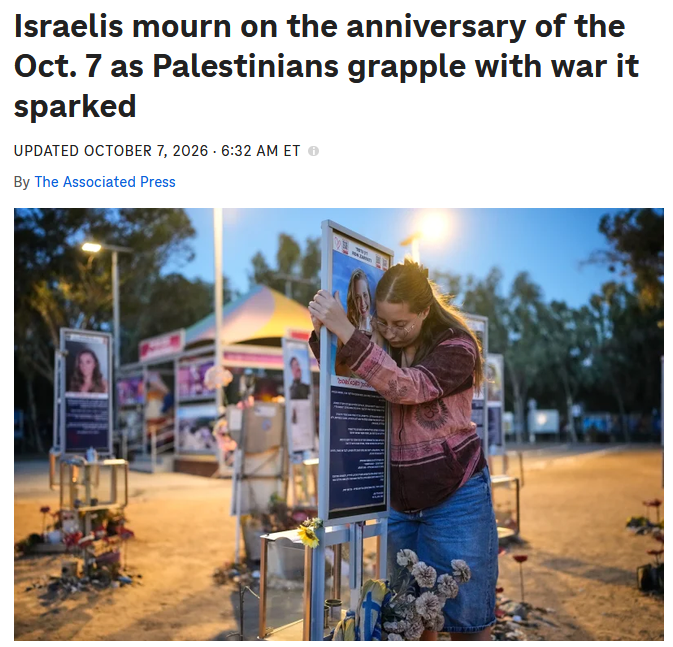
In NPR‘s framing (10/7/26), Israelis “mourn” while Palestinians “grapple with war.”
Take, for example, the Reuters piece headlined “Israelis Mark Three Years Since October 7 as Palestinians Mourn Gaza’s Destruction” (10/7/26). The very first paragraph sets up a simple cause-and-effect scenario: Israelis were the “victims of attacks that set off Israel’s assault in Gaza and plunged the Middle East into war.”
The article goes on to explain that October 7 constituted the “deadliest day in Israel’s history,” and that it “traumatized Israelis.” As for the Palestinians, whose trauma Reuters doesn’t care to speculate about, the news agency acknowledges the acute deadliness of “Israel’s subsequent bombardment and ground operations in Gaza.” But the ultimate upshot is that, while Palestinian suffering is regrettable, Hamas started it.
Similarly, a Washington Post headline (10/7/26) portrays the (unmentionable) genocide as purely reactive in nature: “Israelis Mourn October 7 Attack as Palestinians in Gaza Languish in Ruins of the War It Sparked.” The accompanying text, which is credited to the Associated Press, prioritizes Israeli victimhood, detailing across four paragraphs, for instance, the saga of 37-year-old hostage Elkana Bohbot. Upon being released from Hamas captivity, Bohbot had a second child with his wife, telling the AP that his newborn daughter Michele is “a symbol for the enemy…. This child is the message for you that we were here and we will always be here forever.”
After allowing Bohbot and other Israeli victims their say, the report does briefly quote a couple of Palestinians in Gaza—but with the understanding that they are “languishing” because of the war Hamas “sparked,” triggering Israel’s “retaliatory offensive.” Raed Khozeiq, whose neighborhood, the AP notes, was “largely flattened,” remarks that “no country in the world has gone through what we have experienced here… A war of extermination, starvation, the absence of schools and universities—nothing remains.”
NPR (10/7/26) utilized the same AP report but went with a different verb (and an error) in the headline: “Israelis Mourn on the Anniversary of the Oct. 7 as Palestinians Grapple With War It Sparked.” (Might the missing noun suggest disagreement within NPR over what to call October 7?)
‘The world changed on October 7’
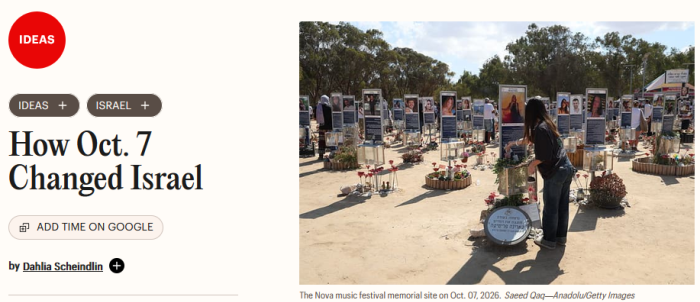
“Within Israel, political sentiments have changed surprisingly little” since October 7, 2023, Israeli analyst Dahlia Scheindlin writes in Time (10/7/26)—which calls into question the media framing that treats that date as the starting point of Israeli/Palestinian history.
It’s convenient for the genocidaires that the corporate media so willingly transmit the Israeli narrative, according to which Israel is always and forever only acting in retaliation to one Palestinian transgression or another. Over past decades of intermittent conflict, corporate media have obediently lapped up Israel’s claim that it is always responding to rocket fire, and dismissing Hamas’s similar defensive claims. (See FAIR.org, 11/5/12, 4/4/02.)
Because Israel is consistently allowed to present its own carefully curated timeline for any given conflict, we have now ended up with a “retaliatory” genocide. In a typical third-anniversary writeup, Time magazine (10/7/26) muses that “the world changed when Hamas attacked Israelis on October 7, 2023, catalyzing devastating conflict throughout the region.”
It’s a lot easier for media outlets to stand by these simplistic cause-and-effect narratives when their reporting on Israel/Palestine has for so long been scrubbed of any historical context. The average news consumer would be less likely to view the October 7 attacks in Israel as isolated and unprompted acts were these acts reported against a solid background of almost 80 continuous years of Palestinians being killed, tortured, maimed, forcibly displaced and subjected to every other form of oppression under the sun by the state of Israel.
In the 23 years before October 7, according to the Israeli human rights group B’Tselem, Israel killed 7,779 Gazans—including 1,741 children—a fact that is never allowed to interfere with the conception that Israeli/Palestinian history began on that day in 2023.
Speaking truth to or about Israel remains a red line for the corporate media, but some outlets are more fanatical than others about toeing the Israeli line. The Wall Street Journal (10/7/26), for one, ran an anniversary dispatch from Tunku Varadarajan—a fellow at the neoconservative American Enterprise Institute—detailing internal debates over reconstruction at the kibbutzim attacked on October 7 and repeatedly highlighting the savagery of the attacks. In his extended report, Varadarajan manages not one word in reference to Israel’s destruction and killing in Gaza but does find space to quote a 76-year-old Israeli woman’s comparison of October 7 to Auschwitz.
No comparable Journal op-ed was published decrying the savagery of bombing hospitals and burning children alive.
‘Not having to watch their government’
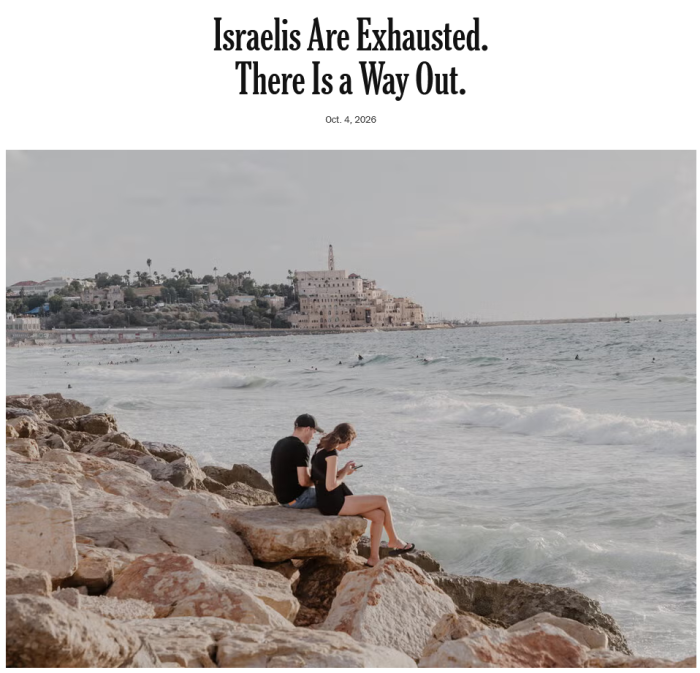
Israeli analyst Yonatan Touval asked in the New York Times (10/4/26), “Can Israelis recover the ordinary privilege of not having to watch their government all the time?”
The New York Times ran an opinion piece (10/4/26) by Israeli foreign policy analyst Yonatan Touval three days prior to the anniversary, headlined “Israelis Are Exhausted. There Is a Way Out.” Though Touval devotes one paragraph in the middle of the article to recognizing Israel’s killing and harassment of Palestinians in both Gaza and the West Bank, Israelis are still the primary victims of the “catastrophe of October 7, 2023”—the term “catastrophe” coincidentally being the English translation of the Arabic word “nakba,” which when capitalized denotes the human disaster brought on by Israel’s violent founding in 1948.
In Touval’s view, Israelis are also victims of “exhaustion” because, before even getting to enjoy their coffee in the morning, they all have to check their phones: “Has something happened in Iran? Has a reserve call-up been announced? What did the government do while you slept?”
Thankfully, there may be a “way out” in the upcoming Israeli elections on October 27, which Touval notes could help decide the political future of longtime Prime Minister Benjamin Netanyahu—on whose watch the “catastrophe” took place—and potentially answer the “more intimate question: Can Israelis recover the ordinary privilege of not having to watch their government all the time?”
Seventy-eight years after the original Nakba, Palestinians are probably pretty exhausted at being denied the ordinary privilege of not having to be genocided. And as the corporate media proceed year after year to churn out Israel’s side of the story, one does indeed wish for a “way out.”
From FAIR via This RSS Feed.