

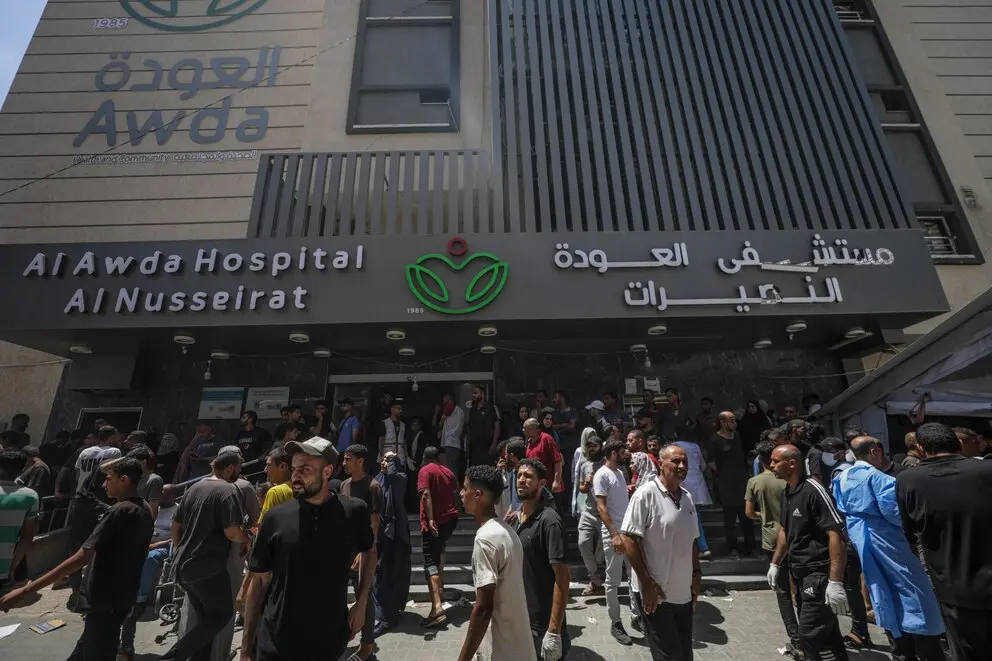
The Al-Awda health complex in central Gaza suspended most of its medical operations for a fourth consecutive day due to generator failures caused by Israel’s blockade of fuel and pharmaceutical supplies, leaving thousands of patients without access to emergency care.
The Al-Awda health and community complex, located in the Nuseirat refugee camp in the central Gaza Strip, has now spent four days with most of its medical services shut down.
The facility’s electricity generators keep failing, a direct consequence of the blockade on fuel and pharmaceutical supplies imposed by Israeli forces.
RELATED: Gaza’s Health Ministry Rejects Israeli Allegations of Military Use of Hospitals
Authorities at the medical center warned that the standstill puts the lives of thousands of patients in imminent danger, particularly those who require emergency treatment and cannot wait for the situation to stabilize. The widespread shortage of medicines, spare parts and diagnostic materials has critically hindered the operation of Gaza’s battered hospital network.
The closures extend far beyond a single building. According to a report published by the World Health Organization (W.H.O.) on September 24, only 19 of the 36 hospitals across Gaza remain in operation. Even those functioning facilities are only partially active and cannot reach their full capacity.
A video of Al-Shifa Hospital and the destruction that occurred, as well as another at Kamal Adwan Hospital, documented by the detainee by Israel, Dr. Hossam Abu Safiya. pic.twitter.com/2UwiBYlijM
— Shams 🇮🇶 (@shamsalrAwy4mo) October 8, 2026
The international agency warned that the lack of supplies has interrupted kidney dialysis sessions and left oncology patients, mothers and newborns without specialized care. These are patients whose treatment cannot be postponed without life-threatening consequences, and they now depend on hospitals that can barely keep their doors open.
Health System Near Collapse
Gaza’s Health Ministry reported that persistent violations of the ceasefire by Israeli troops have killed 1,471 Palestinians and wounded another 5,189 since October 2025, when the truce agreement came into force. Military incursions have steadily deteriorated the survival conditions of the civilian population amid what the ministry describes as the total collapse of essential public services.
The toll since the beginning of hostilities in October 2023 is far greater. Israeli army attacks have left more than 74,000 people dead and more than 175,000 injured over the past three years. Mass bombardments destroyed roughly 90 percent of the enclave’s residential, health and road infrastructure, leaving nearly every aspect of daily life compromised.
That destruction explains why a fuel shortage at one medical complex can cascade so quickly. Hospitals rely on generators because the electrical grid has been dismantled. When fuel cannot enter, lights go out, ventilators stop and operating rooms fall silent.
Gaza: An announcement of a near-complete halt of medical services inside Al-Awda Hospital in the central Gaza Strip, due to a severe shortage of generator fuel and the absence of spare parts as a result of the Israeli blockade, which threatens the ability of medical staff to care… pic.twitter.com/vWCi2ZoP2P
— Middle East Observer (@ME_Observer_) October 7, 2026
Humanitarian organizations have renewed their urgent call to end the Israeli blockade and open safe corridors allowing large-scale medical assistance to enter the enclave. International agencies insist on lifting restrictions on fuel to prevent the definitive closure of the few medical centers still providing aid in Gaza.
For patients at Al-Awda and across the territory, the difference between a functioning generator and a failed one can be measured in lives. With each passing day of the blockade, that margin narrows further.
From teleSUR English via This RSS Feed.