

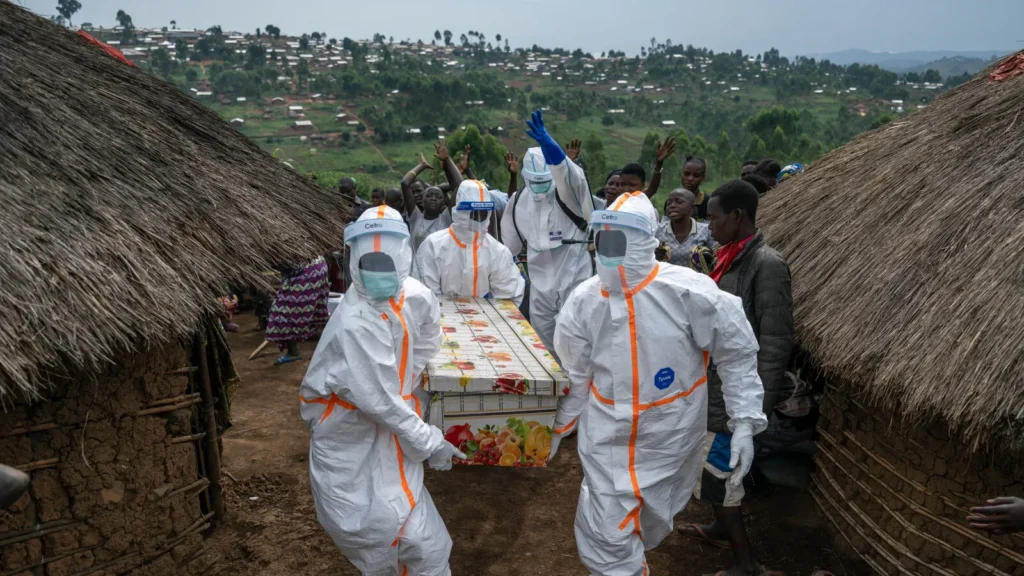
The Ebola epidemic that has struck the Democratic Republic of the Congo (DRC) since May has caused 8,728 confirmed cases and 4,205 deaths, according to the latest report from the World Health Organization, which puts the case fatality rate at 48.2 percent.
Geographically, the outbreak keeps expanding. In recent weeks it reached the health zone of Alimbongo in North Kivu province, extending its reach to 64 health zones spread across seven provinces in the eastern part of the country. Ituri province remains among the areas hardest hit by the emergency.
W.H.O. said transmission intensity remains high nationwide, although the epidemiological impact is unevenly distributed. In some areas there are clear signs that chains of transmission are slowing, while in others the spread continues to intensify strongly.
RELATED: Kenya Confirms First Ebola Case After Patient Dies In Nairobi
The agency voiced deep concern over the high mortality rate and the large number of deaths occurring outside hospitals. Both figures point to serious delays in detecting the virus early and in giving patients timely access to proper medical care. People who die outside health facilities, in particular, signal that infections are going unrecognized until it is too late to intervene.
Dans les Centres de Traitement Ebola, la lutte ne s’arrête jamais. Jour et nuit, les professionnels de santé se relaient au chevet des patients pour une prise en charge appropriée.
Chaque shift s’inscrit dans une même chaîne de soins. À chaque relève, l’équipe qui prend le… pic.twitter.com/Blix9X8K8G
— Ministère de la Santé RDC (@MinSanteRDC) October 9, 2026
The outbreak formally was declared on May 15, at the same time in the DRC and neighboring Uganda. Ugandan authorities declared their own emergency over on July 28, a decision that W.H.O. ratified on August 25, leaving the DRC as the main front of the epidemic in the region.
Fastest Spread on Record
The threat of the virus crossing national borders flared again on October 6, when Kenyan health authorities confirmed the country’s first Ebola case. The patient, a Kenyan citizen with a recent travel history to the DRC, died after being admitted to a hospital. The imported case marked the outbreak’s first confirmed infection beyond the two nations where it erupted in May, reviving fears that the virus could spill into neighboring states.
Doctors Without Borders (MSF) warned that the outbreak in North Kivu province is “out of control” and that healthcare capacity in the area is stretched to the limit. The humanitarian group has sounded the alarm repeatedly as hospitals and treatment centers struggle to absorb the flow of patients.
Kenya’s first #Ebola death has triggered a race to trace everyone the victim came into contact with. @WHO Representative in the country explains why the coming days will be decisive in preventing community spread. pic.twitter.com/6TYVOlskrg
— United Nations Geneva (@UNGeneva) October 8, 2026
The current outbreak is caused by the Bundibugyo strain, known for spreading quickly. W.H.O. cautioned that this event shows the fastest transmission rate ever documented and could surpass the West Africa outbreak of 2014 to 2016 in both scale and mortality. That earlier epidemic left more than 11,000 people dead.
From teleSUR English via This RSS Feed.