

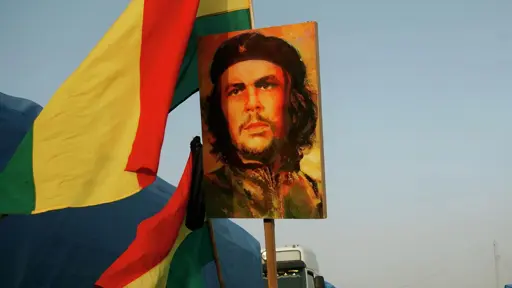
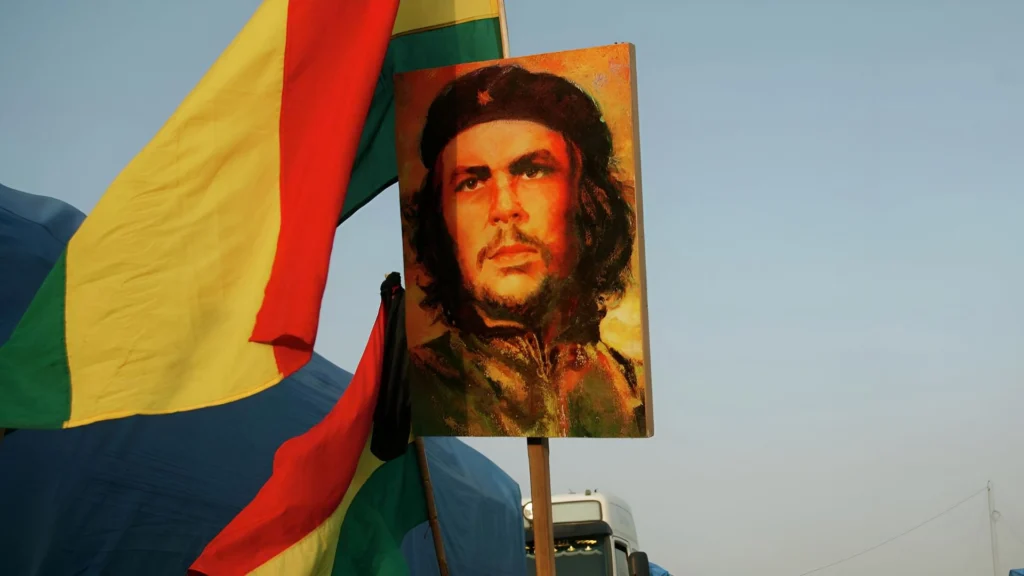
The Andean country as the operational pivot for Guevara’s internationalist revolution.
Between 1966 and October 1967, Ernesto “Che” Guevara led his final revolutionary campaign in southeastern Bolivia. Operating under the name of the National Liberation Army of Bolivia (Ejército de Liberación Nacional de Bolivia, ELN), this guerrilla movement aimed to create an armed insurgent nucleus in South America.
RELATED:
Che Guevara, 58 Years of Fire: An Immortal Symbol of Anti-Imperialism
Guevara’s campaign had a broader internationalist vision, outlined in his 1967 Message to the Tricontinental, where he called “How close we could look into a bright future should two, three or many Vietnams flourish throughout the world” to counter global imperialist power.
Guevara viewed Bolivia not merely as a site for a national revolution, but as a central strategic base. Located in the heart of South America, Bolivia shares borders with five countries: Argentina, Peru, Brazil, Paraguay, and Chile.
From this central position, a Mobile Guerrilla Column (Foco) could expand into neighboring regions, specifically targeting the Southern Cone. This strategy relied on the focus theory, which held that a small group of committed armed fighters operating in rural areas could create the subjective conditions necessary for a wider revolution.
Nearly sixty years after Che Guevara launched his final campaign in Bolivia, his assassination remains a defining moment in the history of revolutionary internationalism. This in-depth article examines the campaign in Bolivia and the Che legacy.
Today marks the 59th anniversary of the death of Ernesto ‘Che’ Guevara.
On 8 October 1967, Che was captured in the jungles of Bolivia leading guerrillas in a struggle to free the country from imperialist exploitation.
He was executed on the orders of the CIA the next day. pic.twitter.com/OsOSvS24PQ
— Cuba Solidarity Campaign (@CubaSolidarity) October 9, 2026
Political Context of Bolivia and Che’s Arrival
Bolivia’s 1966 political situation was defined by military rule and socio-economic conflict. General René Barrientos had seized power in November 1964 after overthrowing President Víctor Paz Estenssoro.
Barrientos regime enforced strict control over labor unions, particularly the tin mining sector, which formed the organized core of the Bolivian working class.
Tensions escalated into state violence, such as the San Juan Massacre on June 24, 1967, when Barrientos troops raided the Siglo XX and Catavi mining camps, resulting in dozens of deaths among workers and their families.
Guevara entered Bolivia covertly on November 3, 1966. He traveled using a Uruguayan passport issued under the false identity of Adolfo Mena González, a businessman working for the Organization of American States.
After landing at El Alto airport, Guevara moved south toward the Ñancahuazú. In Ñancahuazú, the guerrilla group bought a remote farm to serve as its primary base camp.
Early logistical efforts at the camp focused on building underground supply caches, establishing communications infrastructure, and organizing training routines for both Cuban veterans and local volunteers.
The Bolivian Communist Party vs. The Revolutionary Base
A factor that shaped the campaign was the political divide between Che Guevara and the leadership of the Bolivian Communist Party (Partido Comunista de Bolivia, PCB). On December 31, 1966, Guevara met with Mario Monje (Secretary-General of the PCB) at the Ñancahuazú base camp.
Monje insisted on three conditions for party participation: his overall political and military command of the guerrilla movement on Bolivian territory; prioritizing party urban networks over rural operations; and support must align with the Soviet line of peaceful coexistence.
Guevara rejected these demands, arguing that political authority in an armed struggle must reside in the field with the guerrilla leadership rather than an urban committee.
However, individual cadres and radicalized sectors joined the effort. Key Bolivian figures included brothers Inti and Coco Peredo, who took on prominent operational roles within the column, alongside union activists, student members of the Communist Youth, and radicalized miners.
The force also included veteran Cuban revolutionaries, such as Juan Vitalio Acuña Núñez (“Joaquín”) and Haydée Tamara Bunke Bider (“Tania”), along with Peruvian fighters.
The ELN also struggled to secure support among the local peasantry. The rural population in the Ñancahuazú region was sparse, culturally distinct, and spoke local indigenous languages such as Quechua and Guaraní.
Furthermore, the 1952 Bolivian agrarian reforms granted land titles to many peasant communities, reducing immediate rural unrest in that specific region.
🇨🇺 8 October | Day of the Heroic Guerrilla
59 years after his capture in Bolivia, Cuba honours Che Guevara: revolutionary, internationalist and uncompromising opponent of imperialism.
His ideals of liberation, sovereignty and solidarity live on.
¡Hasta la Victoria Siempre! pic.twitter.com/3ufyWcbUGP
— Cuba in the UK (@EmbaCuba_UK) October 8, 2026
Military Course of the Campaign and the Onset of Combat
National Liberation Army of Bolivia engagements began on March 23, 1967, when a Bolivian Army patrol stumbled into an ELN ambush in the Ñancahuazú River canyon.
The ELN captured weapons and equipment without suffering casualties. Subsequent engagements at Ipirapitá and El Peñón further demonstrated the tactical effectiveness of the core group against standard military infantry.
In April 1967, Guevara separated his main column from a rearguard unit led by Joaquín to transport sick fighters and establish contact with urban supply networks.
Due to dense terrain and broken communications, the two units were never able to reunite. Joaquín’s column was eventually ambushed and annihilated by government forces on August 31, 1967, at Vinto del Sur while crossing the Río Grande, leaving the remaining fighters isolated.
As the campaign progressed, international involvement increased. The United States government provided military assistance and intelligence support to the Bolivian armed forces. A team of US Army Special Forces (Green Berets) arrived in Bolivia to train the 2nd Ranger Battalion, a specialized counterinsurgency unit.
CIA officers, including Felix Rodríguez, were deployed to assist Bolivian military intelligence with tracking, radio communications, and interrogation operations.
#PeoplesHistory | Today, we remember the legendary revolutionary Ernesto Che Guevara. Here is a speech by him reminding us of the atrocities of imperialism, the same imperialism that killed him in La Higuera, Bolivia, in 1967.#CheGuevara #Che pic.twitter.com/7PoT11UHJn
— BT Long Reads (@BTlongreads) October 9, 2022
The Battle of Yuro Ravine, Capture, and State Execution
By October 1967, the remaining ELN force was reduced to 17 fighters, encumbered by illness, lack of water, and encirclement by hundreds of Bolivian army troops. On October 8, 1967, local informant reports led government forces to surround the guerrilla unit at the Yuro Ravine (Quebrada del Yuro).
During the ensuing firefight, Guevara was wounded in the leg, his barrel was damaged by gunfire, and his pistol magazine was destroyed. He was captured along with fellow combatant Simeon “Willy” Cuba Sanabria.
The captured fighters were taken to the nearby village of La Higuera and held in the local one-room adobe schoolhouse. Intelligence officers and Bolivian commanders interrogated Guevara overnight.
On the morning of October 9, 1967, President René Barrientos issued the order for extrajudicial execution. To make the death appear as if it occurred during combat, Sergeant Mario Terán was instructed to shoot Guevara below the neck. Terán executed Guevara using a burst from a semi-automatic rifle.
Following the execution, Guevara’s body was strapped to a helicopter and flown to Vallegrande. The body was displayed to journalists and residents inside the laundry room of the Our Lady of Malta Hospital.
To prevent the creation of a physical burial site or pilgrimage monument, military authorities severed Guevara’s hands for fingerprint verification, secretly buried his remains alongside those of six other fighters beneath the Vallegrande airport runway, and kept the location classified.
Political Legacy of Che in Bolivia and Beyond
Guevara’s final campaign is important for anti-imperialist political movements across Latin America. Guevara’s campaign diary, recovered after his death and published internationally as The Bolivia Diary, sheds light on the operational realities and ideological motivations of armed movements during the Cold War.
Guevara’s emphasis on internationalism influenced subsequent political organizations throughout the region.
Thirty years after his execution, in July 1997, a joint team of Cuban and Argentine forensic anthropologists located and exhumed the remains of Guevara and his fellow combatants beneath the airstrip at Vallegrande.
The remains were returned to Cuba, where they were interred in a dedicated mausoleum in Santa Clara, the site of his major military victory during the Cuban Revolution in 1958.
Today, the Ñancahuazú campaign remains a focal point for historical analysis regarding Latin American revolutionary movements and counterinsurgency strategies during the second half of the twentieth century.
Sources: Granma – Juventud Rebelde – Cuba Debate – Cubavisión – CiberCuba – EcuRed – TRT World – Xinhua – CGTN – Brasil de Fato – Resumen Latinoamericano – Página 12 – Radio del Sur – Con El Mazo Dando – Barricada TV
From teleSUR English via This RSS Feed.