

On September 11, 2001, 2,977 people were killed by airplane hijackers affiliated with Al Qaeda, who were mostly Saudi Arabian citizens. The post-9/11 wars waged by the Bush administration directly killed (conservatively) nearly a million people in Afghanistan, Iraq and elsewhere, though indirect deaths likely exceeded 4 million. Stateside, blatant Islamophobia increased—there were 481 anti-Islamic hate crimes reported to the FBI in 2001, vs. 28 in 2000—as US citizens were propagandized to associate everyday Muslims with terrorism (FAIR.org, 10/1/08; ACLU, 2/22/13).
And yet in remembering 9/11 on its 25th anniversary, US corporate media opinion sections overwhelmingly focused on the victims who died on 9/11, while largely ignoring the post-9/11 victims who outnumbered them by more than 300 to 1.
FAIR found 50 editorials and columns about the 25th anniversary of 9/11 published between September 1 and September 11 in the New York Times, Wall Street Journal, Washington Post and USA Today. None of those outlets published a standalone opinion piece that remembered those killed or injured in the Forever Wars, or who experienced Islamophobic discrimination or attacks.
Only seven explicitly mentioned the people killed in the post-9/11 wars. Three of these were brief mentions (New York Times, 9/10/26; Wall Street Journal, 9/10/26; USA Today, 9/11/26). Three others degraded their significance (Wall Street Journal, 9/7/26; New York Times, 9/10/26; Washington Post, 9/10/26).
The seventh came from the New York Times editorial board (9/11/26), under the headline “How the Heroic Response went Awry.” The Times twice mentioned the number of civilians who were killed in the wars and referenced the US’s torturing of imprisoned people at Guantánamo Bay and detaining them without charge, as well as the increased surveillance of US citizens, especially Muslims. However, these were framed as “mistakes,” rather than “conscious policy choices with grave consequences for millions of Arab and Muslim people,” as FAIR contributor Gregory Shupak noted (FAIR.org, 10/1/26).
Meanwhile, only eight referenced or alluded to the discrimination Muslims in the US have faced since 9/11—three from the Times and Journal, two from USA Today, and none from the Washington Post. (Three of these articles were also counted among the articles that mentioned victims of US wars.)
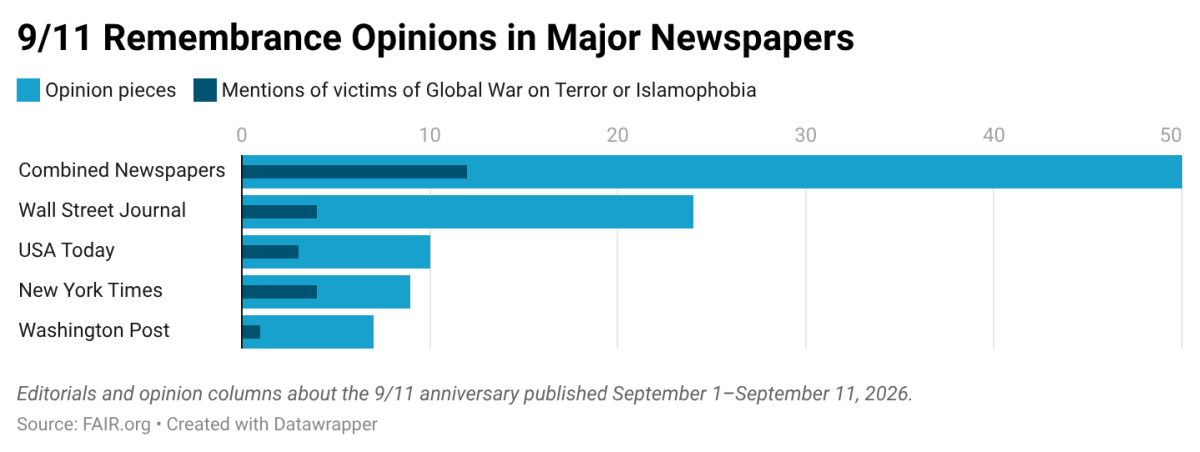
In 9/11 commentary in four major newpapers, 38 out of 50 articles didn’t mention either the victims of the post-9/11 wars or the rise in Islamophobia.
Ignoring Islamophobia
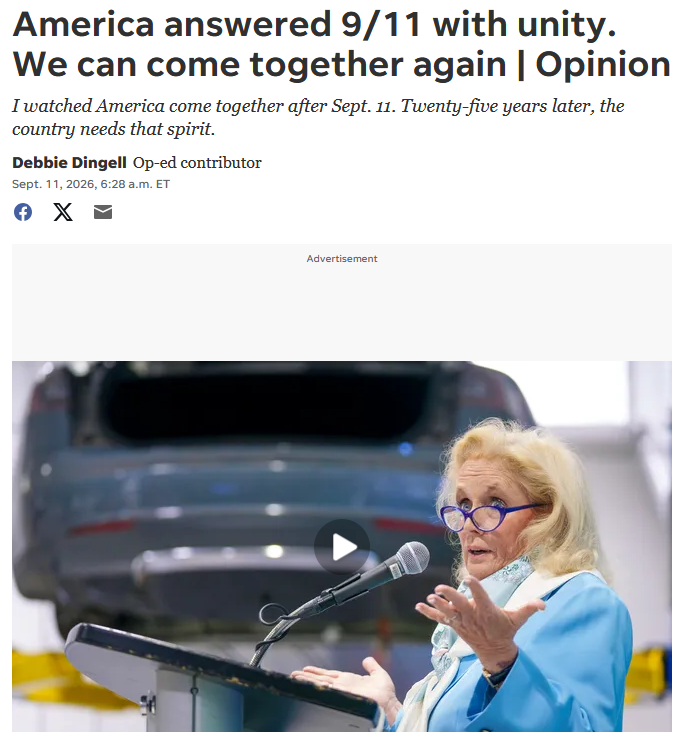
Rep. Debbie Dingell’s piece in USA Today (9/11/26) was one of two articles (of 50 in the sample) that explicitly mentioned “Islamophobia.”
Of the eight references to Islamophobia, seven were buried in the articles and/or limited to brief explanations, and some downplayed its existence.
There were two explicit references to Islamophobia in the sample, both in USA Today. Michigan Democratic Rep. Debbie Dingell (9/11/26) wrote that the memory of 9/11 “asks us to stand up against antisemitism, racism and Islamophobia whenever and wherever they appear.” USA Today’s progressive columnist Sara Pequeño (9/11/26) wrote that she found herself “stuck grappling with how the United States responded—the forever wars, the Islamophobia, the paranoia.”
Others briefly noted the targeted discrimination Muslims faced post-9/11. The New York Times editorial board (9/11/26) acknowledged that the “most intrusive civil liberties encroachments” after 9/11 “were reserved for Muslims”—though this was framed as a “mistake.”
An article in the Times by investigative journalist Radley Balko (9/10/26) mentioned reports that found that FBI assessments “disproportionately targeted Muslims.”
The Wall Street Journal twice noted the existence of post-9/11 bigotry against Muslims, but downplayed its extent and the role of the Bush administration in fomenting it. The Journal’s editorial board (9/10/26) wrote that
Americans also deserve credit for their failure to blame Muslims or Arabs en masse. There were as always individual acts of bigotry, though our guess is fewer than today’s increasing antisemitism. President George W. Bush went out of his way to reject claims of collective guilt by religious or ethnic association.
The Journal’s William Galston (9/8/26) offered slightly more acknowledgment of Islamophobia, but similarly tried to wash the bloody hands of Bush. Galston wrote that “despite the best efforts of then-President George W. Bush, our response to 9/11 helped create mistrust of Muslim immigrants and of Islam itself.”
The Journal and Galston ignored how Bush’s PATRIOT Act disproportionately targeted Muslim Americans through practices like FBI infiltration of mosques (NPR, 11/8/21) and coercion of Muslims into being informants (Intercept, 3/16/15).
Whose voices?
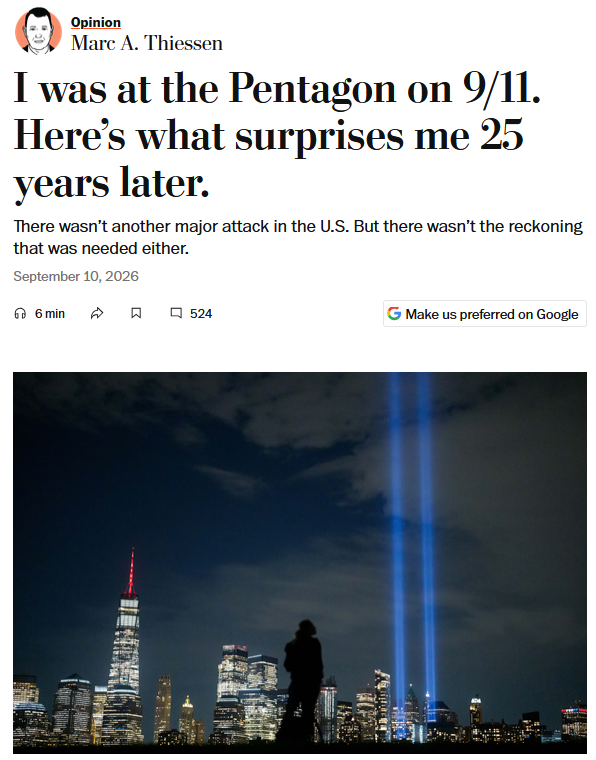
Washington Post columnist Marc Thiessen (9/10/26) can’t believe that a Senate candidate would compare the thousands of civilians killed by Al Qaeda to the hundreds of thousands of civilians killed in the subsequent US wars.
Why were the victims of the 9/11 wars and Islamophobia largely ignored? At least in part, this framing can be explained by whose voices were published during the study period.
Of the 46 bylined opinion columns, 14 were written by someone who at their launch had championed the wars, while only three had publicly opposed them at the time. The critics were journalist Peter Bergen (New York Times, 9/8/26) and columnist William Galston (Wall Street Journal, 9/8/26), both of whom referenced the discrimination Muslims have faced since 9/11. A third writer, investigative journalist Radley Balko (New York Times, 9/10/26), had advocated against the Iraq War at first, but switched to supporting it once Bush launched the invasion in March 2003 (Fox News, 3/26/03).
There was also a striking gender imbalance: 38 of the writers were men (81%), while nine were women. (This counts both authors of a USA Today article—9/11/26—co-written by a man and woman.)
The newspaper outlets published seven articles by opinion writers who previously worked in the George W. Bush administration. None made even passing mention to the Muslims who faced backlash after 9/11. Only one referenced the brown people their administration helped massacre in the post-9/11 wars. Even then, the Washington Post’s Marc Thiessen (9/10/26)—speechwriter for Defense Secretary Donald Rumsfeld for the launch of both wars and later for Bush—belittled the idea that the 9/11 victims and the many more post-9/11 war victims could be compared, writing:
I would never have believed it if you had told me that September morning…that Michigan voters would nominate a Democratic Senate candidate who equated the victims of 9/11 to those killed in the US military response and campaigned with Hasan Piker, a far-left activist who once declared that “America deserved 9/11.”
Another, the Journal’s Peggy Noonan, served as chief speechwriter for the first George Bush when he ran for the presidency in 1988. At least two pieces were written by US military veterans.
Bush alumni defend their wars
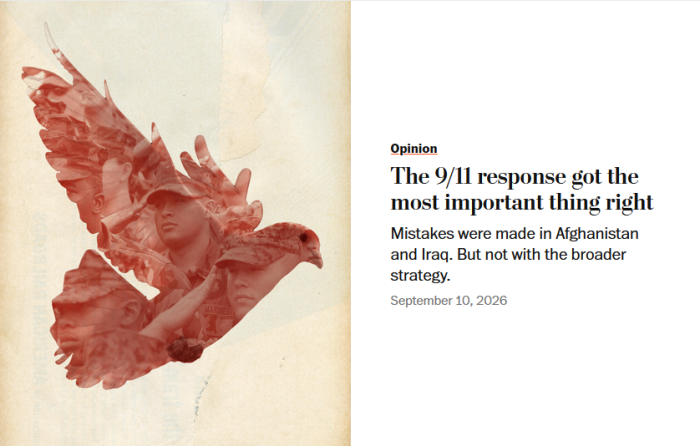
The Washington Post (9/10/26) illustrated an op-ed justifying a strategy that led to 19 years of war and 4 million deaths with an image of the dove of peace.
Unsurprisingly, the Bush alumni were prominent among the commentators who defended their administration’s wars. Aside from the column by Thiessen, the Washi****ngton Post also published op-eds by a pair of Bush officials—National Security Advisor Condoleezza Rice (9/11/26) and Undersecretary of Defense Douglas Feith (9/10/26)—who failed to mention their own roles in advancing the WMD and Saddam/Al Qaeda lies that Bush premised the Iraq War on (NPR, 2/9/07; Mother Jones, 3/20/23).
Rice wrote that the “service and sacrifice” by the “armed forces and the intelligence community” in the “war on terror kept us safe.” Feith similarly wrote that “there is much to criticize in the war on terrorism. On its main objective, however, the success has been remarkable,” citing the absence of “another 9/11-scale attack” on the US.
The Wall Street Journal published an op-ed (9/11/26) by Paul Wolfowitz, Bush’s deputy secretary of Defense from 2001 to 2005. Wolfowitz wrote that “there is still much to debate about the decisions the US made in the years that followed in what could be called the 9/11 wars.” He noted that “those questions are important,” but that 9/11 isn’t the time for them: It should be
a time to appreciate the shared dedication and sacrifice of our fellow citizens in defending this great and caring country, even when Americans disagreed about how best to achieve that goal.
The Journal also ran a piece by William McGurn (9/7/26), Bush’s chief speechwriter from 2006 to 2008. McGurn framed Bush committing additional troops in Iraq in 2007 as a “military success…winning a war the experts had decreed lost.”
The New York Times’ David French (9/10/26), who explained that he joined the US military as a JAG in 2006 “after my conscience no longer allowed me to remain at home,” wrote a piece with a remarkably rosy spin, headlined, “The War on Terror Did Not Fail.”
Missing Muslims
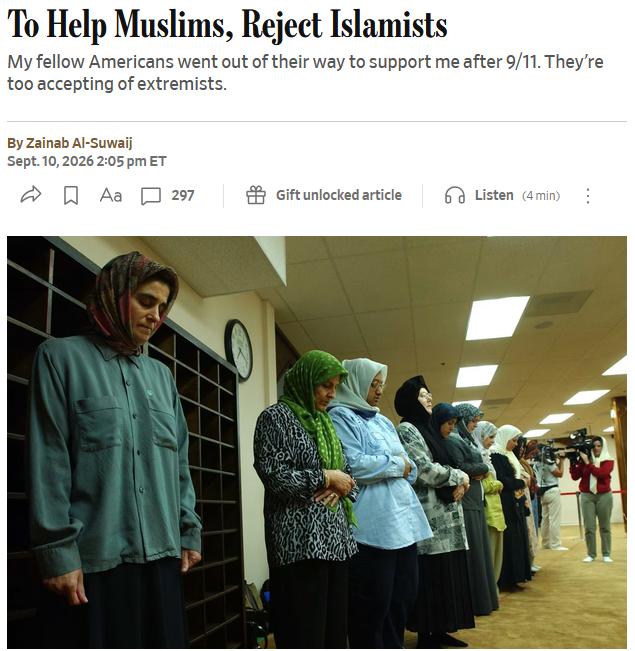
The one piece (Wall Street Journal, 9/10/26) written by a Muslim in our study warned of an “Islamist threat” that uses “civil-rights rhetoric that confuses decent Americans.”
As Maha Hilal—a Muslim Arab-American expert on institutionalized Islamophobia and the “war on terror”—wrote in Truthout (9/11/26):
Measuring the war by whether it successfully reduced “terrorism” risks accepting its stated objectives as the appropriate measure of its success. More problematic is what this framework obscures: the immense state violence carried out in the name of counterterrorism, and the Muslim lives rendered expendable in pursuit of an ever-expanding national security project.
But perspectives like Hilal’s were largely silenced by US corporate media during the sample period. FAIR only found one piece in the study period written by a person who identified as Muslim.
Even then, the lone Muslim voice was the conservative president of the American Muslim League, Zainab Al-Suwaij. Al-Suwaij publicly supported the US’s invasion of Iraq at the time (New York Times, 5/23/03) and has long warned about the danger “Islamists” pose to Muslims (New York Times, 6/25/08).
Al-Suwaij fearmongered in the Wall Street Journal (9/10/26) about the “Middle East’s radicalism” being exported to America. Although she spent the eighth paragraph speaking against Islamophobia—“we must also speak bluntly to those fellow Americans who think Islam is the problem”—Al-Suwaij concluded in the next paragraph that the “US government can’t keep kicking down the road the problem of Islamism in America.”
If the Journal found the right-wing Al-Suwaij to be worthy of inclusion, why couldn’t the outlet—and more centrist papers like the New York Times, Washington Post and USA Today—find a progressive Muslim voice to publish in its opinion pages in the lead-up to the 25th anniversary of 9/11?
To be clear, it is perfectly appropriate to publish opinions that focus on the victims of the 9/11 attacks. Indeed, some articles were heartbreaking commemorations of family members or friends killed that day (New York Times, 9/9/26; Wall Street Journal, 9/10/26; USA Today, 9/10/26, 9/11/26) or devastating first-hand accounts (Wall Street Journal, 9/4/26, 9/8/26; Washington Post, 9/6/26).
But there is no good reason that the vastly more numerous victims of the US response to 9/11 don’t get the same media attention. Ignoring them whitewashes the war crimes that came with that response, and obscures the throughline from Bush’s “war on terror” to Trump’s warmongering abroad and repression of Muslims at home.
Research assistance: Lara-Nour Walton.
From FAIR via This RSS Feed.