

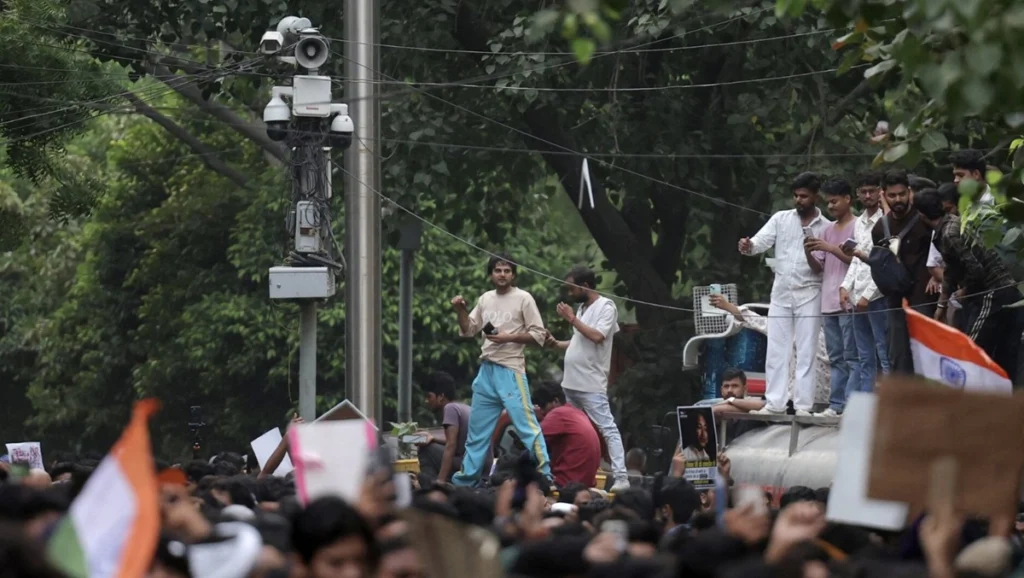
Authorities are using facial recognition, social media analysis, mobile phone data and digital tracking to identify protesters.
How do you monitor a protest organized by a generation that mobilizes through mobile phones? In India, the answer increasingly involves using the same technology: facial recognition, cameras, social media analysis and digital tracking to identify participants, reconstruct networks and anticipate demonstrations.
RELATED:
India Confirms Talks With Russia To Deepen Energy Cooperation
The youth movement Cockroach Janta Party (CJP), known as the “Cockroaches,” has called for a march in New Delhi on Saturday to demand the resignation of the head of the Election Commission.
While the group uses social media and messaging apps to organize the protest, police are retrieving data collected during the July demonstrations.
Authorities are now monitoring the movements of about 2,800 people previously identified, tracking bus companies used in earlier protests and conducting checks at hotels and other accommodations.
🇮🇳 🪳 The #Cockroach Janta Party began as a satirical youth movement just a few months ago, but has since emerged as a rallying point for disillusioned young people across #India.
So, what’s driving the growing frustration and wave of protests?
Here’s the story ⤵️ pic.twitter.com/WUWlBxDvNP
— FRANCE 24 English (@France24_en) July 24, 2026
How Does Police Identify Protesters in Real Time?
During last July’s youth protests, police deployed two surveillance vehicles, one of them called Ikshana, equipped with 360-degree cameras and an artificial intelligence-assisted facial recognition system capable of comparing captured faces in real time with police databases. The vehicle also incorporates automatic license plate recognition.
Police maintain that the tool is intended to identify people with criminal records or those wanted by the courts and that it does not indiscriminately record all protesters.
In a report submitted to the Supreme Court, police said the system identified 2,873 people with criminal records during those demonstrations. The reliability of those results was called into question, however, after an investigation by The Indian Express reported that at least 25 people on the list were in prison when they were supposedly detected at the protest.
Police have insisted that a facial recognition match requires subsequent verification and is not, by itself, sufficient grounds for taking action against an individual.
The far-right and crushing austerity are ascendent. But youth around the world are fighting back.
Spain: Massive protests for fair housing have been ongoing since the forcible eviction of 87-year-old Maricarmen Abascal.
India: The “Cockroach” party is leading a movement to… pic.twitter.com/gqPtUZ7oja
— BreakThrough News (@BTnewsroom) October 8, 2026
What Happens to the Data After a Protest?
Following the July demonstrations, police created 20 teams to reconstruct how they had been organized, according to police sources cited in the Indian newspaper’s investigation.
Investigators analyzed facial recognition records, security camera footage, mobile phone data, social media posts and WhatsApp groups organized by universities and neighborhoods across the city. They also reviewed call records and data obtained from mobile phone antennas in protest areas.
The investigation also extended to Bitchat, a messaging app that allows phones to connect directly via Bluetooth and operate without a conventional internet connection. The app was removed from India’s App Store in early October following a request from the Ministry of Electronics and Information Technology.
Apple said the removal was in response to a government demand over content deemed illegal in India, according to documents released by the app’s founder, Jack Dorsey.
What Role Do Social Media Platforms Play?
This week, the Ministry of Electronics and Information Technology asked major platforms to identify illegal content and prioritize requests concerning false, manipulated or out-of-context posts that could affect public order.
The notice calls for particular attention to old videos presented as current, material generated using artificial intelligence, and altered posts or content that could incite violence.
It also asks companies to identify AI-generated content and respond quickly to requests from law enforcement agencies. The government maintains that the directive is a general guideline and is not aimed exclusively at the current protests.
India’s Cockroach Janta Party says its members have been arrested across India ahead of Saturday’s protest in New Delhi.
Protesters are demanding the election chief’s resignation over alleged irregularities in voter-list revisions that critics say benefited Modi’s BJP. pic.twitter.com/0GZ8ty27Z0
— Al Jazeera English (@AJEnglish) October 9, 2026
What Are the Legal Limits of This Surveillance?
The Supreme Court is currently examining whether police have sufficient legal authority to use facial recognition and biometric surveillance on participants in demonstrations.
The case also raises the question of whether these practices could violate constitutional rights such as privacy, freedom of expression and peaceful assembly.
India has developed extensive urban surveillance infrastructure in recent years. The Home Ministry’s Safe City project uses networks of cameras connected to command centers and technological tools to support police work.
For a generation that organizes protests, broadcasts arrests and spreads slogans from mobile phones, technology is an essential mobilization tool. For law enforcement agencies, those same phones, faces, images and communications generate data that can be used to reconstruct a protest and prepare a response to the next one.
teleSUR/ JF
Source: EFE
From teleSUR English via This RSS Feed.