

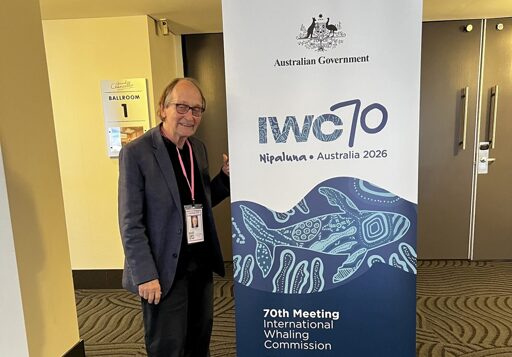
Paul Spong’s life has been entwined with whales for nearly six decades. In the 1960s, Spong, who hails from Aotearoa New Zealand, moved to the U.S. to study physiological psychology at the Brain Research Institute at the University of California, Los Angeles. Then, in 1967, he entered the world of cetaceans when the Vancouver Aquarium in Canada hired him to study the behavior of a once-wild orca (Orcinus orca) named Skana, who’d been captured from Puget Sound that same year. While conducting behavioral, visual and auditory experiments on Skana, Spong quickly noticed the orca’s high intelligence and self-awareness, and advocated for her release. But the aquarium, which didn’t renew Spong’s contract, held onto Skana until her death in 1980. After his experience with Skana, Spong decided to investigate orcas in their natural habitat. In 1970, he landed on Hanson Island, off the northeastern coast of Vancouver Island, in British Columbia, Canada, with a tent and hydrophone, intending to study the local whales over the Northern Hemisphere summer. But his project stretched out longer than a single season, and by the late 1970s, Spong had founded a permanent research facility on Hanson Island, known today as the OrcaLab. Spong and his wife, whale researcher Helena Symonds, now serve as co-directors of the organization. Northern resident orcas near Hanson Island in British Columbia. Image courtesy of OrcaLab. Spong and Symonds made a conscious decision to take a hands-off approach, only observing the orcas using land-based hydrophones and cameras, rather than tracking them…This article was originally published on Mongabay
From Conservation news via This RSS Feed.