



Photo by Tingey Injury Law Firm on Unsplash
Erin In The Morning is a reader-supported publication. To receive new posts and support my work, consider becoming a subscriber.
Paris Lee was shot six times and killed by Samuel Ward Jr.; this is an indisputable fact. Ward was convicted of voluntary manslaughter in May 2025. He claimed it was self-defense, but the jury didn’t buy it.
This week, however, the Tennessee Court of Criminal Appeals reversed his conviction. A three-judge panel declared that the jury was under the impression Lee was cisgender; that in not disclosing the victim’s status as a trans woman, the trial judge “misled” the jury; and that Ward was entitled to a new trial where he could use this fact to bolster his claim of self-defense.
This story was first reported by independent journalist Jamie Satterfield. Other outlets and LGBTQ organizations also reported on Lee’s death at the time, with some referring to her as Kitty Monroe, which was her name on social media.
“After a short deliberation, a Shelby County jury found Samuel Ward guilty of voluntary manslaughter in the shooting death of Paris Lee, concluding a case that revealed inconsistencies between the defendant’s claims and the physical evidence presented in court,” a May 2025 press release from the Shelby County District Attorney reads. “Ward claimed self-defense throughout the trial, but the jury rejected his narrative and found him guilty.”
The appellate judges did not contest any of the evidence. Rather, they took issue with one facet of the trial in particular: The original court had disallowed the defense from disclosing Lee’s sex assigned at birth to the jury, finding that it would cause an undue prejudice against the victim.
Ward’s defense appealed, and a panel of judges was tasked with answering several procedural questions: Did Ward have a right to use his victim’s sex assigned at birth as part of his defense? Moreover, did the trial judge dilute Ward’s right to defend himself by striking references to Lee’s assigned sex from the record?
“A deadly weapon is a deadly weapon is a deadly weapon,” the judge explained at trial. “Whether that person has a vagina or a penis has no bearing on the deadliness of a firearm.”
But the panel disagreed. They found that prohibiting the disclosure of Lee’s transgender status was prohibiting potentially exculpatory evidence for Ward.
“The State conceded that if the proof showed the victim’s assigned sex was the reason for the altercation between Defendant and the victim, it would be relevant to the adequate provocation element of voluntary manslaughter,” court documents read. “However, the State argued, the proof at trial would establish that the victim ‘was a large woman’ who was armed with a [firearm] and, therefore, the victim’s assigned sex was not relevant to the issue of self-defense.”
Conversely, Ward’s lawyers argued that Lee’s status as a trans woman impacted “how much fear” Ward felt, and therefore, how justifiable his actions were in the moment that he killed her.
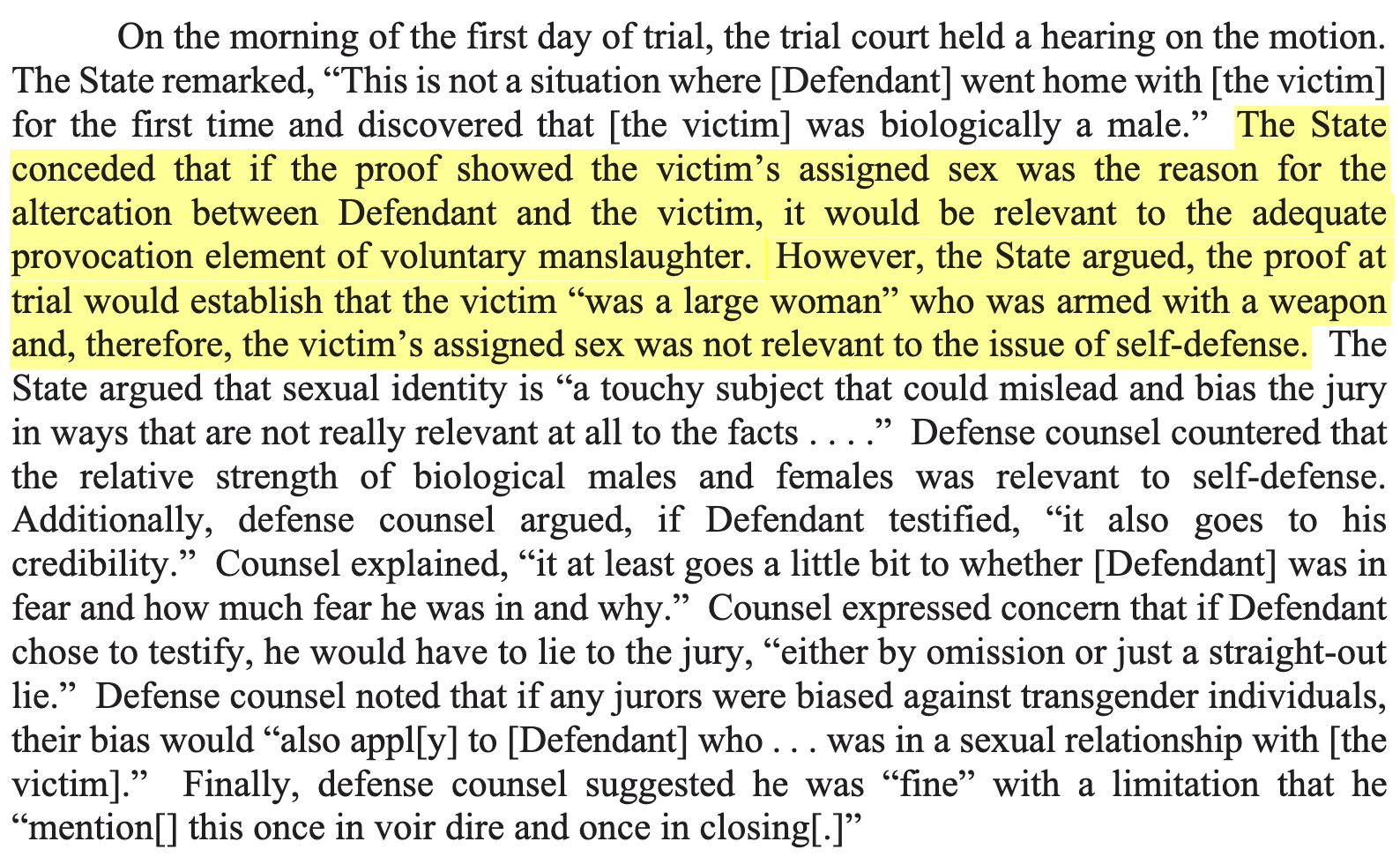
Excerpt from the appellate ruling.
What’s more: During trial, Ward waived his right to testify. He refused to take the stand unless he was allowed to call Lee’s gender into question, explicitly stating that he thought he would be judged more harshly by jurors for killing a presumed-cisgender woman than a transgender one.
The defense also argued that, while a jury may hold prejudice against Lee as a trans woman, Ward would face equal amounts of discrimination on the basis of his decision to sleep with transgender women.
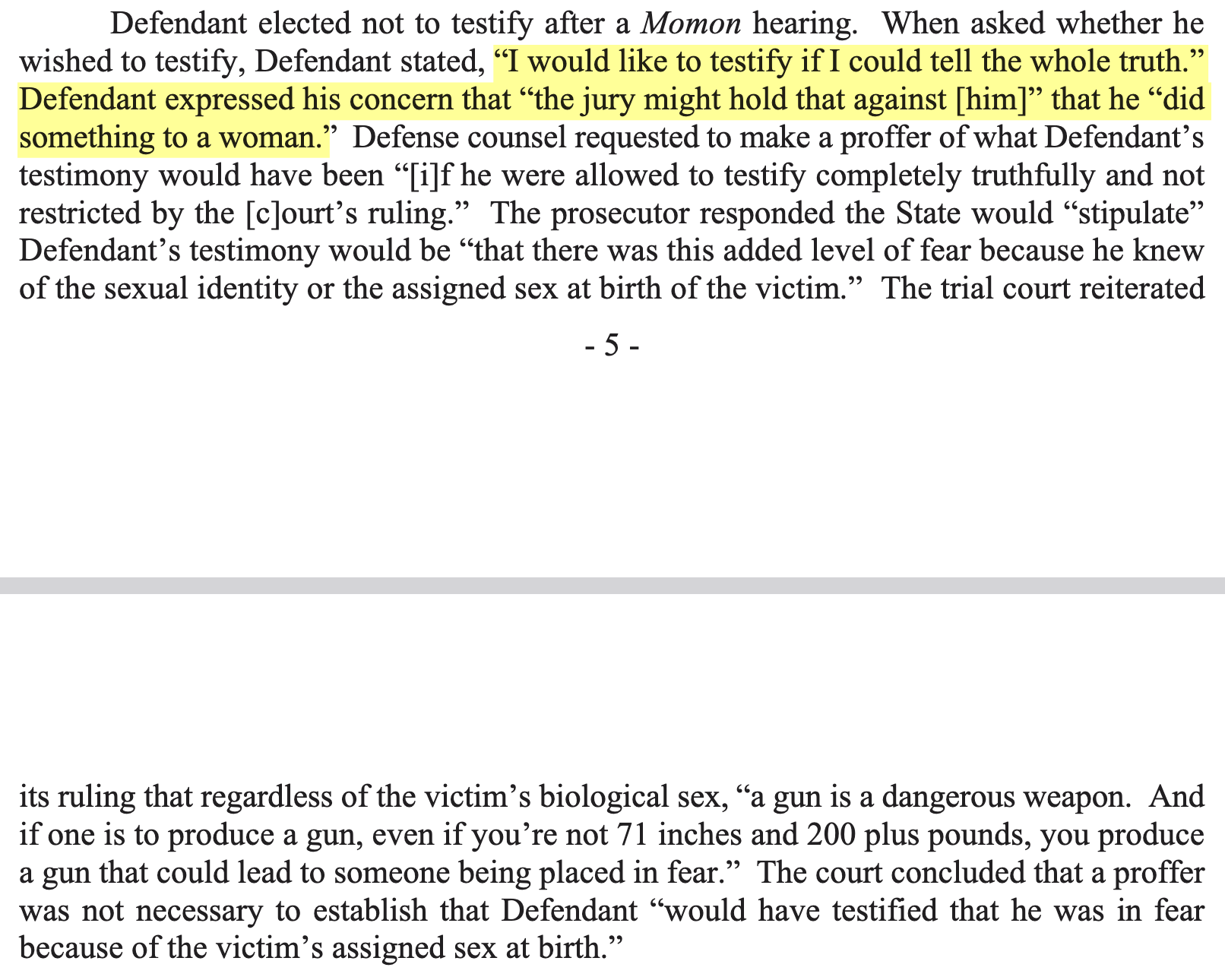
Excerpt from the appellate ruling.
According to the press release from the DA, the killing occurred after Ward went to Lee’s home, and a verbal altercation ensued. Lee asked Ward to leave, and he reportedly refused. Ward then claims that Lee pointed a gun at him.
In Ward’s telling, this caused him to fall backward down a staircase, with Lee still standing at the top. At the bottom of the stairs, he said he drew his gun and fired upward at Lee.
Ward shot Lee six times. Police found only one bullet casing from Lee’s gun; if she fired her weapon at all, she only did so once. Ward was wholly uninjured.
Physical evidence and expert testimony from the medical examiner “contradicted Ward’s version of events,” the press release continues. “The trajectories of the gunshot wounds did not align with the defendant’s statement. Additionally, Ward had no visible injuries, undermining his claim of self-defense.”
After killing Lee, Ward “left the scene and drove approximately 30 minutes to his home before calling 911—leaving Lee to die at the foot of her staircase,” the DA’s office concluded.
Even before killing Lee, Ward was a known entity to trans women in the area, according to Kayla Gore, who is the executive director of My Sistah’s House—a Memphis-based organization that supports Black and Brown trans people fleeing violence. Gore said Ward largely pursued relationships with transgender women.
After Lee’s death, Gore said she received countless calls about the case and spoke extensively to Lee’s loved ones. The crime left everyone terrified in its wake.
“What concerns me as a community organizer is what happens when a courtroom treats a Black trans woman’s identity as a material explanation like for someone’s fears,” Gore told Erin in the Morning. “They want that as evidence presented to the jury or the judge as a deciding factor on whether or not this was self-defense. It sends a message far beyond the courtroom.”
That message, she said, is that trans women can be harmed and killed with impunity—especially Black trans women, who are more likely than almost any other demographic to be the victims of hate crimes and domestic violence, while being the least likely to have resources available to them in the aftermath.
“I understand what the appellate court was addressing with the defendant’s right to present a defense,” Gore continued, “but there is a profound difference between saying evidence may be relevant to a legal defense, and saying that a transgender woman’s identity somehow makes her inherently more threatening.”
The case is a bitter reminder of the ways LGBTQ people have had their identities weaponized by the courts in the past, most notoriously through a legal defense tactic known as gay or trans “panic.”
According to the LGBTQ+ Bar Association, the trans “panic” defense is a legal strategy wherein someone charged with violent crimes uses their victim’s real or perceived gender identity to reduce or evade criminal liability, in tandem with other legal lines of defense—such as claiming provocation or an insanity plea.
“The LGBTQ+ ‘panic’ defense is usually employed to bolster a self-defense claim when the victim’s behavior does not meet the threat of serious bodily harm standard or when the defendant used greater force than reasonably necessary to avoid danger,” the LGBTQ+ Bar’s primer on the topic says. “This strategy requires the defendant to argue that their victim’s LGBTQ+ identity made them a greater threat than a heterosexual and/or cisgender person.”
This argument can be hugely consequential during a trial because self-defense claims rely on evaluating a defendant’s perceived risk of harm. This determines how justifiable deadly force might be.
So in Lee’s case, the argument stands to be that she was more dangerous than a cisgender woman, or that Ward otherwise had more reason to fear her because she was trans.
“We live in a society where Black trans women are stereotyped as dangerous, deceptive, threatening,” Gore said. She called the case’s remand “a slap in the face of all survivors.”
Moreover, according to Satterfield—the local journalist who broke the story—it is “the first such ruling of its kind in Tennessee’s legal history.”
The LGBT panic defense is banned in 20 states, but Tennessee is not one of them.
If you are a trans person of color fleeing domestic violence in need of affirming and inclusive resources, you can reach out to My Sistah’s House to be referred to a number of providers nationwide. You can also reach out to Trans Lifeline at 877-565-8860, the LGBT National Hotline at (888) 843-4564, or the LGBT National Youth Talkline (serving youth through age 25) at (800) 246-7743.
Erin In The Morning is a reader-supported publication. To receive new posts and support my work, consider becoming a subscriber.
From Erin In The Morning via This RSS Feed.
Gay panic, now trans flavored! Fuck this place, seriously.