

Six months before the presidential elections, just as the electoral calendar seemed to be emerging as the only way to resolve the French political crisis, the high school student revolt has brought social struggle back to the forefront. A generation of young people from the working-class high schools of the Parisian suburbs, expected to quietly pursue their studies and accept their fate in the capitalist system, have asserted their demands and established their own timeline for action.
The structural reasons for this explosion of struggle — “social selection” (according to which French schools sort students by their social status), anxiety about the future, and the decline of education — have combined with a particular conjuncture: the end of Macron’s presidency. After nearly 10 years of successive attacks and crises, his already-eroded authority is once again being challenged.
While political forces were preparing their campaigns, the high school students burst onto the scene, explaining that their future could no longer wait. As Elisabeth Allain-Moreno, general secretary of the SE-UNSA union, points out, “After 10 years of Emmanuel Macron’s education policies, student anger was to be expected. One might even wonder why it wasn’t expressed sooner.”
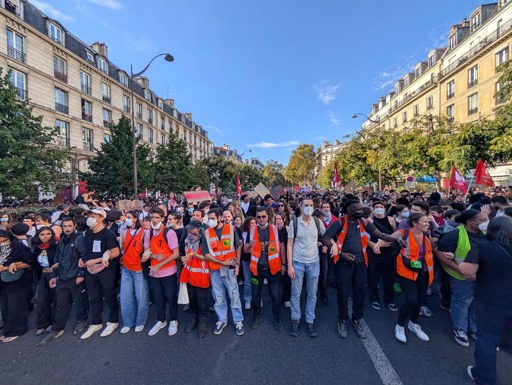
In this context, the events of October 6, which mobilized more than 450,000 people nationwide, mark a significant step forward. They demonstrate that repression and media propaganda have neither broken the students’ resolve nor isolated their movement. On the contrary, high schoolers were joined in their mobilization that Tuesday by university students, parents, teachers, and union members, and the attempt to criminalize their struggle was thwarted as the mobilization broadened its demands and gained new support. According to an Ipsos poll, 62 percent of the population views the movement as justified.
This widening support includes a particularly progressive element: students from privileged schools in Paris are mobilizing against the inequalities suffered by their peers in working-class neighborhoods. “The same public school in Saint-Denis as in Paris,” chanted students at Henri-IV, for example. At the private Massillon high school in Paris, students spoke of their “privileges” and protested with banners of solidarity for the Paul-Éluard high school in Saint-Denis. These actions challenge the competition between students and the divide between those who benefit from favorable study conditions and those who must fight to win them. In short, the revolt is beginning to build bridges where the education system erects barriers.
But this progress must be consolidated. University students, who have begun to mobilize in recent days, must strengthen their struggle: expand the blockades, organize large assemblies, and open universities to high school students to organize meetings and coordination in response to the many school closures. Their experience and spaces can become points of support for those who launched the revolt and who remain the most vulnerable to repression.
The involvement of workers must also deepen. Solidarity is fundamental, but it must translate into collective action in the workplace and strike action to build a united front against government repression and attacks. In this sense, while several organizations supported the day of action on October 6, the fact that the interunion group set the date for the next interprofessional mobilization for November 5 the day before demonstrates a desire to bypass the high school student movement and the October 17 protests. Therefore, all union members who see the urgent need to remain in solidarity with high school students must contact their unions. As calls for mobilization multiply for October 17, workers must demand a plan to unify the anger and allow it to continue despite the school holidays.
On the government side, French prime minister Sébastien Lecornu is trying to regain the initiative by combining a defense of the police response with vague promises. On Tuesday, he announced the gradual reopening of high schools and the organization of a half day of discussions, with the aim of ending the blockades and street protests and shifting discussions to the classrooms within the framework of institutional procedures overseen by the principals. The government acknowledges the problems but seeks to address them using its own methods, imposing its own pace and buying time to demobilize the students.
There is no guarantee that it will succeed. While many groups of high school students intend to continue the blockades, students and teachers could take advantage of the reopening to self-organize, debate their demands, elect representatives, and connect schools with one another. The establishment of such assemblies and coordinating bodies is crucial to enabling high school students to pursue their struggle and control all negotiations. University students have a crucial role to play in this task: putting their skills and mobilization capacity at the service of a common movement.
October 6 widened the breach opened by the youth of working-class neighborhoods. The movement must now achieve continuity and organization: assemblies, mandated delegates, coordination between high schools and universities, and workers’ strikes that embody the feeling of solidarity. The meeting convened by Macron with some of his ministers this Tuesday evening demonstrates the government’s anxiety in the face of a revolt it cannot contain. This moment must be seized to go on the offensive: uniting the strength of youth with that of workers, broadening the mobilization, and building the social confrontation capable of defeating the government and its attacks.
This article was first published in French at Révolution Permanente on October 7, 2026.
The post In France, the High School Student Revolt Gains Ground and Shakes the End of Macron’s Reign appeared first on Left Voice.
From Left Voice via This RSS Feed.