

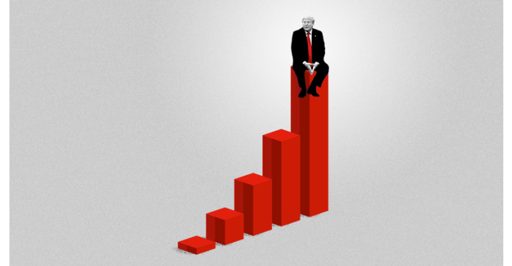
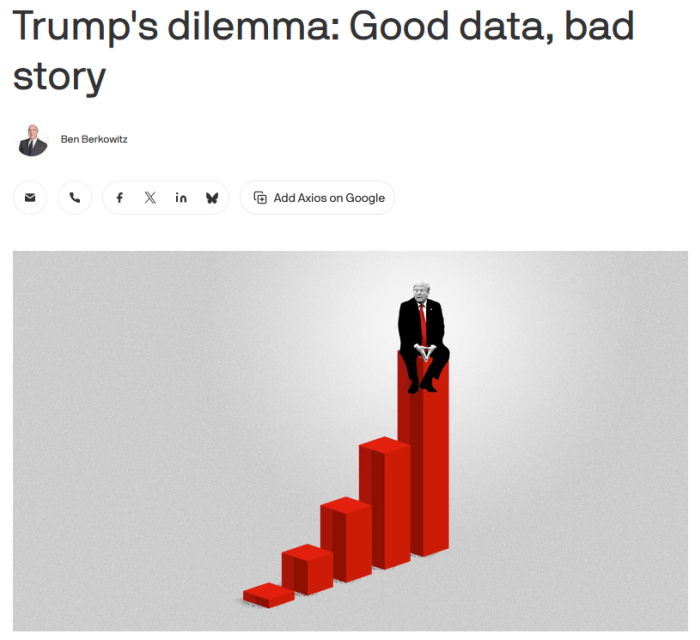
It’s not clear what ever-rising statistics Axios (10/5/26) is envisioning Trump sitting atop—gasoline prices, maybe?
Axios (10/5/26) thinks it’s spotted a mystery: “President Trump’s economic data keeps getting stronger. His economic polling keeps getting worse by the day.”
Or as the political news site put it in an earlier story (9/30/26): “America’s economy is roaring ahead. And Americans feel lousy about it.”
As both stories note, people don’t feel like the economy is “roaring ahead.” So what’s the proof that they’re wrong? As is its wont, Axios provides bullet points in the October 5 piece to lay out the “ample evidence the economy is, statistically speaking, relatively strong.”
First up: “Economic growth is solid and accelerating.” The link that backs that up goes to the September 30 piece, which reported, “The economy grew at a 2.2% annualized rate in the second quarter, a sharp upgrade from the 1.5% previously reported.”
Is 2.2% growth “relatively strong,” though? Average annual GDP growth since 1947 is 3.2%, a full percentage point higher. If that seems like too long a time frame for comparison, the Biden years—a period when the economy was rarely described as “roaring ahead” or “relatively strong”—averaged 3.7% annual GDP growth. Leaving out 2021—an exceptional year when the economy bounced back strongly from the Covid recession—still leaves Biden’s economy growing at 2.8% a year.
Relatively speaking, then, Trump’s growth is rather weak. It’s not “accelerating,” either; over the six quarters so far of Trump’s second term, the average annual growth rate has been 2.2%—the same as in the most recent quarter.
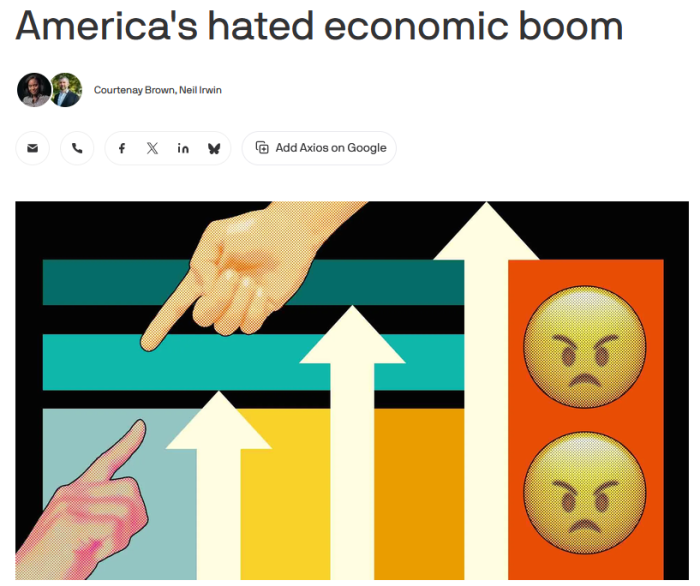
“The economy enters fall with more momentum than anyone knew,” Axios (9/30/26) writes, in a journalistic technique known as “putting lipstick on a pig.”
Next, Axios offers: “The labor market is relatively stable.” (Note that “relatively stable” is not another way to say “roaring ahead.”) That link goes to an Axios piece (10/2/26) with the headline, “US Adds 29,000 Jobs in September, Unemployment Edges Up.”
Historically, 29,000 is not a lot of jobs to add in a month; in Biden’s term, the economy gained an average of 329,000 jobs every month. Even in Biden’s slowest year for job growth, 2024, his average monthly gain was 122,000. Trump’s monthly average since 2025: 35,000.
Economist Dean Baker (CEPR, 10/2/26), writing about the job report, described the 29,000 number as “considerably less than most analysts had expected,” and a sign that “job growth slowed substantially in September.”
And “stable” is a stretch when the economy has lost jobs in one out of every three months since the beginning of 2025. There wasn’t a single month under Biden’s watch when the economy lost jobs.
The September 30 article said there were “few signs of labor market weakness” in Trump’s America. One of the main gauges of labor strength is the employment-population ratio, which counts how many working-age adults have jobs. (It’s broader than the unemployment figure, which doesn’t count people who have given up looking for work.)
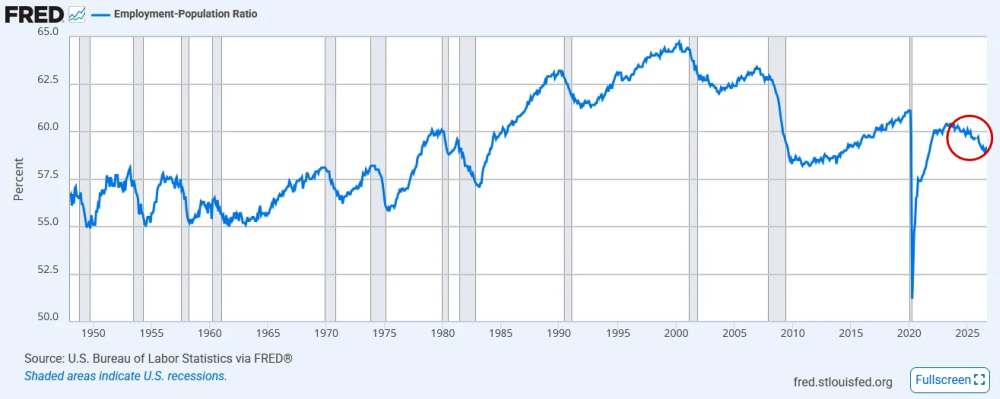
One of these expansions is not like the others: Federal Reserve Economic Data chart of the Employment-Population Ratio, with Trump’s second term highlighted.
Normally, when the economy is not in a recession, this number goes steadily up—but in Trump’s second term, it’s gone steadily down, from 60.1% in January 2025 to 59.2% in September 2026. Looking back on the entire post–World War II era, no other period of economic expansion has seen the percentage of working adults go down like that.
The most recent Axios piece concludes with the “bottom line”: “There’s good reason to think the economy’s not that bad,” but “voters don’t care.” I’d say, rather, that Axios doesn’t care about giving voters an accurate picture of how mediocre Trump’s economy really is.
From FAIR via This RSS Feed.
You must log in or # to comment.