

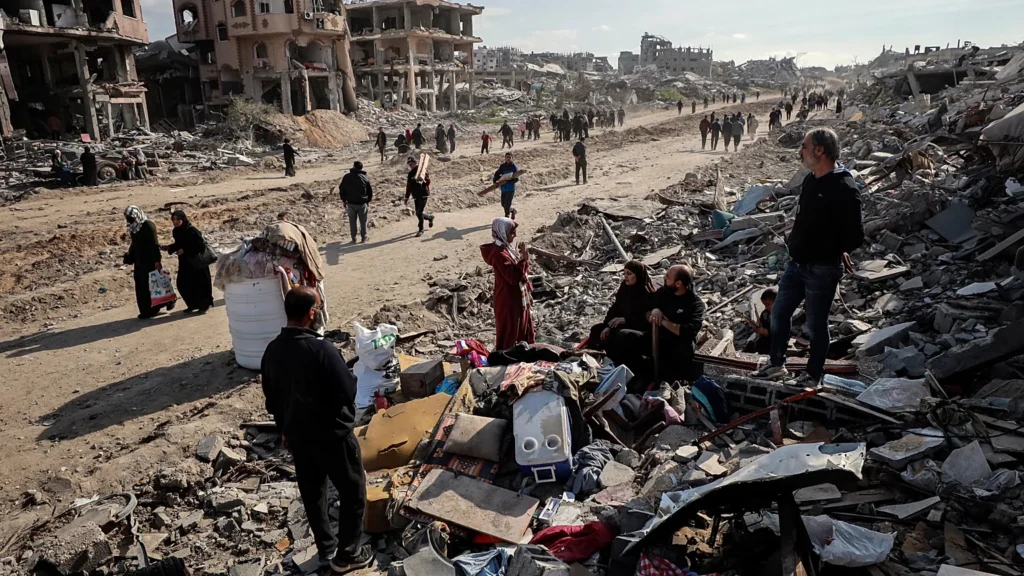
The Zionist assault perpetuates decades of territorial displacement, land annexation, and military siege against the Palestinian people.
The genocide against Palestine entered a new phase on October 7, 2023, when the Israeli government formally declared a state of war and initiated military operations named Operation Swords of Iron.
RELATED:
Ansar Allah Defends Palestine and the Holy Sites: Al-Houthi
The Israeli defense ministry instituted a complete blockade of the Gaza Strip, cutting off supplies of electricity, food, water, and fuel to the population of over two million residents.
This in-depth article presents a factual overview of the historical context, military developments, and long-term background surrounding the ongoing crisis in Gaza and the West Bank.
Israel’s brutality against Palestinians didn’t begin on October 7, 2023. On the third anniversary of its genocidal war on Gaza, we revisit that history and challenge Israel and its allies’ framing of that day as the starting point pic.twitter.com/0CyIiqsACn
— TRT World (@trtworld) October 6, 2026
Context of October 7, 2023, and the Onset of Genocide
The military israelí attacks, called Operation Swords of Iron, began with immediate air strikes on October 7, 2023, across the territory, followed by a ground invasion launched on October 27.
United Nations agencies, international humanitarian organizations, and human rights bodies quickly documented severe impacts on the Palestinian civilian population. Reports from the United Nations Office for the Coordination of Humanitarian Affairs (OCHA) and the Gaza Ministry of Health indicated rapid infrastructure destruction and mounting casualties in the initial weeks.
International observers, including representatives from the United Nations High Commissioner for Human Rights, noted that the total siege and heavy aerial bombardment against Gaza represented a major escalation in the regional conflict.
Tensions predating October 7 were marked by ongoing political friction. These included regular Israeli military raids in the occupied West Bank, expanding settlement construction, restricted movement for Palestinians, disputes over access to the Al-Aqsa Mosque compound in East Jerusalem, and the ongoing 17-year blockade of the Gaza Strip established in 2007.
Root Causes and a Century of Progressive Colonization
The events of October 7, 2023, occurred within a broader historical context extending back over a century. Historians and institutions trace the origins of Israel’s territorial disputes and colonization policies in Palestine back to the early 20th century.
In 1917, the British government issued the Balfour Declaration, expressing official support for establishing a national home for the Jewish people in Palestine, then under Ottoman rule and later a British Mandate in 1920.
Following World War II, the United Nations General Assembly passed Resolution 181 in November 1947, recommending the partition of Mandatory Palestine into separate Jewish and Arab states, with Jerusalem under an international regime.
The period surrounding the termination of the British Mandate in May 1948 led to the first Arab-Israeli war and the displacement of the Palestinian population, an event known in Palestinian history as the Nakba.
According to United Nations records, approximately 700,000 Palestinians were displaced or fled from their homes between 1947 and 1949, and hundreds of villages were depopulated.
In the June 1967 War, the Israeli military occupied the remaining Palestinian territories, including the West Bank, East Jerusalem, and the Gaza Strip, as well as the Syrian Golan Heights and the Egyptian Sinai Peninsula.
Since 1967, territorial governance in the West Bank and East Jerusalem has been defined by the expansion of Israeli civilian settlements. United Nations Security Council Resolution 2334, adopted in 2016, reaffirmed that the establishment of settlements in Palestinian territory occupied since 1967 has no legal validity and constitutes a violation under international law.
In Gaza, Israel withdrew its land-based military forces and settlements in 2005 but retained a blockade and control over the territory’s airspace, maritime border, and primary land crossings, establishing a comprehensive air, sea, and land blockade in 2007.
🇮🇱 ❌️ 🇵🇸 IDF soldiers preparing for Operation Swords of Iron pic.twitter.com/xYZWkvj1AK
— Angelo Giuliano 🇨🇭🇮🇹 (@angeloinchina) October 7, 2023
Statistics and Data Regarding Human Toll and Material Destruction
The physical scale of destruction and human casualties following October 7, 2023, reached unprecedented levels in the history of the Israeli-Palestinian conflict.
According to records from the Gaza Ministry of Health and periodic updates from the United Nations Office for the Coordination of Humanitarian Affairs, the reported Palestinian death toll in Gaza exceeded 73,000 people over the course of the ongoing escalation.
Official documentation indicates that women and children account for more than 60 percent of the total fatalities. Additionally, the number of recorded injuries surpassed 174,000 individuals, many of whom sustained complex injuries requiring specialized surgical care that became increasingly unavailable as medical infrastructure deteriorated.
Satellite analysis conducted by the United Nations Satellite Centre alongside independent academic assessments documented the destruction or severe damage of over 60 percent of all residential structures in the Gaza Strip.
Critical civilian infrastructure suffered extensive damage across every municipality. More than 80 percent of educational facilities, including primary schools, vocational centers, and universities, sustained direct hits or structural damage.
The healthcare system experienced severe operational impairment, with the World Health Organization reporting that the majority of Gaza’s 36 main hospitals and dozens of primary healthcare clinics were rendered non-operational due to direct military damage, lack of fuel, or surrounding combat operations.
Water treatment facilities, power supply grids, and agricultural land were similarly rendered non-functional, contributing to severe environmental contamination and food insecurity.
The conflict resulted in the internal displacement of approximately 1.9 million people within Gaza, representing more than 85 percent of the total population.
Families were repeatedly displaced across different regions of the strip under official evacuation orders issued by the Israeli military. Reports issued by the Integrated Food Security Phase Classification and the World Food Programme identified widespread risk of famine, citing severe restrictions on the delivery of commercial goods and international humanitarian assistance through land border crossings.
Israeli occupation forces have demolished properties belonging to Yousef Zyadna, a Palestinian Bedouin citizen of Israel who rescued 30 Israelis from the Nova music festival during the October 7, 2023 operation.
According to Israeli news site Local Call, Israeli bulldozers… pic.twitter.com/w9OfcnCgz7
— Quds News Network (@QudsNen) October 8, 2026
The Impact on the International Palestinian Community
The developments following October 7, 2023, generated substantial political, social, and legal impacts across the global Palestinian diaspora and the international community.
For the millions of Palestinians living outside the occupied territories, including refugees in neighboring countries such as Lebanon, Jordan, and Syria, as well as populations across Europe and the Americas, the escalation amplified long-standing concerns regarding national displacement, loss of family members, and the preservation of cultural heritage in Gaza.
Internationally, the crisis led to significant legal and political proceedings at major multilateral institutions. In December 2023, the Republic of South Africa filed an application against Israel at the International Court of Justice, alleging violations of the 1948 Convention on the Prevention and Punishment of the Crime of Genocide. The court issued provisional measures ordering the prevention of acts falling under the scope of the Genocide Convention and requesting the uninterrupted flow of humanitarian assistance into Gaza.
Concurrently, the Prosecutor of the International Criminal Court requested arrest warrants for political and military leaders on both sides of the conflict, citing allegations of war crimes and crimes against humanity.
The situation also prompted widespread public demonstrations across major global cities, alongside academic and civic mobilization in support of Palestinian rights and immediate ceasefires.
These public demonstrations were accompanied by diplomatic shifts, as several governments in Latin America, Africa, and Asia suspended or downgraded diplomatic relations with Israel, while several European nations officially recognized the State of Palestine.
In Western nations, public discourse surrounding the conflict saw heightened debates regarding freedom of speech, assembly rights, and the conditions attached to foreign military aid and trade agreements.
The US embassy in Israel says that it is ‘closely monitoring’ the security situation in Israel after rocket attacks and the infiltration of Hamas fighters from Gaza.
🔴 LIVE updates: https://t.co/i2VdE8ofse pic.twitter.com/3YkTpLVdc1
— Al Jazeera English (@AJEnglish) October 7, 2023
Media Warfare and Information Control
The audiovisual documentation of events following October 7, 2023, highlighted a major shift in how modern conflicts are reported and communicated globally.
The widespread availability of live-streaming technology, smartphone video recording, and direct social media broadcasting enabled Palestinian journalists and civilian residents to transmit real-time documentation of airstrikes, displacement, and humanitarian conditions directly to an international audience.
This real-time documentation occurred alongside an unprecedented mortality rate among media workers. Reports published by the Committee to Protect Journalists, Reporters Without Borders, and the International Federation of Journalists documented the killing of over 240 journalists and media workers in Gaza.
Organizations such as the Palestinian Journalists Syndicate reported figures exceeding 260 media fatalities, marking the deadliest period for press workers recorded since systematic tracking began.
Prominent Palestinian reporters, including Hamza al-Dahdouh, Ismail al-Ghoul, and Anas al-Sharif, were killed in targeted airstrikes while conducting field reporting. In addition to direct fatalities, dozens of media workers were injured, detained by Israeli forces, or experienced the deaths of extensive immediate and extended family members in residential strikes.
The Israeli military maintained a complete ban on independent access for international journalists to the Gaza Strip, permitting entry only through strictly controlled military escorts with operational pre-screening requirements.
78 years of ongoing Nakba.
78 years of erasure.Against all odds, we remain on our land and the land of our ancestors.
Return is our right.
Freedom is our destiny.On May 15, join the Palestinian people in commemorating the Nakba. #NAKBA78
🎥 PAL Global Echo pic.twitter.com/4T8PXdPp8Q
— State of Palestine (@Palestine_UN) May 14, 2026
The Anti-Colonial Framework
Three years after the events of October 7, 2023, the enduring crisis in Palestine continues to reframe global geopolitical relationships, international law, and anti-colonial movements.
The prolonged conflict has underscored fundamental shifts in international diplomacy. Broad coalition movements across the world have increasingly challenged traditional Western diplomatic hegemony, demanding structural reforms within the United Nations Security Council, an end to unconditional foreign military aid packages to Israel, and strict adherence to international treaties regarding illegal land occupation and settlement expansion.
As international consensus increasingly recognizes the structural roots of the dispute dating back through decades of military occupation and population displacement, any permanent resolution requires addressing core political imperatives, including the dismantling of systemic inequality, the recognition of fundamental Palestinian rights under international law, and the fulfillment of genuine national self-determination.
Sources: Britannica – RT – TeleSUR – Al Jazeera – Al Mayadeen – Palestina – BBC – UNRWA – El Orden Mundial – Anadolu Agency – Peoples Dispatch – Instituto Tricontinental – ALBA Movimientos – Brasil de Fato – Lisandro Brusco – Vijay Prashad – Venezuelanalysis – RSF – Palestine.com
From teleSUR English via This RSS Feed.