

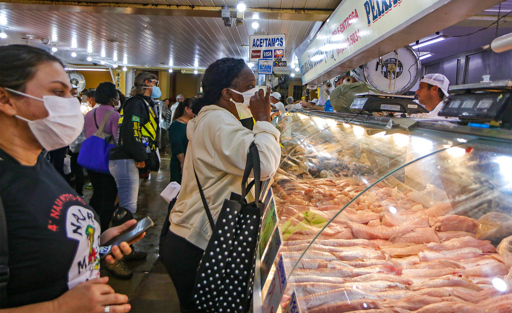
PORTO ALEGRE, Brazil — “Good choice!” said the clerk at one of the fish stalls in the Porto Alegre Public Market when Mongabay asked about the peixe anjo, which means “angel fish” in Portuguese, in mid-September. “We sell a lot of these. It’s really good, and it doesn’t have any bones.” The same product was for sale by at least four other fishmongers in the traditional market of the capital of Rio Grande do Sul state, in the South of Brazil. Prices were attractive, ranging from 30 to 37 reais per kilo ($5.70 to $7). The problem is that the “angel” isn’t just any fish — it’s a shark. More specifically, an angelshark, and in Brazil, that means three of the world’s most endangered shark species: Squatina guggenheim, the angular angelshark; S. occulta, the hidden angelshark; and S. argentina, the Argentine angelshark. And fishing of these species is prohibited in Brazil. For many years, the Brazilian government authorized the import of angelsharks from neighboring countries. According to data from the Federal Revenue Service obtained by Mongabay through the Freedom of Information Act, 48 metric tons of S. guggenheim meat and 194.6 metric tons of S. argentina entered Brazil between January 2021 and Sept. 10, 2026, totaling 242.6 metric tons. Most of the shipments came from Argentina, entering the country through the customs ports of São Borja and Uruguaiana municipalities in Rio Grande do Sul, and Dionísio Cerqueira in Santa Catarina state. Once in Brazil, the imported product was mixed with…This article was originally published on Mongabay
From Conservation news via This RSS Feed.