

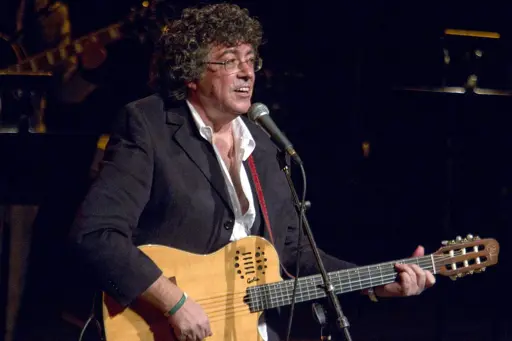
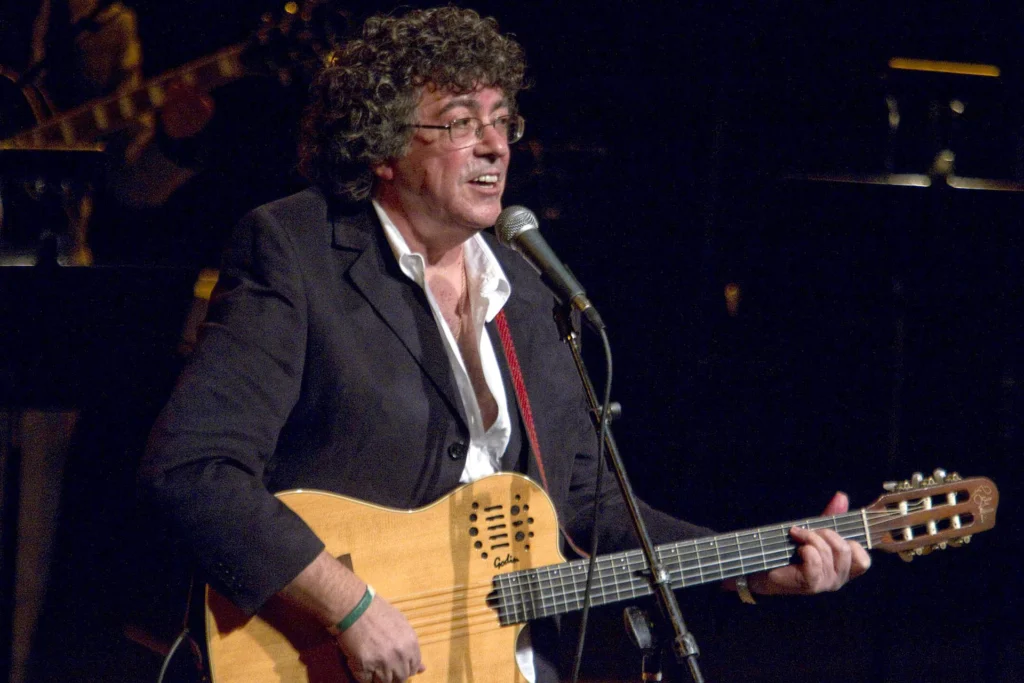
Piero Antonio Franco De Benedictis, the popular Argentine-Italian singer-songwriter died Wednesday in Buenos Aires at age 81 after several days in the Italian Hospital.
“With deep sorrow, we announce the passing of our dear Piero, at 81 years of age,” the family wrote on social media. “His voice, his songs and his message of peace remain with us forever. His light will continue to shine in every corner where his music keeps reaching. His family and friends thank you for the greetings“, the communiqué added.
The musician had been hospitalized since Monday in grave condition at the Italian Hospital in Buenos Aires, but his family and inner circle did not disclose what illness he was facing. Piero had suffered health complications in recent years, including a respiratory condition in September 2023 during a visit to Ecuador.
RELATED: Susan Sarandon Turns 80 Without Ceasing to Support Social Strugles
Born on April 19, 1945, in the Italian region of Apulia, Piero emigrated to Argentina with his family when he was just 3 years old. After a stay in Banfield, in Buenos Aires province, he settled in the town of Allen, in Río Negro province, where his father opened a shop selling radios and record players while he trained as a seminarian in Viedma, the provincial capital.
His path in music formally began in 1964, with appearances on Argentinean TV channels and in night venues alongside figures such as Leo Dan and Palito Ortega. International fame arrived in 1968 with the release of his iconic song “Mi Viejo,” (“My old father”) a tribute to fathers that became part of the Latin American songbook.
That same year, Piero met writer José Tcherkaski, and the two formed a partnership that produced the great successes of his career. In 1969, he took First Prize at the Third Buenos Aires Song Festival with the song “Cómo somos” (“As we are”).
Ha muerto a los 81 años el cantautor Piero, quien inmortalizó con su voz varios himnos latinoamericanos, entre ellos ‘Mi viejo’. Su influencia fue tal que incluso Rubén Blades pensó en él para interpretar ‘Pablo Pueblo’, una de sus grandes obras. QEPD. pic.twitter.com/ctv1VOTQ1l
— Juana Peña (@Chris_Montz) October 7, 2026
During the 1970s, Piero’s work turned toward protest song, in tune with the political climate and state violence of the era. From that period emerged another of his most celebrated compositions, “Para el pueblo lo que es del pueblo” (“For the People What Belongs to the People”).
After the start of Argentina’s last civic-military dictatorship (1976-1983), and following an attempted kidnapping, Piero was forced into exile. He emigrated to Spain and later to Colombia during the 1980s, yet his bond with audiences across the continent held firm.
In the mid-1980s, the artist said he was leaving behind the “protest music” label and redefining his work as “proposal music.” In this new stage, he extended his social commitment beyond the stage, devoting himself to food sovereignty initiatives and the creation of community eco-farms. Among his many honors, he received the Latin Grammy Award for Musical Excellence in 2016.
Murió a los 81 años el cantautor argentino Piero pic.twitter.com/auILJ3IxSc
— Rock & Pop (@fmrockandpop) October 7, 2026
In January 2023, Piero gave a memorable show at the National Pear Festival, marking his reunion with Allen after 16 years. “Allen means many things: kids, friends, people and unforgettable characters from all my life,” he said at a press conference at the time.
Although he spent much of his career on stages across Latin America and the world because of his long absence from the country, his bond with the Argentine public remained unchanged.
Piero’s death came while he was still active in music. In April of this year, he traveled to Colombia for a tour presenting a special show based on his children’s album “La sinfonía inconclusa del mar” (“The unfinished symphony of the sea)”, accompanied by actors, dancers and his band.
Six days before his death, he shared with followers one of the last great moments of his career. Fashion house Saint Laurent, under creative director Anthony Vaccarello, chose his voice to open its Spring-Summer 2027 show in Paris, staged with the Eiffel Tower illuminated in the background. The song was “Io Vengo,” the Italian version of “Yo vengo,” (“I´m coming”), one of his repertoire’s themes.
“It is very powerful to hear my voice there at the start of the show,” he said when sharing images of the moment. He noted that the track began with a slow, melancholic performance before giving way to a vibrant electronic base. “Music has those bridges that embrace such diverse paths,” he reflected.
The clip offered a final glimpse of an artist still connected to his craft and to the public that followed him for more than five decades.
From teleSUR English via This RSS Feed.