

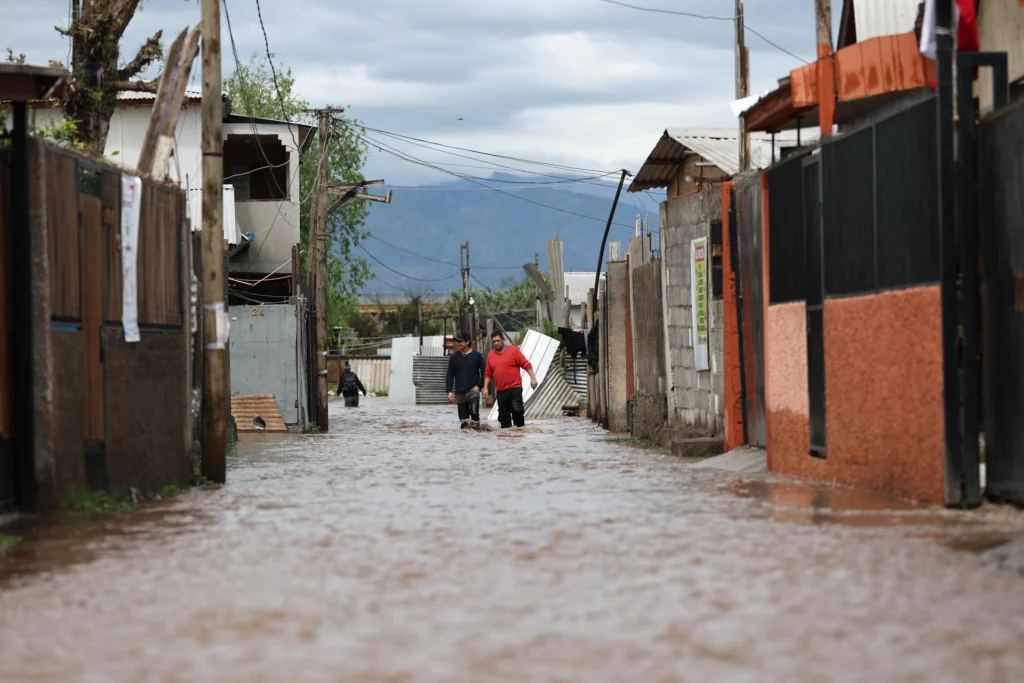
Chile’s National Disaster Prevention and Response Service (Senapred) declared a Yellow Alert for the Santiago Metropolitan Region on Tuesday night after intense rainfall in central Chile caused flooded streets, a landslide and active ravines in several municipalities, and the alert remains in effect.
The measure took effect on Tuesday night and will remain in place for as long as weather and emergency conditions require it.
Chilean authorities said the Yellow Alert allows for stronger coordination and the deployment of additional resources should the situation worsen.
RELATED: Intensifying El Niño Deepens Economic Risks Across LATAM
According to the authorities’ latest report, the rain has already caused waterlogging on streets and underpasses in various municipalities. A mass removal of earth, or landslide, was reported in Melipilla, while ravines were activated in San José de Maipo, raising concern in areas exposed to slides and sudden rises in water levels.
Emergency teams have been deployed across the region to respond to reported incidents and monitor how the weather system evolves. The National Disaster Prevention and Response Service (Senapred) has also ordered a staggered readiness of resources so it can respond if conditions intensify.
Ante el sistema frontal que afecta a la zona centro-sur, se mantienen vigentes las Alertas Amarillas para las regiones Metropolitana y del Maule.
El llamado es a evitar situaciones de riesgo, seguir las indicaciones de las autoridades en especial mensajería #SAE y mantenerse… pic.twitter.com/yaazf4YnYB
— Máximo Pavez 🇨🇱 (@MaximoPavezC) October 7, 2026
Text reads: “In view of the frontal system affecting the central-southern zone, the Yellow Alerts for the Metropolitan and Maule regions remain in force (…)”
Chile’s Meteorological authorities maintains several alerts and warnings for the Metropolitan Region. One alert forecasts moderate to heavy rain in the coastal range, the valley and the Andean foothills. Other warnings anticipate normal to moderate winds in mountain areas and normal to moderate rainfall in the foothills and the Andes.
The forecast also warns of possible thunderstorms, hail and strong wind gusts across the coastal range, the valley, the foothills and the mountains. Those conditions could make travel difficult, especially in low-lying areas, mountain roads and underpasses where water accumulates quickly.
The National Geology and Mining Service (Sernageomin) warned of a high likelihood of mudflows and rockslides in the coastal range, the valley and the foothills. The combination of intense rain and vulnerable terrain can raise risks on slopes, ravines and roads near waterways.
The most serious incident occurred in the Santiago municipality of San Bernardo, where police and firefighters found the dead body of a man between 50 and 60 years old in a low-level passage almost three meters deep that was completely waterlogged. Although the person was on the street and usually stayed overnight in the sector, the Justice is investigating whether the cause of death was due to direct drowning by water accumulation.
Several points in the capital remain under water. Chile’s Superintendency of Electricity and Fuels confirmed that around 12,000 homes in the Metropolitan Region are without power. Hundreds of streets and underpasses are completely flooded.
Outside the capital, the situation is not much better. At least 10,000 homes are without electricity, half of them in the greater Valparaíso area.
Warnings and Safety Advice
Authorities are continuing to monitor the situation and urged residents to follow official notices, avoid crossing flooded streets or underpasses, and stay away from ravines and rivers where flow is rising. They also recommended staying alert for possible evacuation instructions and reporting risk situations to emergency agencies.
Although rainfall began to recede, technical meteorological agencies warned that additional rain is expected during the day, so emergency teams continue to be deployed in the field.
The duration of the Yellow Alert will depend on conditions on the ground and on weather forecasts for the coming hours.
From teleSUR English via This RSS Feed.