

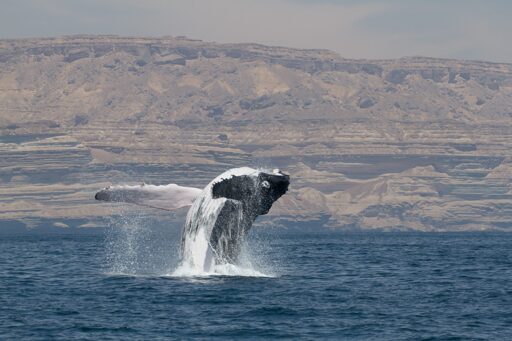
Humpback whales found in the Arabian Sea are likely a distinct subspecies, having evolved in isolation for tens of thousands of years, according to a newly published genetic analysis. “Arabian Sea humpback whales have long been an enigma to the scientific community,” lead author Rita Amaral, from the Wildlife Conservation Society (WCS), said in a press release. “Their ecology is unlike that of any other known humpback whale population, and this new genetic work represents an important milestone in understanding how that uniqueness developed.” Humpback whales (Megaptera novaeangliae) are found throughout the world’s oceans, typically migrating from warm waters near the equator, where they breed, to the colder poles, where they feed. To date, scientists recognize three subspecies: the North Atlantic (M. n. novaeangliae), Southern Hemisphere (M. n. australis), and North Pacific (M. n. kuzira) humpback whales. Unlike most humpbacks, however, the population living in the Arabian Sea doesn’t migrate, remaining in tropical and subtropical waters all year. Researchers compared mitochondrial DNA, which mothers pass to their babies, collected from 2,285 humpback whales globally, including those from the Arabian Sea coast of Oman. The analysis showed considerable genetic differentiation between the latter population and the other subspecies. The researchers also found the Arabian Sea population had the lowest genetic diversity observed across any global ocean basin. The study estimates humpback whales in the Arabian Sea diverged from the other populations between roughly 43,000 and 113,000 years ago, suggesting a long history of isolation. Such isolation also makes them vulnerable to…This article was originally published on Mongabay
From Conservation news via This RSS Feed.