

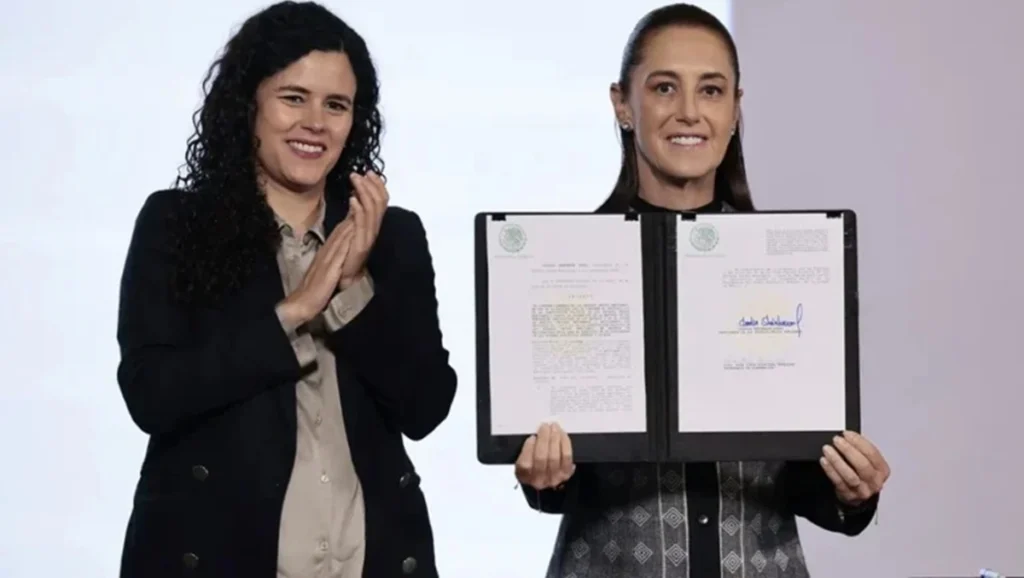
The norm will take effect in 2028 and also applies to candidates for state governorships and the Mexico City mayor’s office.
On Wednesday, President Claudia Sheinbaum signed the constitutional reform that will require those seeking the presidency, a governorship or the Mexico City mayor’s office to renounce any other nationality before registering their candidacy, a measure that will begin to take effect in 2028.
RELATED:
Sheinbaum Accuses U.S. Right-Wing Groups of Seeking Political Change in Mexico
Presidential legal counsel Luisa Maria Alcalde announced that the reform will be published Wednesday in the Official Gazette of the Federation (DOF), after receiving the support of two-thirds of both chambers of Congress and 22 state legislatures.
“If any person has dual nationality, they may renounce it before registering with the National Electoral Institute,” Alcalde explained during the president’s morning news conference.
The reform amends Articles 82, 116 and 122 of the Constitution and establishes that those seeking to head the federal and state executive branches must be Mexican by birth and must not hold another nationality or must renounce it before applying to register as candidates.
Mexico sends troops after US says shots fired across border https://t.co/IhV4MOpb9l
— The Straits Times (@straits_times) October 5, 2026
It also prohibits those who hold those positions from acquiring another nationality, using a foreign passport, exercising political rights linked to another citizenship or seeking diplomatic protection from another state.
Regulatory provisions must still be issued to determine the procedure for proving the renunciation of another nationality and the Mexican and foreign authorities that will be required to participate.
The reform will begin to take effect in 2028, for which Congress and the state governments will have to adjust the corresponding legislation.
In late August, Sheinbaum presented the reform initiative to Parliament, arguing that those who head Mexico’s executive branch or state governments must represent the country exclusively and avoid possible conflicts arising from maintaining another nationality.
The debate over dual nationality has also been present in other Latin American countries. Ecuadorian President Daniel Noboa and Colombian President Abelardo de la Espriella in Colombia also have U.S. citizenship. Progressive social and political organizations have questioned their binational status because of the conflicts of interest that condition entails.
teleSUR/ JF
Source: EFE
From teleSUR English via This RSS Feed.