

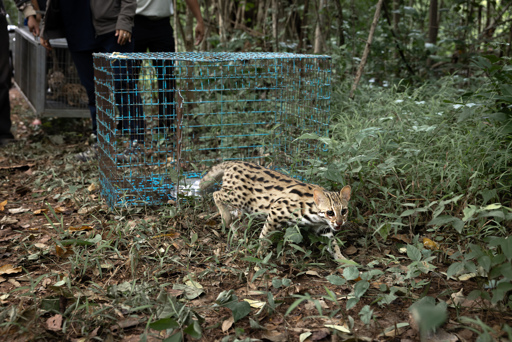
KHON KAEN, Thailand – A wildlife officer holds a leopard cat cub in one hand, its entire body small enough for her fingers to wrap around its torso. With the other hand, she feeds it formula milk from a syringe. This is the latest rescue at the Department of National Parks and Wildlife’s rescue center in Khon Kaen, northeastern Thailand, which rehabilitates and ultimately releases dozens of lost and injured leopard cat cubs every year. Behind the officer, 15 larger leopard cats (Prionailurus bengalensis), rescued as young cubs months earlier, pace around inside their cages. They look a lot like domestic cats, only slightly more slender and with sharply defined markings on their fur; unlike domestic cats, they bare their teeth and growl whenever a human walks past. Nine of the cats, between 8 and 9 months old, will be released in the forest that afternoon. The other six, a younger cohort, will take their place in the center’s specialized behavioral rehabilitation pens, where they will spend two months practicing their climbing and hunting skills in preparation for life in the wild. Leopard cats are small wild felines common across much of Asia. The IUCN classes them as least concern, though experts believe populations are increasingly vulnerable to hunting and habitat loss. Highly adaptable to changing landscapes, leopard cats often live close to farms and villages. In northeastern Thailand, females are frequently found raising their litters in sugarcane fields. The tall leaves offer shelter from the sun, but proximity to…This article was originally published on Mongabay
From Conservation news via This RSS Feed.