
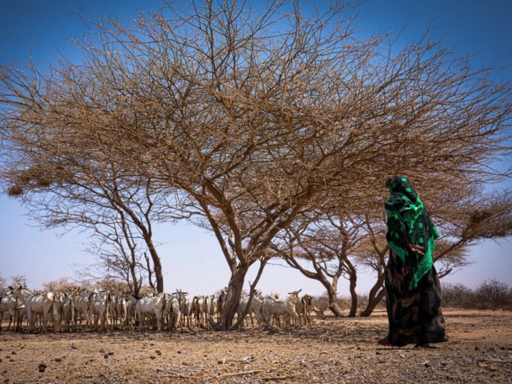

Somalia is facing a massive human catastrophe, fuelled by a combination of climate chaos and decades of foreign intervention (primarily from the US). This crisis is intensifying at a time when north-eastern Africa has become a key focus for regional powers following the US-Israeli war on Iran’s severe disruption of sea traffic.
Somalia’s drought and hunger crisis amid US cuts
In 2026, there are more than six million people in Somalia “facing high levels of hunger”, according to the World Food Programme. In large part, this is due to a worsening drought, which has pushed tens of thousands of people away from their homes. Drought has long been a problem, but it seems to be intensifying.
Save the Children has said that in the Somali region of Baidoa about 26,000 people are “just one step away from famine”.
Aid group CARE has described a “heartbreaking” situation on the ground, explaining that “it is mothers, pregnant women, and young children who are suffering the most”.
The UN, meanwhile, has highlighted:
Across Somalia, two million children are acutely or severely malnourished, making Somalia one of the world’s biggest malnutrition crises.
It also mentioned the role climate change is playing, noting:
The stronger-than-ever El Niño weather pattern is expected to deepen the crisis by intensifying the October-December rainy season.
The US, which has long propped up Somalia’s government, has made the nation’s hunger crisis even worse by freezing “nearly all of the country’s humanitarian aid”.
Meanwhile, the US-Israel war on Iran has added to this by significantly raising fuel and food costs.
Perhaps because Somalia’s situation reflects badly on the US — (after decades helping to perpetuate conflict and injustice there) — Donald Trump’s regime has sought to omit Somalia’s plight from a prominent famine alert system.
Climate breakdown hurts those least responsible
Like other parts of East Africa, the effects of the climate crisis on Somalia have been severe. In addition to poverty and conflict, 48% of the country’s population also face the dual threat of drought and flooding (depending on the season). These challenges in turn feed further conflict.
In 2022, drought caused 43,000 excess deaths and displaced more than six million people towards urban areas already suffering from overcrowding. Displacement relating to climate breakdown has only continued because since 2022, there hasn’t been a typical rainy season. There have only been floods.
Huge funding cuts have caused hundreds of health and malnutrition centres to close or reduce their services. Meanwhile, there’s a serious risk of water-borne and dietary diseases spreading.
Like many other countries, Somalia is not a major culprit behind global climate change but is suffering far more than the nations that are.
The BBC noted:
Somalia has emitted roughly as much carbon dioxide from fossil fuels since the 1950s as the US economy does in an average three days.
Despite this, the country is one of the most vulnerable countries to climate breakdown. Largely as a result of longstanding foreign meddling and resulting injustice, it is one of the countries least able to deal with increasing climate challenges.
Colonial centralisation and Cold War dictatorship
Somalia had a long history before colonialism with the UN’s Food and Agriculture Organisation describing it as being “among the world’s most enduring pastoral cultures”.
It had no centralised rule or state until European colonialists (and the Ethiopian empire) arbitrarily divided it in the 19th century. Its pastoral culture had been under imperial control before, but it was European colonialism that drove both competition for state power and resistance to centralised government.
British and Italian rule fostered lasting differences in development and wealth, and thus feelings of injustice. So even after the long anti-colonial struggle succeeded, tensions remained. Nationalist army commander, Siad Barre, took advantage with a military coup in 1969.
Barre first courted the Soviet Union, manipulating Marxist rhetoric to secure power. But after it opposed his 1977 invasion of Ethiopia, he cosied up to the US and Saudi Arabia, which used Somalia as a Cold War pawn in the battle for the strategically-placed Horn of Africa. As part of this deal, Barre went neoliberal.
Despite his cynical use of left-wing rhetoric, Barre increasingly used his power to enrich himself and members of his clan while brutally repressing his opponents.
Resistance, fragmentation and the rise of al-Shabaab
Much anti-Barre resistance in the 1980s came from the north-western region of Somaliland (previously under British control). Barre responded by massacring up to 200,000 people, particularly from Somaliland’s Isaaq clan. Many Isaaq members received Ethiopian support in resisting Barre.
Somaliland’s resistance first focused on defeating Barre. But his 1988 Isaaq genocide sowed the seeds for it to seek independence and more democratic rule after his 1991 downfall, which plunged Somalia into civil war and humanitarian crisis.
Somalia saw brutal infighting between clan leaders, which provoked a famine that killed hundreds of thousands. The US and other foreign states intervened (backing local warlords in some cases). Their involvement fuelled a conservative fundamentalist fightback, leading to the rise of prominent al-Qaeda affiliate al-Shabaab.
Despite the counterproductive effect, the US has nonetheless continued to fan the flames, especially under Donald Trump.
Pervasive neoliberalism and poverty
During the Cold War, the US tried to counter the disruption of national liberation movements by pushing extreme capitalist policies on willing regimes via the Western and US-oriented World Bank and International Monetary Fund (IMF). Barre was one who submitted to their agenda — (see Link 1 /Link 2 /Link 3).
His corrupt regime left Somalia with massive levels of debt and underdevelopment. Both the World Bank and IMF retreated after his downfall. But when a government able and willing to submit was finally back in power, they started to deal with Somalia again from 2013.
Their focus on the private sector and “structural reforms” helped to make Somalia a deeply neoliberal state, along with the post-Barre corporate utopia of no licences, little taxation, and few state rules.
Although there are more regulations now, low taxes remain. The private sector is still king, accounting for around 95% of all jobs, which are overwhelmingly informal, including in education and healthcare. This is partly due to the close links between business elites and politicians.
The World Bank has praised Somalia’s big debt reduction, but that means little to ordinary people. The country remains one of Africa’s poorest, with roughly 70% of people living in poverty, suffering from high living costs and an extreme lack of social protections.
On top of climate crisis and conflict eroding traditional ways of life, the economic desperation of ordinary Somalis almost certainly plays a key role in fuelling both piracy and armed conflict in the country. But the current neoliberal government, with its historic links to corruption, keeps following IMF prescriptions.
Ex-prime minister, Hassan Ali Khaire, claimed Somalia’s current President Hassan Sheikh Mohamud has been focusing too much time on trying to consolidate his own power and not enough on preparing the country for its looming humanitarian crisis.
Weakening US-Somalia ties and the Israel connection
Mohamud’s Prime Minister Hamza Abdi Barre is a close friend and ideological ally, facilitating his efforts to consolidate power. But a big obstacle for him may be his government’s links with the conservative Muslim Brotherhood.
Although Somalia has called for even stronger ties with the US and subscribed to its economic agenda, Trump’s heavily pro-Israel government prioritises protecting junior partner, Israel. That means challenging the Muslim Brotherhood.
While the Muslim Brotherhood’s modern leaders have leaned towards neoliberalism (sometimes against the wishes of ordinary members), it remains both a strong critic of Israel and a potential threat to pro-Israel dictatorships in the Middle East. That’s why the Trump regime has increasingly targeted it as a ‘terror’ group.
In Somalia, Barre expressed sympathy for Hamas (rooted in the Muslim Brotherhood and close to Israel’s bogeyman, Iran). Mohamud has increasingly criticised Israel as a “destabilising force” since its recognition of Somaliland’s independence.
Trump’s love of gutting foreign aid has been very bad for Somalia, which has long relied on US aid. With him prioritising funds for far-right allies from Israel to Latin America, cutting aid to a Somali government critical of Israel was probably an easy choice.
Somalia keeps seeking US support, though. Despite moving closer to Iran and Russia, its main allies are still pro-US regional powers. NATO giant Turkey, for example, has its biggest overseas military base in Somalia. Saudi Arabia, Qatar and Egypt have also grown closer to Somalia in recent years.
Israel, however, has not.
So Trump says Somalia is “not even a country“, squeezes its government, and accuses it of corruption. Back home, meanwhile, he attacks Somalis (partly as key left-wing critic Ilhan Omar is Somali), calling them “garbage“, saying they’re “destroying America“, and putting Somali immigrants in Guantanamo Bay.
The US wants to keep its presence in the Horn of Africa
Since 2002, the US has had its only permanent African military base in Djibouti (formerly ‘French Somaliland’). Across the Bab al-Mandeb Strait, meanwhile, are Yemen’s Houthis — a big part of the regional resistance to US-Israeli crimes. Neutral Djibouti has annoyed the US by stopping it from attacking Houthis from its African base.
In this context, right-wing lobbyists have pushed Trump to join Israel in recognising Somaliland’s independence in order to strengthen the US presence near the Bab al-Mandeb Strait. Somaliland has also launched a flailing charm offensive, offering to grant military access and name an airport after Trump.
However, the Trump regime has so far been reluctant to recognise Somaliland because of the potential response from Somalia and other regional states. There have also been reports of transactional anti-US collaboration between al-Shabaab and the Houthis, increasing the perceived importance of keeping a US foothold in Somalia.
Somalia has lobbied hard to prevent such a recognition too. The country may well be more beneficial to the US due to its vast shoreline and natural resources. So for now, the Trump regime has reaffirmed US-Somali security ties and resumed diplomacy. It has also controversially (and counterproductively) stepped up air strikes.
Another move suggesting US concern about the Bab al-Mandeb Strait, and unwillingness to take a risk with Somaliland, was its recent decision to drop sanctions on nearby Eritrea, which allied itself militarily with Somalia and Egypt in 2024.
Somalia’s place in regional tensions
Increasingly opposing Somalia’s regional bloc are Israel, the United Arab Emirates (UAE), and Ethiopia. Israel’s 2025 recognition of Somaliland, for example, sparked a backlash in Somalia and beyond, adding to concerns about massive UAE investment in Somaliland and a 2024 Ethiopian agreement with Somaliland (opening the path to recognition).
Both Ethiopian troops and UAE money had previously been key players in Somalia. But amid tensions over Somaliland, Somalia essentially cut ties with the UAE in early 2026. The country’s relationship with Ethiopia is on rocky ground too, despite the two states stressing their respect for each other’s “territorial integrity” in 2024.
Ethiopia hasn’t yet recognised Somaliland’s independence for this reason, but escalating resistance inside Ethiopia to government repression may put bilateral ties to the test. Because the Ogaden National Liberation Front (ONLF) from the Somali region of Ethiopia recently joined other groups in a new anti-regime alliance.
The secular nationalist ONLF has historic ties to Eritrea, and previously struggled for independence until 2018. Ogadeni civilians suffered countless human rights abuses during the war.
Somalia is also at odds with Ethiopia (and the UAE) in Sudan, where it has developed close ties with the military government. The UAE and Ethiopia have reportedly backed the anti-government RSF in Sudan’s brutal civil war.
The other major player setting Somalia against the Israel-UAE-Ethiopia bloc is NATO member Turkey, which has emerged as a key regional power and would possibly back Somalia if its conflicts worsen.
Although both Turkey and Israel are US allies, they’ve clashed in post-Assad Syria, where both want greater influence. In the Horn of Africa, Somalia may be emerging as a similar battleground because as one Somaliland adviser recently said:
We want Israel to support us against Turkey.
A risky government power play at home
Within Somali borders, meanwhile, al-Shabaab’s power isn’t fading. It still has a big presence in the centre and south, and some say it’s stronger than ever. In 2025, for example, it controlled up to 30% of Somali territory — more than the central government and the attention of Somalia’s government seems to be elsewhere.
Rather than focusing primarily on the fight against al-Shabaab, the Somali regime has been playing power games, repressing and attacking regional forces who want autonomy, particularly since Israel’s recognition of Somaliland.
In north-eastern Puntland, for example, local forces announced their autonomy in 1998 to ensure stability but still hoped for a federal Somalia. Mohamud’s constitutional changes in 2024, however, pushed it even further away. It offers possible global leverage over Somalia’s government because it has close links with the US, the UAE, and Ethiopia.
Puntland attracts international backing in part because of its key role in addressing the problem of piracy, which has increased again in recent years. This year, for example, pirates have exploited the global focus on other key waterways to massively ramp up their hijackings, despite many drone strikes against them.
The southern state of Jubaland, meanwhile, agrees with Puntland that the central Somali government has been uncommunicative and anti-democratic. Next to Kenya, Jubaland’s local government has previously received Kenyan and Ethiopian support in fighting against al-Shabaab.
In short, one of Mohamud’s key successes has been uniting regional Somali leaders in disdain for his government.
Powerful men play politics as ordinary people suffer
There are many groups in Somalia that want to stop al-Shabaab from grabbing power, but if they can’t unite against it without relying on foreign powers, it will keep entrenching itself in Somali politics. The country will then just be a pawn in a regional game of chess where international powers seek power and influence regardless of the impact on ordinary people.
Millions of ordinary people in Somalia are on the brink of even greater suffering. While the climate crisis worsens, the situation may be almost impossible to stop.
National and international politicians very much have the power to unite and prioritise human wellbeing. The question is whether they have the will to do so.
Featured image via Abdulkadir Mohamed/ NRC
By Ed Sykes
From Canary via This RSS Feed.