

The New York Times “whistleblower” cited as evidence of bias the fact that Times “staffers spent weeks searching for evidence that Hamas did not use the tunnels beneath al-Shifa Hospital” (Jerusalem Post, 9/23/26). The underground space turned out to have been built by Israel when it helped renovate the hospital complex in the 1980s (Intercept, 11/21/23).
Florida’s Republican attorney general, James Uthmeier, is taking on the New York Times for its coverage of Israel and Palestine. The legal action says less about the newspaper’s coverage than it does about the state of the pro-Israel right.
Uthmeier claimed to be acting to protect the state pension fund’s investment in the New York Times Co. The Times (9/23/26), reporting on the suit against itself, said that the attorney general charged that the paper’s “credibility had been hurt in particular by what he saw as an anti-Israel bias in its coverage of the Israel/Hamas war.”
The Times coverage said the lawsuit “demanded access to internal documents in an attempt to determine whether the company’s board of directors had allowed journalistic standards to be,” as Uthmeier put it, “weaponized within the company to serve the personal agendas of unchecked editors.”
The suit is based partially on “concerns raised by a purported newsroom whistleblower who said internal reporting channels did not resolve her complaints” about bias and editorial standards (Jerusalem Post, 9/23/26).
‘Deference to Israeli narratives’
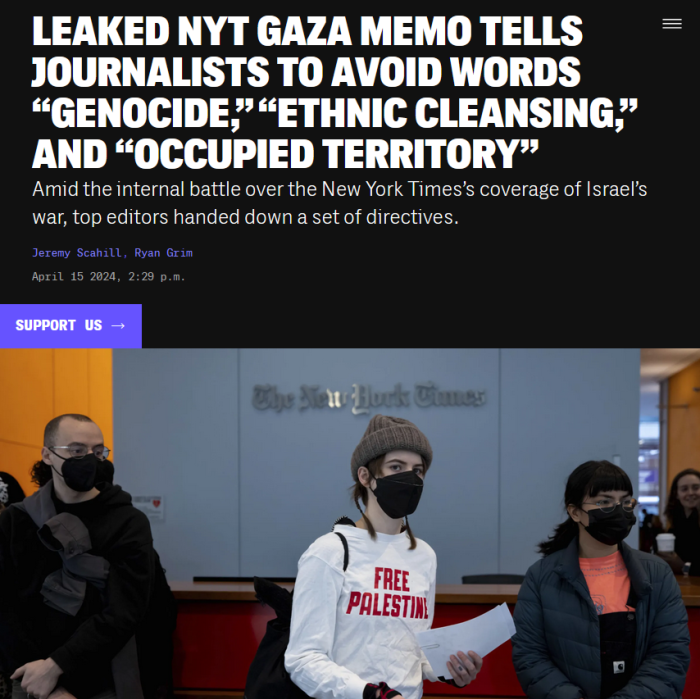
A New York Times staffer told the Intercept (4/15/24), “There are unique standards applied to violence perpetrated by Israel.”
If you’re confused about how the New York Times‘ supposed anti-Israel bias negatively impacts the company stock value, you should be. On the day the lawsuit was announced, Times Company stock opened north of $65, more than 20 points higher than its value on October 7, 2023. If Florida’s pension fund had bought shares of Times stock the day of the massacre, they’d be doing quite well today after three years of such coverage.
More importantly, the idea that if a government holds stock in a media company, it has the right to litigate the editorial decisions of the company’s news outlets—that’s an attempt to do an end run around the First Amendment. If the Florida pension fund is so morally disgusted at the Times’ coverage of Israel/Palestine, it can always divest. What it can’t do is enlist the court system to function as the Times‘ super-editor.
The lawsuit did not mention that their newsroom whistleblower isn’t the only one inside the Times with concerns about bias—but the others have said the problem is a pro-Israel slant. In 2024, there was dissent within the Times staff over the editorial and ethical standards involved in the paper’s story (12/28/23) about alleged sexual assaults against Israelis during October 7 attack, calling into question a bias in favor of Israelis (Intercept, 1/28/24; Washington Post, 3/2/24; Weekend Edition, 3/3/24; FAIR.org, 10/7/24).
The Intercept (4/15/24) reported on internal dissension over the Times‘ coverage of Gaza, citing staffers who “believed the paper was going out of its way to defer to Israel’s narrative on the events and was not applying even standards in its coverage.” The staffers cited the paper’s official restrictions on the use of terms like “genocide,” “ethnic cleansing” and “occupied territories” as “evidence of the paper’s deference to Israeli narratives.”
Unequal coverage of an unequal reality
The New York Post (9/13/26) finds it “damning” that the New York Times gave less attention to 437 Israeli soldiers who died attacking Gaza than to 73,000 Palestinians—at least half women and children—that the Israeli military killed.
FAIR.org’s readers know that there is substantial analysis showing the opposite of the lawsuit’s central premise, that in reality Times coverage of Gaza has bent over backwards for Israel (e.g., FAIR.org, 12/8/23, 1/25/24, 3/13/24, 4/18/24, 5/16/25, 6/5/25, 8/4/25, 9/4/25, 12/12/25).
When the New York Times (4/19/22) introduced its current top editor, Joseph Kahn, it cited the influence of his father, Leo Kahn, who “often dissected newspaper coverage with his son.” The elder Kahn was a board member of CAMERA, the fiercely pro-Israel media pressure group; the Times has frequently altered its coverage in response to CAMERA’s complaints (Intercept, 1/28/24.)
But everything is a matter of perspective. Florida’s lawsuit cites Edieal Pinker, a professor at the Yale School of Management, who claims in Studies in Conflict & Terrorism (9/7/26) that the Times has been too anti-Israel:
Namely, reporting on both Israeli military and civilian casualties incurred, post October 7, is sparse. Reporting on Israeli suffering through personal accounts of non–October 7 victims is very limited, while reporting of Palestinian personal accounts of suffering is very frequent. Reporting of Hamas militant casualties is sparse and reporting of Palestinian acts of violence post–October 7 is very sparse. Mentions of Hamas, Hezbollah or Iran are much less frequent than mentions of Israel.
“Personal accounts of Palestinian suffering appear two out of every three days, while comparable accounts of Israeli suffering rarely appear,” he said, while the New York Post (9/13/26), trumpeting Pinker’s “damning” study, added, “A total of 437 Israeli soldiers have been killed since the Jewish state began its offensive in Gaza.”
But 437 is a much smaller number than 70,000, which is the number of Palestinians Israel admits to killing in Gaza in the last three years (CNN, 1/31/26). Nor is there much mystery in why coverage of a war waged by Israel against Gaza mentions Israel much more frequently than Iran.
If the study found more coverage of Palestinian suffering than of Israeli suffering—and it’s not clear that it did; the category of “non–October 7 victims” seems to be carefully chosen—that would not be a sign of bias but of acknowledgement of reality. Gaza has been flattened, and major human rights groups both within and outside of Israel agree that that country is conducting a genocide there. In an apparent effort to suggest that Israelis are also having a rough time during the Gaza War, the New York Times (8/29/25) offered a report on “a series of hostile encounters between Palestinian supporters and Israelis traveling in Europe this summer.”
If Serbian nationalists complained that Western coverage of the siege of Sarajevo didn’t highlight Serb suffering or their nationalist motivation as much as the plight of Bosniaks, they wouldn’t be taken seriously. And rightfully so.
‘Fantastical tale of torture’
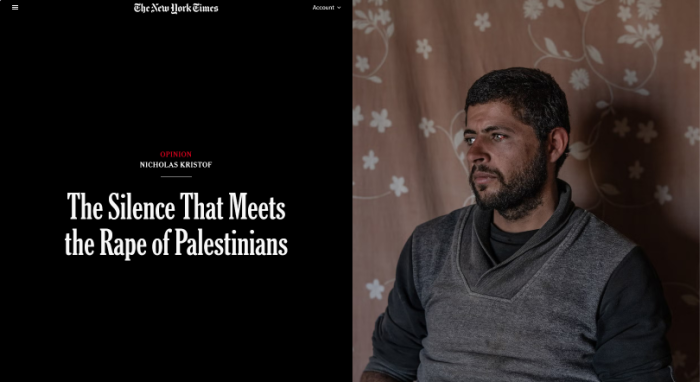
It’s unclear why this New York Times opinion piece (5/11/26) documenting sexual abuse of Palestinian prisoners represents the Times‘ bias, rather than the front-page Times news report (12/28/23) alleging systematic rape by Hamas on October 7, 2023, based on far shakier sources.
Among the other alleged editorial transgressions the lawsuit cites, one stands out: columnist Nicholas Kristof’s opinion piece (New York Times, 5/11/26) in which Palestinians recounted a “pattern of widespread Israeli sexual violence against men, women and even children—by soldiers, settlers, interrogators in the Shin Bet internal security agency and, above all, prison guards.” One of the sources claimed “he was held down and stripped naked, and as he was blindfolded and handcuffed, a dog was summoned,” who then upon command “mounted him.”
Kristof added, “Other Palestinian prisoners and human rights monitors have also cited reports of police dogs being coached to rape prisoners.” The article was accompanied by a video (5/11/26) of Kristof’s reporting.
The story outraged the pro-Israel right (Free Press, 5/12/26; The Hill, 5/18/26), and Israel threatened to sue the paper (Times of Israel, 6/3/26). The Wall Street Journal (5/13/26) called it a “fantastical tale of torture and dog rape in Israel.”
“Abuse in prisons and wartime detention obviously ought to be investigated, thoroughly and without prejudice,” admitted the anti-woke moral panicker Quillette (5/15/26), before the website accused Kristof of creating “a grotesque moral tableau,” demonstrating “how sexual accusation can become a political cudgel.” (Kristof’s accounts of sexual abuse in Israeli prisons corroborated violations documented by human rights observers—B’Tselem, 8/24; UN Human Rights Council, 5/27/24; CPJ, 2/19/26.)
The right’s rejection of the possibility that Israel could teach dogs to rape prisoners has a cruel twist, as Nazi commander Klaus Barbie taught dogs to sexually assault Jewish prisoners (Jewish Telegraphic Agency, 5/27/87; Canadian Journal of Human Sexuality, 7/28/15; X, 5/13/26).
‘The left’s appalling admiration’
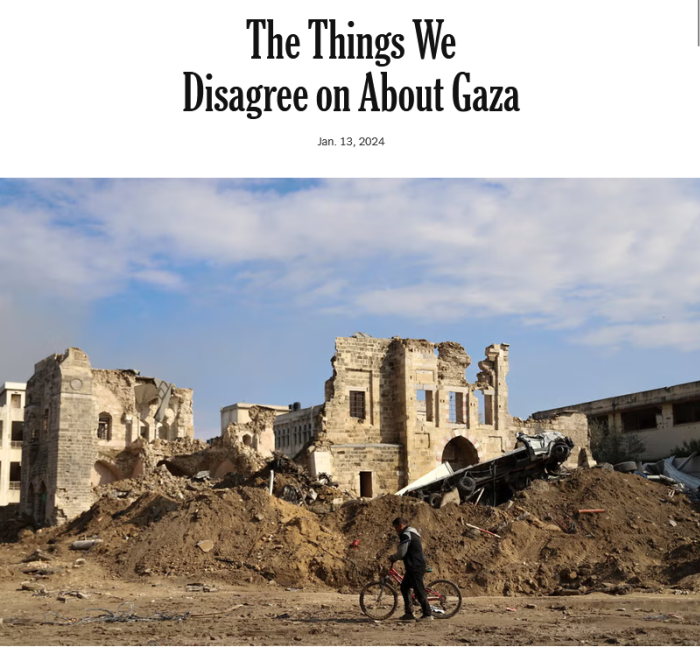
The New York Times‘ Nicholas Kristof (1/13/24) and his Zionist critics apparently agree that one should treat the history of Israel/Palestine as if it started on October 7, 2023.
The choice of including Kristof’s work as an example of rampant anti-Israel fervor at the paper is curious. For one thing, he commonly writes about human rights abuses by US enemy states like China (New York Times, 1/24/08, 5/22/19, 6/1/19, 6/12/21), Russia (11/16/22, 7/15/23) and Venezuela (1/4/26), so he’s hardly anti-West. Nor is he some radical Israel-basher; as FAIR’s Julie Hollar (2/1/24) noted in a study of Gaza opinion, “Kristof was hardly a voice for the pro-Palestinian left, and twice made clear his position against a ceasefire.”
Take this line from a column on Gaza where he describes why he has focused his recent coverage on Israel, while also admonishing Hamas and the left-wing pro-Palestine movement (New York Times, 1/13/24):
Yes, Hamas started this war with its brutal attack on civilians, and it has been indifferent to Palestinian lives. As someone who has reported regularly from Gaza over the years, I’m aghast at the admiration some American leftists show for an organization as cruel, misogynistic and economically incompetent as Hamas; it’s an echo of the left’s appalling admiration for Mao a half-century ago.
“Hamas started this war.” In fact, Israel had killed more than 7,000 Palestinians in the Gaza Strip from 2000 up until October 7, 2023, according to the Israeli rights group B’Tselem. Kristof’s framing hardly shows “anti-Israel bias.”
Working for the clampdown
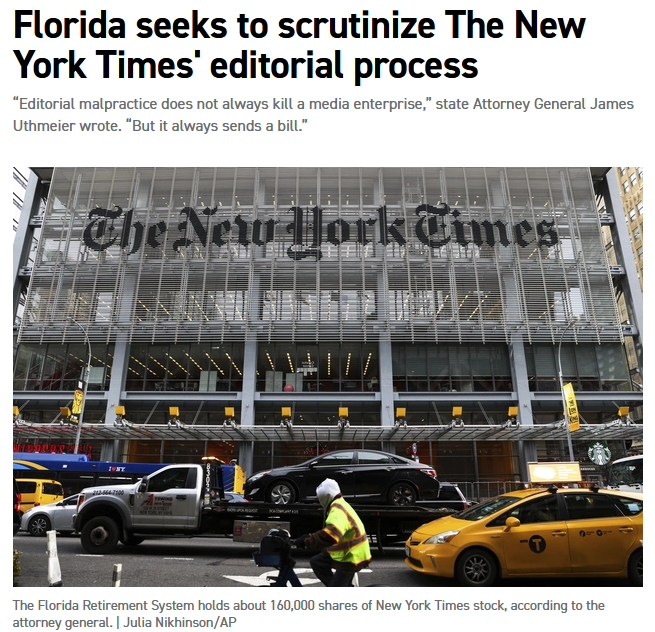
The New York Times told Politico (8/10/26) that Florida’s demand, “while positioned as a request under corporate law, is a clear attempt to chill First Amendment–protected journalism.”
For free speech reasons alone, press advocates should hope a judge quickly dismisses this lawsuit. But one still has to question the broader agenda here.
It’s not shocking that this suit comes out of Florida, which under Republican Gov. Ron DeSantis has led the nation in a clampdown against academic freedom (People, 3/27/26) and the LGBTQ community (Human Rights Campaign, 5/17/23). As it happens, Uthmeier—who is running in a tight race for re-election (Florida Politics, 9/17/26)—previously served as DeSantis’ presidential campaign manager, as well as the governor’s chief of staff; he’s been described as “one of his most trusted advisers” (New York Times, 8/8/23).
“Targeting the New York Times is a fitting move for Uthmeier, who as Gov. Ron DeSantis’ handpicked attorney general has gone after companies like Target on similar grounds,” Politico (8/10/26) reported in the run up to the lawsuit. (The attorney general had argued “that marketing for LGBTQ±friendly products lost investors like Florida money,” the website noted.)
If Florida wants to keep its title as the former Confederate state leading the way in authoritarian overhaul, then attacking the nation’s most prominent Democrat-friendly newspaper helps its cred. DeSantis and his allies had previously attempted to legally curtail press freedom in his state (FAIR.org, 5/5/23).
Meanwhile, some people fear “a measure approved by Florida lawmakers could jeopardize student speech and free expression,” as it “empowers the state to designate domestic and foreign terrorist organizations, and would also mandate universities to expel students if they ‘promote’ a terrorist group” (Tallahassee Democrat, 3/16/26).
Israel has been a part of DeSantis’ national posturing. After the October 7 attack DeSantis said he “arranged to send drones, weapons and ammunition to Israel as it prepares for an incursion of Gaza” (AP, 10/26/23), and he once declared, “I promised to be the most pro-Israel governor in America” (X, 5/24/19). He warned Airbnb that it faced “sanctions over its decision not to list properties in Israeli settlements in the West Bank” (Miami Herald, 1/16/19). Last year he signed a bill expanding the state’s anti-BDS law by “mandating divestment from boycotting entities, requiring anti-discrimination certifications for arts grants, and restricting contracts with foreign educational institutions that boycott Israel” (Florida’s Voice, 6/27/25).
Florida is taking all of that energy to New York.
Making war on reality
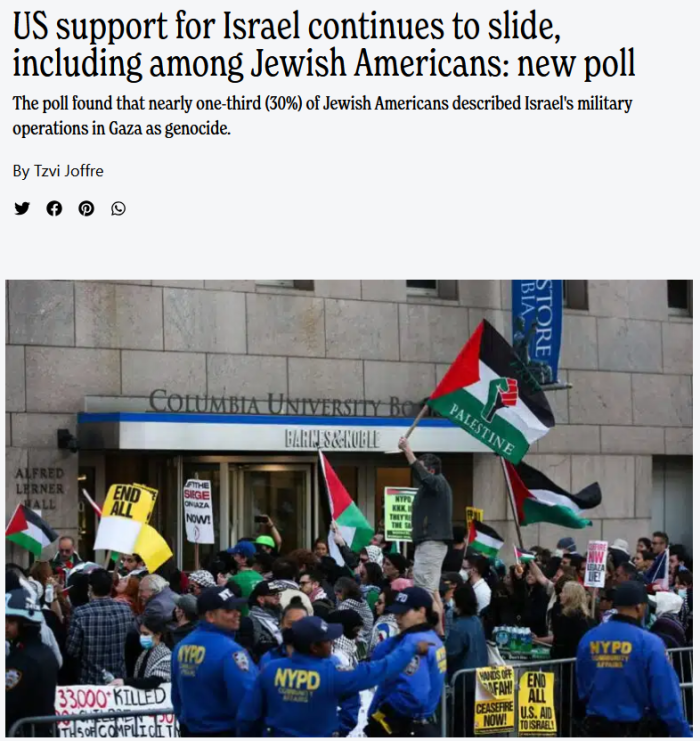
“Nearly a third of all American respondents agreed that Israel committed a genocide in Gaza, while only two in 10 disagreed,” Unpacked (7/17/26) reported, citing an AP/NORC poll (7/7/26).
Despite the general corporate media bias in favor of Israel that FAIR and others have analyzed over the years, Zionists are struggling in the war for public opinion (Haaretz, 9/11/26).
Today, music and film stars are standing with Palestinian victims the same way they have done for victims of war and genocide in the past. Since October 2023, American “public opinion toward Israelis has grown increasingly negative” (Pew Research, 7/9/26). A third of Americans believe Israel has committed genocide (AP, 7/7/26). Last year, polling for American approval of Israel’s actions in Gaza hit 32%, a new low (Gallup, 7/29/25).
It’s harder and harder for pro-Israel groups to claim the ethnic cleansing is justified in response to the October 7 attack. So they are resorting to claiming that these images and narratives of destruction and loss are simply not real.
This lawsuit helps give supporters of Israel an excuse to not believe what they are seeing. Instead they should assume that a paper owned by a prominent New York Jewish family, the Sulzbergers, is creating facts about Gaza that put Israel in a bad light.
The Times publicly said it will fight the lawsuit. Beyond that, press freedom advocates should be concerned about the immediate implications of this lawsuit, but also the grander issue problem, which is that the pro-Israel community, depleted of plausible defenses of this rogue regime, has to make war with both reality and the messengers of this egregious human rights crisis.
From FAIR via This RSS Feed.