

Bullets:
Last November, President Trump predicted that China’s monopolies over rare earth metals would end, within eighteen months to two years.
But nearly a year later, analysts conclude that some progress is being made on light rare earths, yet not nearly fast enough to change much until 2030.
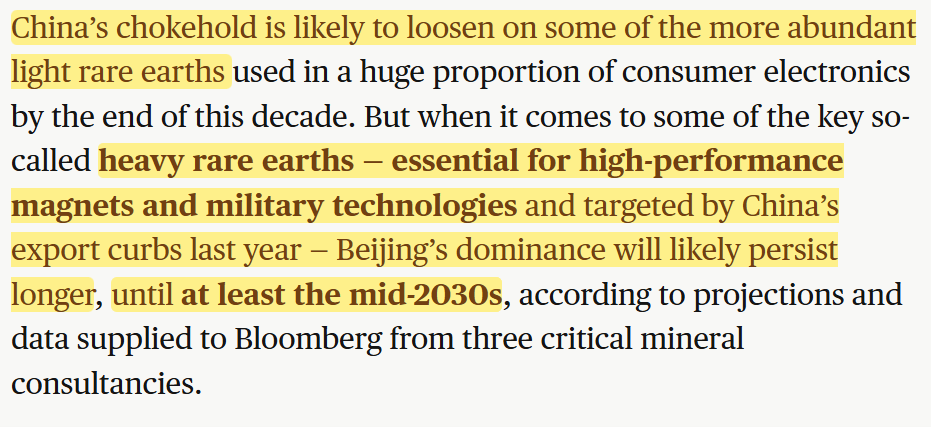
In the case of the heavy rare earth elements, however, China’s dominance will last at least another decade, and will cost over a trillion dollars to close.
It is the heavy rare earths that are urgently sought by weapons makers and manufacturing.
China has strict export bans of rare earth metals and magnets for military applications.
Inside China / Business is a reader-supported publication. To receive new posts and support my work, consider becoming a free or paid subscriber.
Report:
Good morning.
China has near monopolies on the mining and the refining of the most important metals, which are necessary for modern life. And that’s a big problem for the Pentagon and the EU, who need Chinese rare earth metals and magnets to rearm. That’s also a big problem for the artificial intelligence theme and the trillions of dollars invested there, because components and materials from China are required to get the AI data centers built. And it’s a big problem for Western manufacturers of new energy vehicles and power generation equipment.
For decades, it was just assumed that weapons makers and factories could just pick up the phone and order up whatever they needed to build bombs or fighter jets or electric cars. But China has shut off the exports of those metals to any Western company that takes Pentagon money, and that is almost all of them, seems like. And now that it’s the Pentagon who can’t get their products made, it’s a national emergency, and Western governments are promising to solve the problem, and quickly.
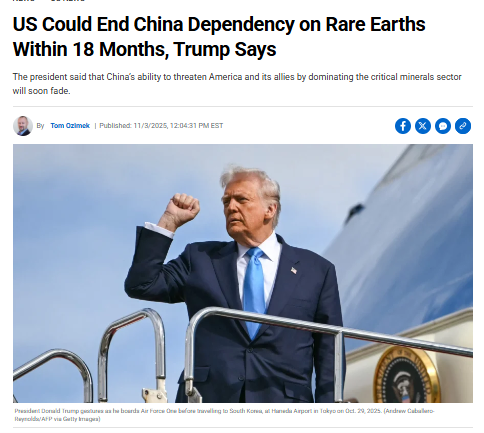
Last November, President Trump said that the US dependence on China for rare earths would end within 18 months. New partnerships with Japan, Australia, and the UK would ensure that a year from now—within two years tops—from that time-- “rare earths will really cease to be a problem.”
China’s export controls “galvanized the US and its allies to go at warp speed” and build out new supply chains. We’ll leave the “warp speed” thing alone for now, but we have heard that before.
There is an American company, the Mountain Pass Mine, which was taken over by a New York hedge fund, and is attracting lots of new capital to reboot operations and expand. One of the owners was a hedgie himself, and now runs the day-to-day at Mountain Pass, and he’s maybe the closest thing the United States has to an expert in the rare earth industry.
To understand why a hedge fund manager would head West and buy some shovels and buckets, there’s our answer: The motivation is driven by the “West’s rearmament cycle”—now desperate for new missiles, bombs, drones, fighter jets, subs, plus the replacement of all the munitions that have been blown up by wars in Europe and the Persian Gulf and in Gaza. MP Materials is Mountain Pass, and is one of a handful of companies that can, in theory, scale up to supply some of the metals that the Pentagon is desperately short of.
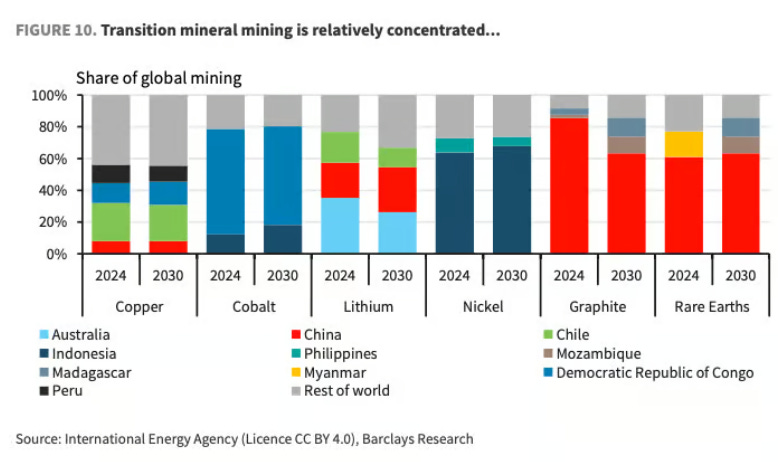
The world map is a major feature of the metals race. Here is where the mines are for copper, cobalt, lithium, nickel, graphite, and the rare earths. The first vertical bar is where the mining is now, and then where it will be in 2030. Nothing can move those needles much. And except for Australia, in light blue, which has a lot of lithium and will lose share to China—in red—by 2030, and the Philippines, which for some reason doesn’t show up on the chart at all, all those other countries are much closer to China, than with the United States or the EU.
That’s the mining. Then there’s the processing—where China and its key trading partners is more than the rest of the world, combined:
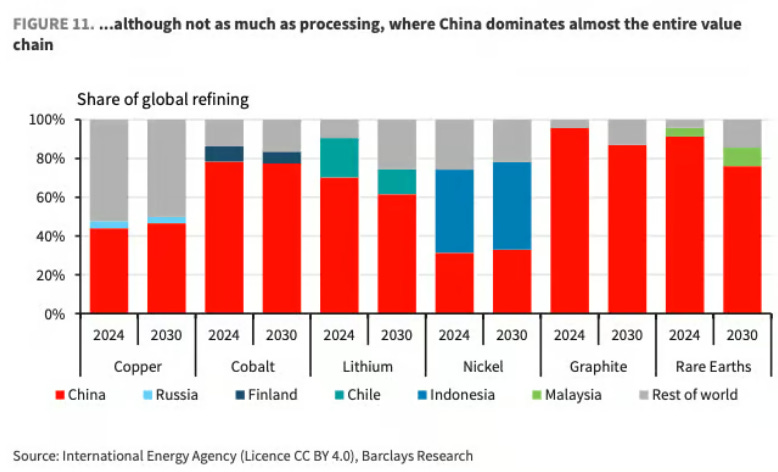
So last November was 11 months ago, and the clock is ticking on the White House efforts to build new supply chains for all those things that China and their key trading partners have. And it’s possible that for some of the light rare earths, progress might be made by the end of this decade. But that makes it December of 2030, not mid-2027. And for everything else, analysts are calling for China’s dominance in those industries to go for at least another decade.
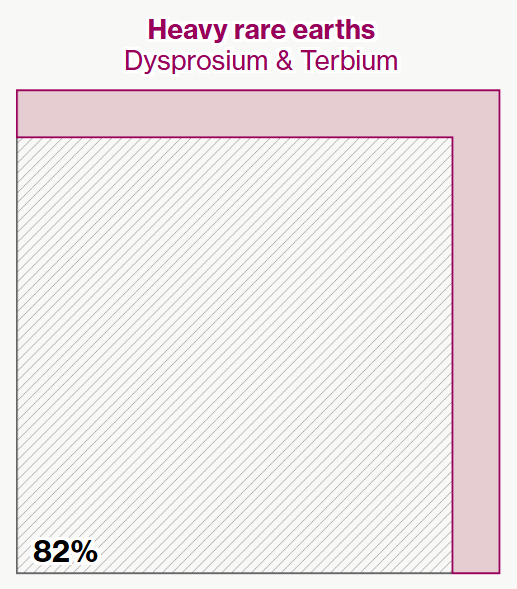
The heavy rare earths are what the Pentagon needs. In the case of dysprosium and terbium, China will still be more that the rest of the world, combined, times four, in 2035.

And things don’t look great on the light rare earths anyway, because demand is growing much faster than non-China supply can match. It is possible that new technologies and applications will be developed, which can reduce reliance on China, but there’s a problem with that thesis we’ll get to.
Japan serves as a strong example for the problems faced by Washington and Europe; the Japanese have been trying for ten years to get away from China, and basically got nowhere. Chinese suppliers are the source of three-fourths of all Japanese rare earth imports, and almost all the heavy rare earths. The heavies are hard to process, and are much rarer than the lights. And it’s a full supply chain problem: China- and China-controlled mining of light and the heavy rare earths are 82% and 96% respectively. For the refining, it’s 91 and 99. For the magnet production, it’s 94%.
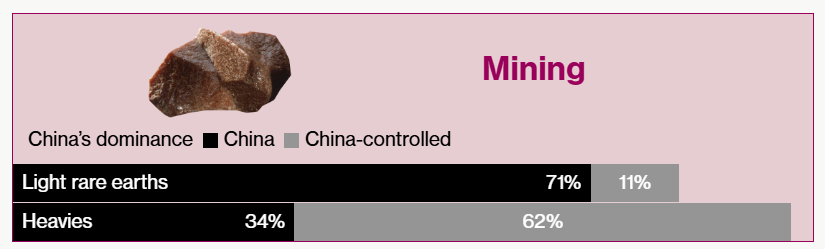
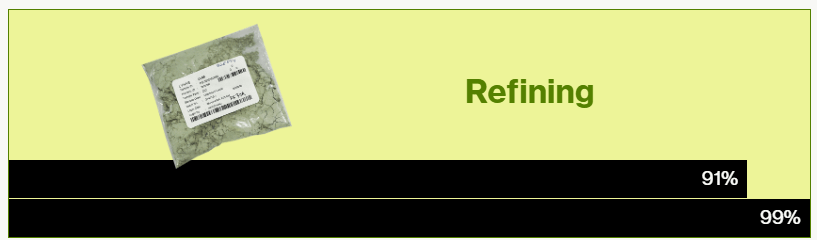
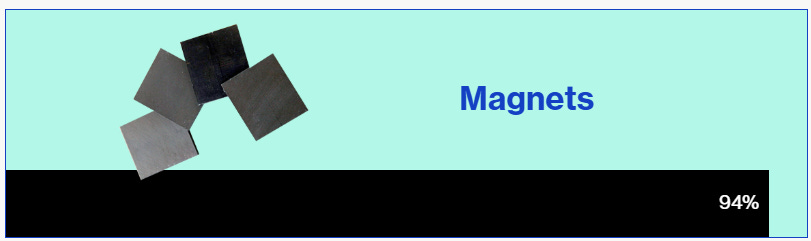
And we’re back to the maps, and back to the same problem. Most of the mines currently in production, and those that are still in the planning stages, are in countries that are far friendlier with China, than with the United States:
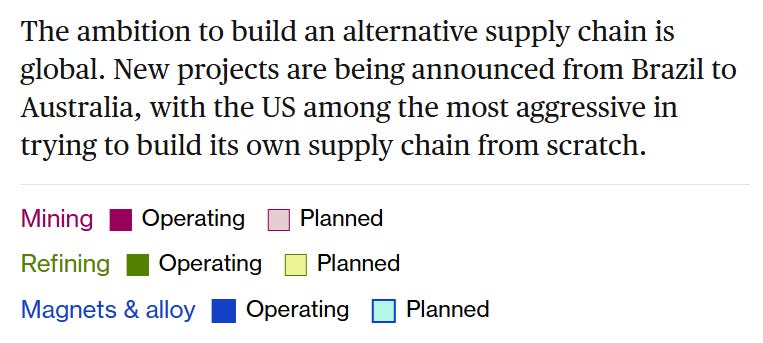
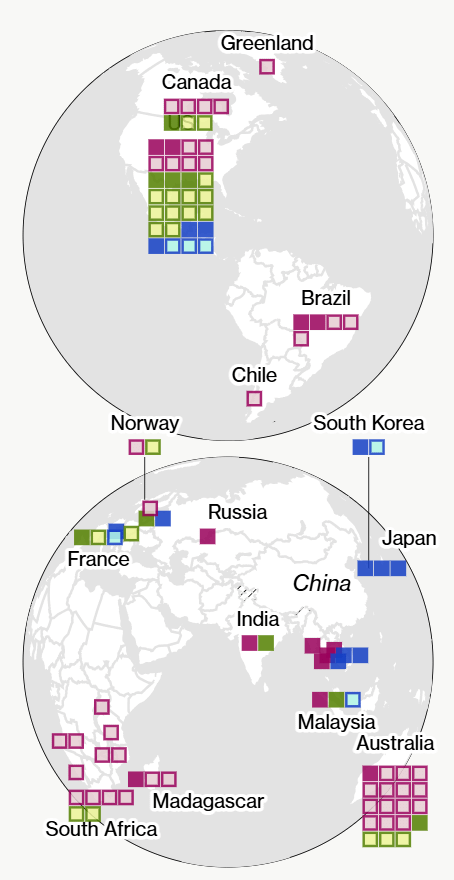
The United States itself doesn’t have most of the rare earths to begin with, and no matter where the deposits are found, it takes a long time to get them out of the ground. Once that’s done, they need to be separated, and that’s where China’s advantages really stand out, as China started this race decades ago.
China has the mines, the refineries, the patents, and the deep expertise in all these technologies. Top talent in chemistry is necessary for the separation and refining, and China has just about all of the world’s top university programs for chemistry. While the United States has fewer than a hundred experts in rare earth separation, China has thousands of them.
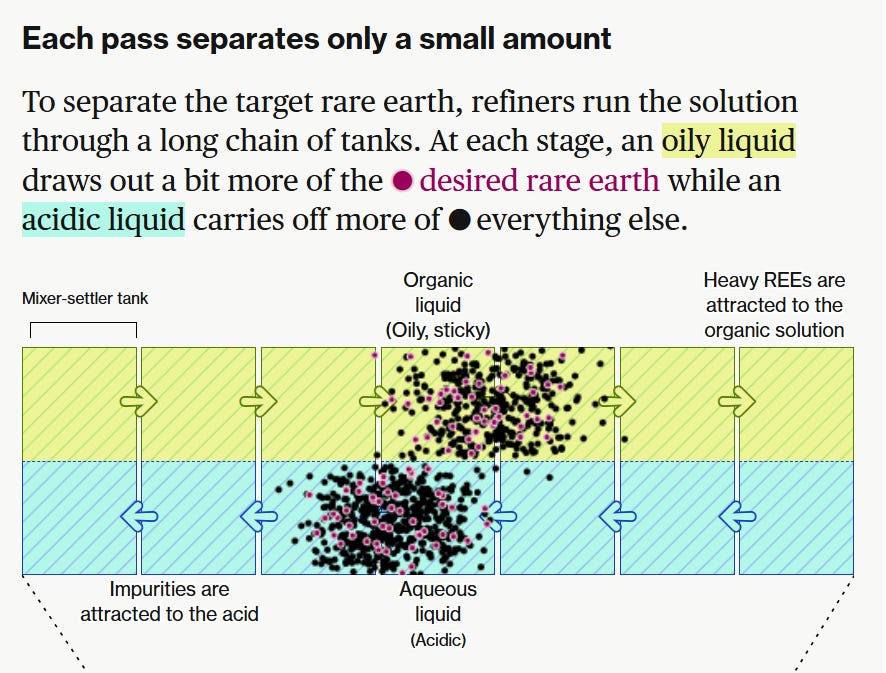
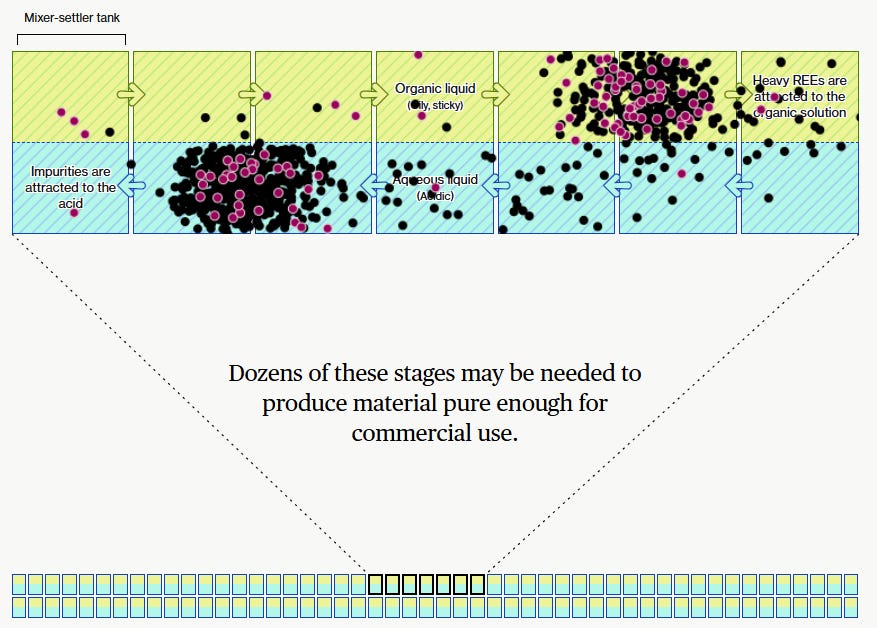
The challenge for the separation is the chemical processes, and the huge expenses needed to get them set up. Light rare earths are easy to tell apart. But for the heavies, very intensive refinement processes are required to separate them. Separation facilities involve a series of tanks, with oil and acidic liquids.
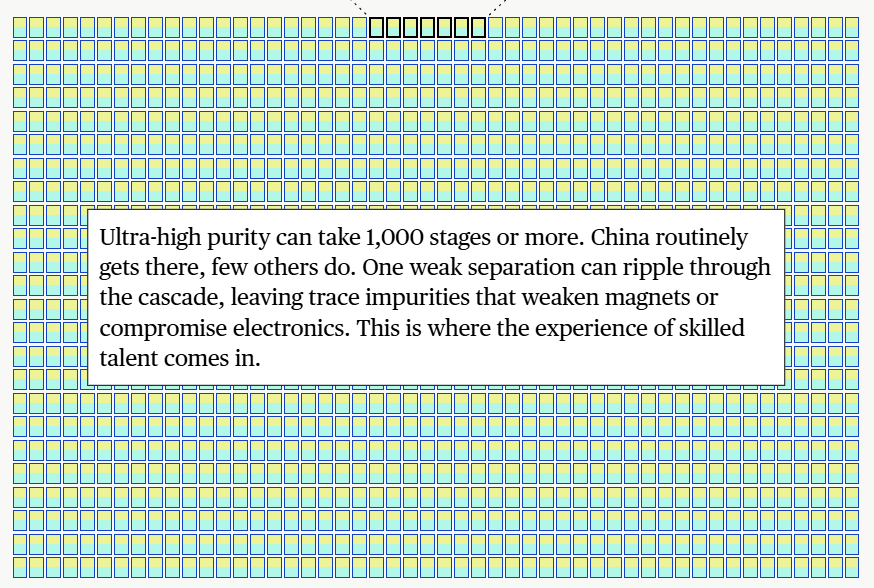
To get the gunk to industrial grade, those processes are run dozens of times. A thousand iterations or more are required to get the highest purities. The “experience of skilled talent” comes in, and we can maybe appreciate that a former hedge fund manager looking at rocks probably lacks the expertise to do much with them, except pick them up and send them to China for the separation and refinement work.
And there is another serious obstacle in this race to build new China-proof supply chains, which is the law of supply and demand itself; the prices paid. The economics of heavy and light rare earth elements run in parallel, China owns the supply, and by the way most of the demand side as well. For the rare earths, it’s Chinese firms that are meeting in the middle to determine prices for everything.
To compel new exploration and development, Western governments are stuck with the question of how to insulate investors and operators from Chinese competition later. Price floors is one idea: by guaranteeing high prices for rare earth producers for the Western markets, producers might be more comfortable making multi-billion dollar investments going out decades.
Problem is that governments turn over regularly, and a deal signed with the Trump Administration might not be in effect in 2029, let alone in 2035. But it also destroys the incentive of engineers to design around the rare earths problem by finding substitute materials.
For now, the US government is throwing money at the problem. By the way, new investments in 2026 cost a lot more than what China paid, decades ago, to get their supply chains built. So it’s a structural problem already, from a return on invested capital standpoint. Over $9 billion in new projects were announced through the first quarter of this year, and some production is already online.
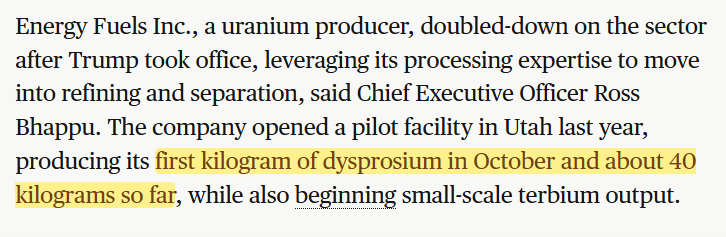
And looking again just at the two we mentioned earlier—dysprosium and terbium. Energy Fuels has a facility in Utah for dysprosium, is learning how to do the separation and refining, and has thus far produced 40 kilograms. That was noteworthy enough for Bloomberg to mention it, but we see how far they’ve got to go.
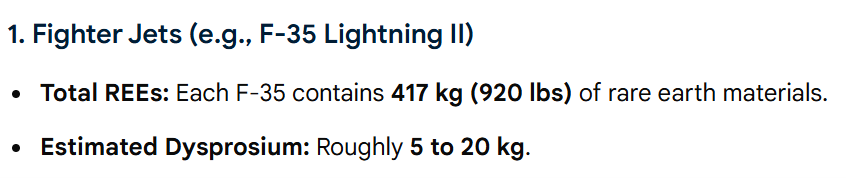
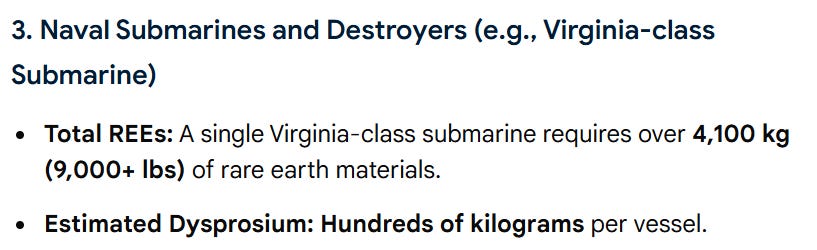
Forty kg is enough for just a couple of F-35’s, and doesn’t do anything at all for the Navy.
So with less than a year to go, we’re not even close.
Be Good.
Resources and links:
US Could End China Dependency on Rare Earths Within 18 Months, Trump Says
https://www.ntd.com/trump-says-us-rare-earths-emergency-program-will-end-china-dependency-within-18-months/_1105464.html
The American rare earths company seeking to topple China’s dominance | 60 Minutes
The $40 Billion Minerals Gamble: Can Trump Break China’s Chokehold Before The West’s Rearmament Hits A Wall?
https://www.zerohedge.com/commodities/40-billion-minerals-gamble-can-trump-break-chinas-chokehold-wests-rearmament-hits-wall
US Needs Another Decade to Fix $1.2 Trillion Rare Earth Crisis
https://www.bloomberg.com/graphics/2026-us-china-heavy-rare-earth-magnets-defense/
US Expands Search for Critical-Mineral Projects for Defense Gear
https://www.bloomberg.com/news/articles/2026-08-24/us-expands-search-for-critical-mineral-projects-for-defense-gear
China’s rare-earth mineral squeeze will hit the Pentagon hard
https://www.defenseone.com/threats/2025/04/chinas-rare-earth-mineral-squeeze-will-hit-pentagon-hard/404776/
Pentagon rare earth push collides with China’s grip
https://www.mining.com/pentagon-rare-earth-push-collides-with-chinas-grip/
Why Google, Amazon and Microsoft Need Chinese Data Center Suppliers
https://www.theinformation.com/newsletters/ai-infrastructure/google-amazon-microsoft-need-chinese-data-center-suppliers
China’s control over indium phosphide exports threatens AI data centre rollout
https://www.reuters.com/world/china/chinas-control-over-indium-phosphide-exports-threatens-ai-data-centre-rollout-2026-06-11/
China targets US rare earth and other firms with export controls
https://www.reuters.com/world/asia-pacific/china-targets-us-rare-earth-other-firms-with-export-controls-2026-06-22/
China targets US rare earth and other firms with export controls
https://www.reuters.com/world/asia-pacific/china-targets-us-rare-earth-other-firms-with-export-controls-2026-06-22/
MP Materials, About Us
https://mpmaterials.com/leadership/michael-rosenthal/
The Rare Earths trade war just got complicated: Chinese industries need them here
US rare earth investments, price floors aim to challenge China’s market grip
https://www.spglobal.com/energy/en/news-research/latest-news/metals/052926-us-rare-earth-price-floors-aim-to-challenge-chinas-market-grip
Chart: Global clean energy manufacturing, by the numbers
https://www.canarymedia.com/articles/clean-energy-manufacturing/chart-global-clean-energy-manufacturing-by-the-numbers
Best Global Universities for Chemistry
https://www.usnews.com/education/best-global-universities/chemistry
China took over another $5 trillion industry, and Europe is moving money and jobs
Inside China / Business is a reader-supported publication. To receive new posts and support my work, consider becoming a free or paid subscriber.
From Inside China / Business via This RSS Feed.