

On Sunday night, Lula supporters waited nervously amid a sea of red in Laranjeiras, one of Rio de Janeiro’s most leftwing neighbourhoods. As election results rolled in, worried expressions spread across the main square, Praça São Salvador, and the chatter at tables grew lower and more urgent.
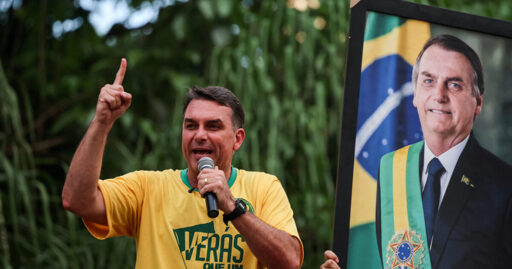
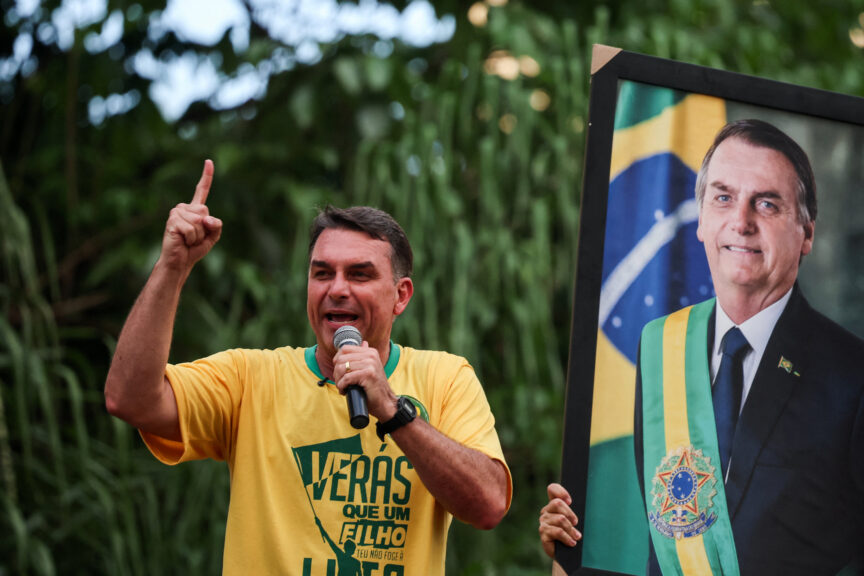
It was not just that there would be a second round; Brazilians had been expecting that for months. It was that senator Flávio Bolsonaro, the son of imprisoned far-right former president Jair Bolsonaro, would now head into it as the frontrunner, around 2.22 million votes ahead of the leftwing incumbent, Luiz Inácio Lula da Silva.
While the result wasn’t unimaginable, most polls did not expect Flávio to come out on top. Neither did common sense: the far-right candidate has spent much of the last year embroiled in the largest banking scandal in the country’s history, with his popularity tanking at times as a result.
In May, one poll had Flávio falling from three to nine points behind Lula, immediately after it emerged that he had sought $24m (£18m) from the former owner of a collapsed bank to fund a hero biopic about his father. (Entitled Dark Horse, the film, which came out in June, stars US actor Jim Caviezel.)
But as the Banco Master scandal took unexpected turns – and the right found new people to blame – the far-right candidate gradually closed the gap, eventually inching ahead of Lula in some September surveys.
Now, after Sunday’s surprise result, many Brazilians are left wondering: did a scandal that should have sunk Flávio and his party actually help put him in first place?
‘In this country, we choose the least bad.’
Until 2024, the mid-sized lender Banco Master grew at breakneck speed by selling high-yield debt through investment platforms. According to federal police investigators, much of that growth rested on the relationships its owner, businessman Daniel Vorcaro, cultivated with the upper echelons of Brazilian politics: federal deputies, senators, former governors and supreme court justices.
Investigators allege Vorcaro – who has been in pre-trial detention since March, and denies all wrongdoing – offered favours, ranging from luxury trips abroad and lavish dinners to parties with sex workers, in exchange for information and political cover for the bank’s interests.
In May, the Intercept Brasil published messages and audio that revealed a close personal relationship between Flávio and Vorcaro, with the presidential candidate calling the banker “brother” in some of the many correspondences they exchanged.
Flávio’s party colleague, meanwhile, was resigned as the Rio de Janeiro governor in March after police opened an investigation into the state’s enormous investment into Banco Master under his leadership. In the time that Cláudio Castro was in office, Rio’s public-sector pension fund put roughly R$1.6bn (£232m) of civil servants’ retirement savings into the bank.
The scandal, which has been headline news in Brazil for months now, has had an enormous impact on the election, with 7% of voters telling pollster Quaest that it might change their ballot. Given Brazil’s electorate is over 150 million, that’s roughly 10 million people – four times the margin that now separates the two candidates.
But precisely how the scandal has affected votes hasn’t been straightforward or consistent over time.
Outside a polling station in Barra da Tijuca, an affluent district in Rio’s west zone, 48-year-old doctor Luciana Frávola said she would still vote for Flávio. “In this country, we choose the least bad,” she told Novara Media. “The PT’s [Lula’s Workers’ Party’s] involvement with Master was bigger than the PL’s [Flávio’s Liberal Party].”
The evidence doesn’t support Frávola’s claim; Lula’s party has not been connected to the scandal in the way Flávio’s has. But in September a new story broke that implicated a different enemy of the Bolsonaros. For many Flávio voters, this has become the scandal’s most salient chapter.
In 2025, Brazil’s supreme court sentenced Jair Bolsonaro to 27 years in prison for plotting to overturn his 2022 election defeat. The case was overseen by Justice Alexandre de Moraes, long regarded by the Bolsonarist right as the embodiment of judicial overreach. A federal police report unsealed in September put Moraes under suspicion by suggesting Vorcaro may have sought the protection of Brazil’s most powerful judge as investigators closed in on his bank.
The report describes in-person meetings between the two men dating back to at least 2023. In a series of messages sent to a contact saved as “Alexandre de Moraes BRASILIA”, Vorcaro repeatedly asked for help approaching the heads of the federal police and the prosecutor-general’s office to halt the investigation.
The messages also show Vorcaro making priority payments to a law firm run by Moraes’s wife, which had a R$129m, three-year contract to represent the bank “wherever necessary”.
Moraes has not been charged, and Brazil’s prosecutor general – himself named in Vorcaro’s messages – has argued the police report should be thrown out. Nor has he been cleared: whether to open a formal investigation is now before the full supreme court, which suspended its deliberations in mid-September. But concern is not confined to the right. Within days of the report’s release, Brazil’s three largest newspapers – Estadão, O Globo and Folha de S.Paulo – published editorials calling for him to step down.
Because the supreme court has acted largely as a unified bloc in cases involving Bolsonaro and his allies, the allegations have cast doubt on the court as a whole. The effect has been to shift the focus of the scandal away from Flávio, who sought millions from Vorcaro, and on to Moraes, the judge who convicted his father. For many of Flávio’s supporters, the Master affair is no longer evidence against their candidate, but confirmation of their long-held view that the court was never impartial.
The Bolsonaros, Trump and Netanyahu.
Not all the pressure on the race has come from inside Brazil. Washington has made little secret of its preference. In July 2025, Donald Trump imposed 50% tariffs on Brazilian goods, calling Jair Bolsonaro’s prosecution a “witch hunt”. This July the administration confirmed a new 25% tariff, first proposed in June, a week after Flávio met Trump at the White House. Flávio says he asked for it to be delayed, but a Datafolha poll found 52% of voters believed it was meant to help his campaign.
On election day, Brazil’s federal police confirmed a preliminary inquiry into possible US interference, following a Guardian report that the state department had earmarked around $1m (£750,000) for groups campaigning against the supreme court.
Elsewhere in the region, Trump has been less subtle: last year he tied a $20bn (£15bn) bailout of Argentina to Javier Milei’s midterm victory, and threatened Honduras with aid cuts unless his preferred candidate won. Both did.
Online, meanwhile, an Amnesty International test in August found Facebook approved more than half of a batch of ads containing election disinformation, including claims of fraud and calls for military rule. Meta said the sample was small and the ads were never published.
Flávio also has support from Israel, with Benjamin Netanyahu publicly backing him at his campaign launch. The presidential candidate has pledged to move Brazil’s embassy from Tel Aviv to Jerusalem. For much of his evangelical base, this is less a matter of foreign policy than of faith. Christian Zionism – the belief that the modern state of Israel fulfils biblical prophecy and that supporting it is a religious duty – has become a pillar of the Brazilian right, imported largely from American evangelicalism.
Frávola, the Flávio voter from Barra da Tijuca, was blunt about foreign policy. “Lula’s policy on Israel and Palestine is completely wrong,” she said. “Hamas is a terrorist group.” Lula’s government condemned the 7 October attacks; but has also been one of the most vocal critics of Israel’s genocide in Gaza.
Meanwhile Rodrigo, who was voting at the same polling station, said he wanted a foreign policy distanced from Iran, South Korea and China, which the 52-year-old described as “leftwing countries with totalitarian governments”. China has been Brazil’s largest trading partner since 2009, buying around a third of its exports – mostly soybeans, iron ore and oil – and remained so throughout Jair Bolsonaro’s presidency from 2019 to 2022.
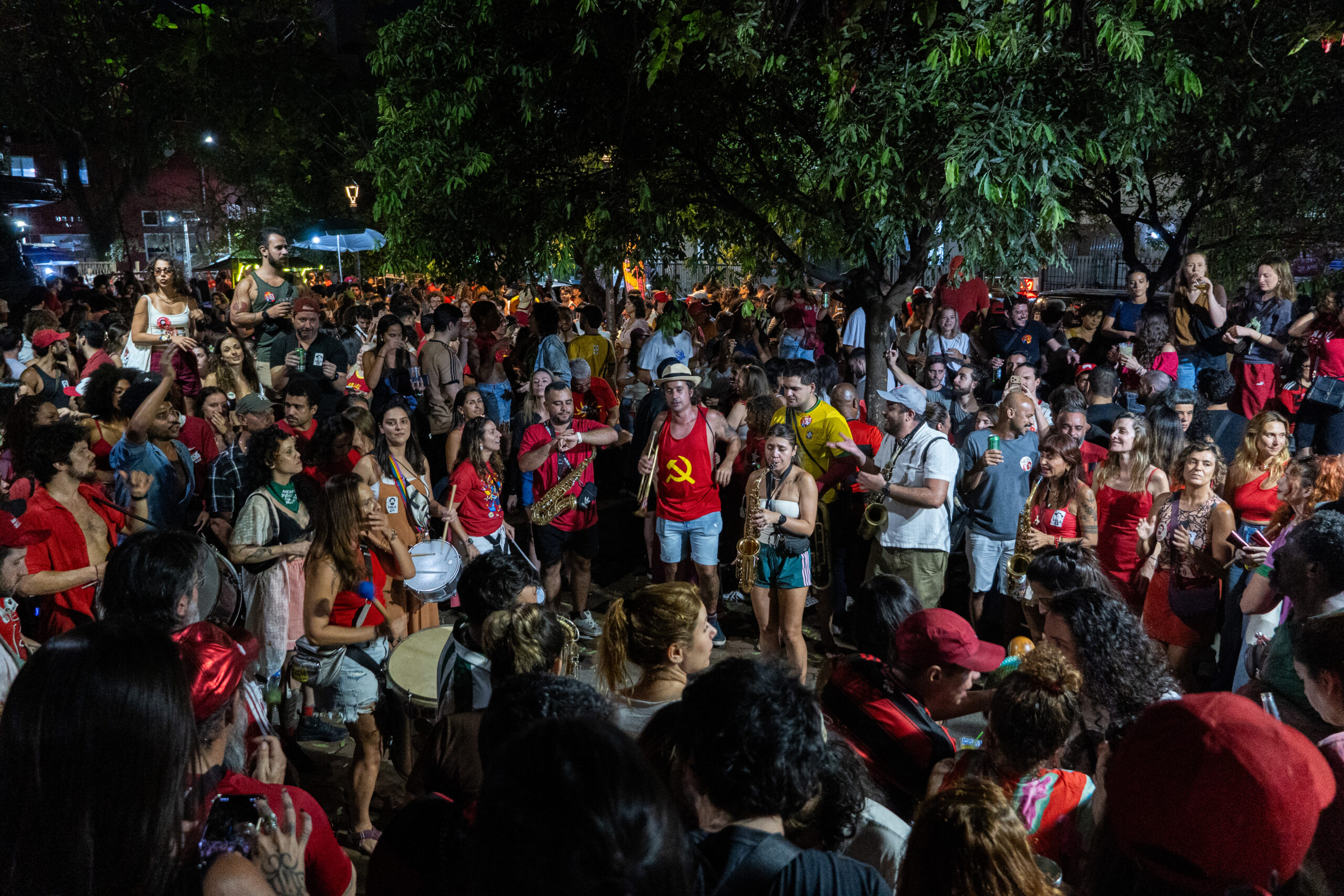
Photo: Rami Hussein
The scandal that should have sunk Flávio Bolsonaro has, at the very least, failed to stop him. But in Laranjeiras, long after the result came in, Lula’s supporters were still singing, dancing and chanting for a Brazil that is sovereign and plural.
As saxophonists played the Italian antifascist anthem Bella Ciao, Mariana Miranda, a 46-year-old public servant, told Novara Media she was undeterred by the result, and confident Lula could still win the run-off on 25 October.
“Politics is something we do every day’’, she said. “People have the right to dream, to desire. But to desire you need a full stomach, dry clothes, a bed to sleep in, living children.”
“I believe in social justice,” she added. “That’s why I voted for Lula.”
From Novara Media via This RSS Feed.