

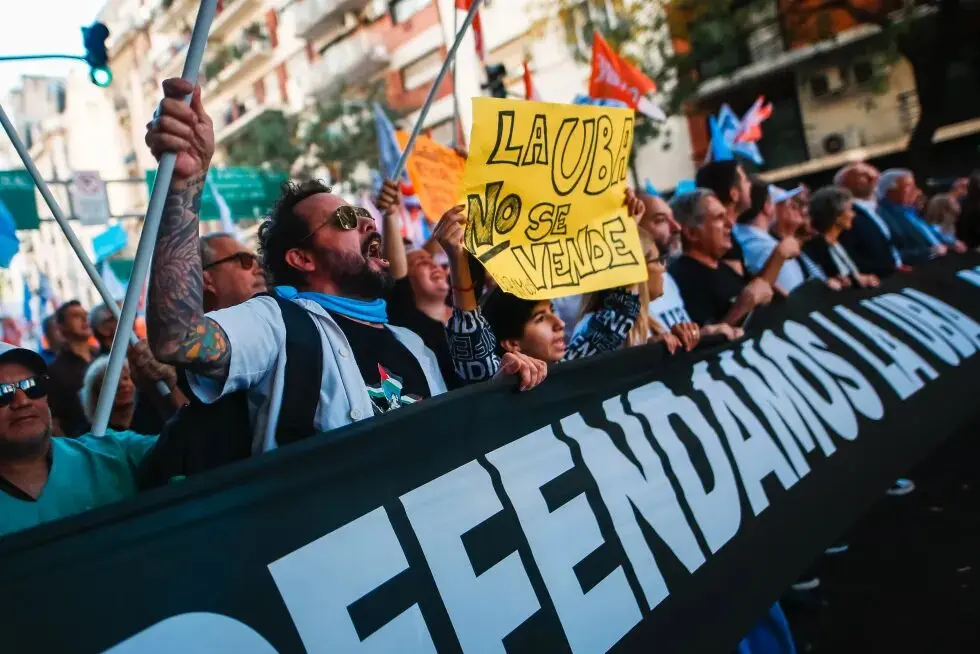
Argentina’s federal court declared unconstitutional the decree through which President Javier Milei sought to halt the University Financing Law this Tuesday, ordering the government to immediately transfer budget funds to public universities.
The ruling responds to a collective legal action filed by the National Interuniversity Council (CIN), the University of Buenos Aires (UBA) and several teachers’ unions.
The 50-page decision was issued on Tuesday by Federal Administrative Court No. 11, under Judge Martín Cormick, and nullifies Decree 759/2025. The judge also held that the Executive lacks valid arguments for failing to comply with a law passed by Congress.
RELATED: President Javier Milei Vetoes University Budget Law
The disputed decree had promulgated the law but suspended its practical implementation, citing an alleged absence of explicit funding sources. To justify the move, the Argentine government leaned on Article 5 of Law 24.629, consistent with Article 38 of the Financial Administration Law, which requires any rule authorizing unplanned spending to detail the resources covering it.
Cormick rejected that reasoning. He noted that the University Financing Law (27.795) itself sets out clear funding guidelines in its Article 9. Giving greater weight to earlier norms, he argued, wrongly assumes Congress ignored the legal framework in force. In fact, he wrote, the legislature met the requirements of Article 5 of Law 24.629 by insisting on the new legislation with the necessary majorities.
⚖️ La justicia declaró inconstitucional el decreto que frenó la Ley de Financiamiento Universitario y ordenó aplicarla de inmediato.
🇦🇷 #UniversidadPúblicaSiempre #UNSJ #SanJuan #Argentina pic.twitter.com/mWQZbQuUES
— UNSJ Oficial (@UNSJ_Oficial) October 6, 2026
Text reads: “The judiciary declared unconstitutional the decree that halted the University Funding Law and ordered its immediate implementation.”
Decree Lacked Reasonableness
Cormick concluded the decree “does not pass a minimum test of reasonableness, since it allows suspending and disapplying, under the pretext of an article of a previous law, the application of a law on which Congress insisted with the required majorities.”
The conflict unfolded over more than a year. Congress approved the University Financing Law in August 2025. On October 9 of that year, the executive vetoed the entire bill through Decree 647/25. Both the Chamber of Deputies and the Senate then ratified the initiative with two-thirds majorities, turning it into law under Article 83 of the National Constitution.
Despite the parliamentary insistence, on October 20, 2025, the government promulgated the measure through Decree 759/25 while suspending its execution. The National Interuniversity Council (CIN) and other institutions responded by filing the collective amparo demanding compliance with the law.
With the government refusing to act, Cormick issued a precautionary measure on December 23, 2025. That order declared the suspensive portion of the decree inapplicable and required immediate compliance with Articles 5 and 6, which address teacher salary increases and university scholarship payments.
The decision was upheld by Chamber III of the Federal Administrative Litigation Court and ratified by the Supreme Court on June 25. After repeated noncompliance, the judge admonished the government twice in September 2026 before issuing Tuesday’s definitive ruling on the merits.
The ruling compels the transfer of budget funds to guarantee the continued operation of the country’s universities. It also reinforces the position of the National Interuniversity Council (CIN), the Buenos Aires University (UBA) and the teachers’ unions, which had argued from the outset that the executive could not suspend a law that Congress insisted upon with constitutional majorities.
For the government, the decision represents another judicial setback in its effort to reshape public university financing. The order leaves no room for delay, requiring the immediate release of resources the universities had been denied since the decree first took effect. Milei’s government has not yet announced whether it will appeal the decision.
From teleSUR English via This RSS Feed.