


By TABITHA MAE
U.S. failures with Iran: The “small potatoes” war cost $37.5 billion—and many human lives
Seasons have passed since the Feb. 28 Iranian missile and drone attack on U.S. naval facilities in Bahrain, the most critical logistical U.S. naval compound in the region. U.S. officials now state that the timeline for restoring Naval Support Activity (NSA) Bahrain is not only unknown, but is estimated to cost $400 million—if ever attempted.
Despite months of the Pentagon maintaining a narrative that U.S. naval forces did not sustain significant damages from the strikes in February, headlines broke in early September with the news that acting Naval Secretary Hung Cao had made statements painting a picture very contradictory to the one concocted by the Pentagon. His message was that, in fact, Iran’s forces “blew the hell out of” NSA Bahrain. The highest ranking naval officer, Adm. Daryl Caudle, stated, “We’re not getting back in there anytime soon.”
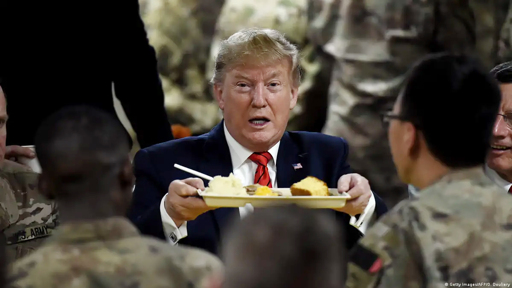
In March, President Trump claimed that the two nations would only be at war for “four to five weeks.” While this has been undeniably untrue for seven months now, and not widely believed from the get-go, this falsity can now be seen as one of the first of many public statements that do not encapsulate the increasingly glaring reality:the U.S. severely underestimated the Iranian military and the leaders of the Trump administration are unwilling to admit it. And now, in October, the war that has cost U.S. taxpayers over $37.5 billion is being shrugged off by Trump, who has now shared support for J.D. Vance’s position refuting that this conquest is a war. Trump claims it is merely a “military conflict,” that it is “small potatoes.”
Contrary to this laxity, U.S. naval officials have told press outlets that war with Iran is placing significant pressure on the United States, as warships and bases in the Middle East have been under a barrage of attacks from Iranian military forces, exacerbated by severe morale issues throughout the troops and diminishing defensive munition supplies. Iran has successfully attacked 15 U.S. military bases over the course of this year, and those hits have not gone unnoticed or unfelt.
The doomsday that wasn’t
On Aug. 24, the Trump administration launched Operation Economic Outcast, self-described as an “unprecedented campaign to sever every remaining economic lifeline sustaining the Islamic Republic of Iran.” The White House official statement on the operation proceeds to claim that Donald Trump and the “overwhelming might” of U.S. military forces had dismantled Iran’s ability to fight back militarily, and that the “endgame” of the war has been ushered in with this operation—“the single greatest financial offensive ever mounted against an adversary.”
Alongside its official name, Trump and Secretary of the Treasury Scott Bessent, who announced the operation, have also coined it “Economic Doomsday.” Sanctions target shipping, digital assets, gold, technology, and aviation, and nations participating economically with Iran were threatened with secondary sanctioning. Bessent stated, “Nations that facilitate any interactions with the regime should quickly heed our message. Those who stand with the United States will reap the rewards of our partnership; those who tether themselves to the Iranian regime should expect to share in the isolation of a withering regime.”
Economists and analysts, on the other hand, have a different take on this supposed “D-Day.” Without diminishing the reality of economic hardship for Iranians, experts say the actions of this administration through Operation Economic Outcast are far from a fatal blow.
Analyst Daniel Fried writes, “It’s not nothing, but it’s no D-Day. … The sanctions announced are to target Iranian, Chinese, and other countries’ firms … But none of the moves was a game changer. The rhetoric was ferocious, but the punch less so.” Bessent’s defense of Operation Economic Outcast, being more of a warning than a critical action, rests on the claim that he did not want to “blow up the global financial system.” There is evidence that the United States is lodging threats against nations unwilling to economically split with Iran, while remaining unwilling to face the risks associated with carrying through what is being weaponized.
Despite the announcement of Operation Economic Outcast being depicted as a final stage of the war with Iran, and post-military combat, the United States struck southern Iran in early September with a sweep of attacks, instigating retaliation from Iran. U.S. bases in Iraq, Jordan, and Bahrain were targeted, while tensions grew over the Strait of Hormuz. An ally of the U.S., Kuwait, was targeted too. Despite this intensification of combat, J.D. Vance claimed that there was “no active shooting” at the moment.
One way or another
As September advanced, more threats and claims rolled out of the Trump regime as to how they plan on handling the war with Iran. Despite widespread reports of dramatically diminishing munition stockpiles, Trump flagrantly—and hollow-heartedly—boasted that the U.S. has such plentiful supplies that depletion could not possibly be imagined, and that the U.S. will end the war, “one way or the other.”
In a rhetorical question of how to go forward, Trump asked, “Will a deal be made with Iran that lets them rebuild and create a far greater country than it ever was before, maybe one of the greatest in the Middle East or even the world? Or do I annihilate the Islamic Republic and do it quickly, never giving them a chance to kill and destroy people and countries again? Do I drive them into hell with no chance of survival and no hope of future greatness or generations?”
On Sept. 27, the foreign minister of Iran, Abbas Araghchi, told NBC News that Iran has no reason to trust in a diplomatic result to the war. While there is a hope for diplomacy, the erratic actions of the Trump administration over the past two years have inspired little confidence. Araghchi stated that, if the time comes, he will be prepared for “doomsday war.”
These remarks came on the coattails of Trump’s rejection of a new peace plan that would have arranged for the reopening of the Strait of Hormuz in one week. After the rejection, Trump announced that bombing of Iran would continue once the midterm elections were concluded. Days later, government officials told CNN that if Tehran demonstrated “concrete progress” toward satisfying U.S. wishes for Iran’s nuclear program, Donald Trump was willing to distribute funds that had been frozen and offer relief on the sanctions that had been placed. That shows a lot of malleability for what was claimed to be an unwavering force of economic destruction.
Morale decreases, by land and by sea
And so, the war goes on. During seven months of grandiose claims of military annihilation of Iran and the unending power of the U.S. military being spewed from Trump and his closest cronies, the polls show that the president lacks the confidence of the U.S. working class. Polls led by Fox News show that seven out of 10 voters do not trust that Trump and his administration have a true strategy or plan to navigate a close to the war with Iran.
In April 2026, 39% of voters believed that war with Iran would decrease safety within the United States. When polled again at the end of September, this count grew to 47% of voters. About 60% of voters in the Fox News poll think that the U.S. should not have engaged in war with Iran altogether. In August, the Institute for Global Affairs published poll results showing that eight in 10 Americans felt that the war with Iran raised their cost of living.
Are these the “rewards” that have been expectedly reaped by siding with the U.S. and its greatness? Rising costs of living and decreasing public morale?
Further, the lowered morale is not a problem that can be felt just within the working class of the mainland United States. American sailors are battling direct neglect from the military and its failure to provide safe and adequate living for those enlisted. Earlier this year, the U.S.S. Gerald Ford suffered extensive fire damage and multiple casualties from a laundry fire and subsequent faulty system for fire suppression. Those unscathed by the fire have not unequivocally had smooth sailing, however. Severe plumbing issues led to hundreds of toilets clogging and filling with human waste.
The crew of the U.S.S. Abraham Lincoln spent a stretch of nine months at sea with no port calls, and in August reports broke of insufficient living conditions—mold, limited food, and dwindling care supplies such as soap and other things needed for hygiene and basic comfort and health. There have been at least eight suicide attempts within the crew of the Lincoln alone.
The response from Trump and Hegseth to this breaking story? Fake news.
In fact, Trump went as far as to claim that these sailors have not been at sea for long enough! New York Senator Kirsten Gillibrand responded, “That this administration can find endless taxpayer dollars for bombs, ballrooms, and billionaires, but cannot take care of our service members, is completely unacceptable.”
Representatives for the U.S. government are repeatedly hinging the timeline for this next period of the war around American midterm elections—a timeline that the Iranian government has already stated that they do not care about in respect for their own national interests. With public support decreasing, costs of living rising, and the violence moving into its seventh month, time will tell on when this war will really end. One thing that has become increasingly apparent, however, is that the United States and the Trump administration have not had ease in navigating the conflict, despite what they want the working class and students to think.
Shifts next door
After decades of U.S. military presence in Iraq, the implementation of a Biden-era decision to withdraw troops has been set to motion. Many questions remain. Will this create the space for the Iraqi working class and peasants to fight for autonomy? Will this be seen as a possible threat in the Middle East as Trump aims to place Iran in an economic and military chokehold?
While it’s clear that millions of Iraqi people have looked forward to the end of the U.S. occupation, the big question remains: What next? There’s no doubt that the U.S. imperialist policy made Iraq unstable and the repercussion of the occupation will be felt for some time.
The path toward withdrawal during the Biden era signified a tactical pivot of the U.S. military away from the Middle East, and toward Asia—particularly, China. But, things have changed since Biden left office and Trump has made the war in Iran a central focus of the government.
What is clear? The working people of Iraq, and every Middle Eastern nation, have a right to self-determination free of U.S. interference. A key missing component for Iraqis in their fight is an independent workers’ movement in Iraq and a mass international antiwar movement that opposes the imperialist war machine.
Filling the streets
It’s an incredible reality that there is no mass movement in opposition to the U.S. war against Iran. There is no question that even among Trump voters there is a strong antiwar sentiment. The ruling class has yet to convince the broader public that war is a good thing. This is one reason Trump’s approval rating is so low.
The U.S. working class is increasingly faced with a rising cost of living so that the floundering U.S. imperialist power can burn the candle at both ends trying to reassert its past hegemonic dominance.
Why has this situation not yet translated into mass action in the streets? One major reason, of course, is the efforts of the Democratic Party—and the unions, NGOs, and other organizations that support the party—to divert opposition out of the streets and toward the ballot box. Their electoral message has ramped up particularly as we get closer to the mid-term elections and the Republicans seem more vulnerable in the polls.
While in 2026 the attacks on civil liberties, environment destruction, war, declining wages, rights, and more are drastic, the response that is needed from the working class is far from unprecedented. We need a return to the strategies and tactics of the past antiwar movements that quite clearly showed how people, working together in mass coalitions, could effectively oppose U.S. imperialism.
We can also look at the immigrant rights movements of the early 2000s, which culminated in what was effectively a general strike in the “A Day Without Immigrants” action on May 1, 2006. Taking that as a model, what could happen if U.S. workers stood together and refused to work to maintain war production?
With these blueprints extant, the task remaining for us today is to organize with friends, neighbors, coworkers, and comrades to build massive movements of protest and resistance.
Photo: Trump serves mashed potatoes to U.S. troops in Afghanistan on Thanksgiving Day 2019. (O. Douliery / AFP / Getty Images)
The post Trump’s ‘small potatoes’ war first appeared on Workers’ Voice/La Voz de los Trabajadores.
From Workers’ Voice/La Voz de los Trabajadores via This RSS Feed.
I don’t understand how this shitty pirate nation is printing all this money.
