


Content warning: This article contains distressing/ graphic images and videos of physical violence
West Bank’s olive harvesting season has not yet officially started but ‘Israeli’ violence in olive groves, and theft of produce is already occurring throughout the territory
Every autumn, Palestinian families return to their groves to harvest olives. It is work, income and memory — trees planted by grandparents, tended through generations and picked at the same time each year.
In the occupied West Bank, it is also one of the most important parts of the economy.
Up to 100,000 families depend on the season for all or part of their livelihoods. In a good year, exports can bring almost $200 million into the Palestinian economy. The olive oil sector contributes about 8% of the West Bank’s GDP and supports more than 60,000 jobs.
Due to this, harvesting olives has become increasingly dangerous.
Olive season: October 2025 most violent
During the 2025 olive season, there were at least 360 attacks throughout the occupied West Bank by settlers. More than 25,000 olive trees were damaged or destroyed, and Palestinians were denied access to around 12,400 hectares of their agricultural land. Losses amounted to more than $100 million.
The UN Office for the Coordination of Humanitarian Affairs (OCHA) and human rights monitors noted that the 2025 season witnessed the highest level of harvest-related settler attacks and community disruptions since tracking began. October 2025 marked the most violent month of settler incidents recorded in the West Bank since 2006.
This year, for many farmers, the harvest has again become a season of fear as the targeted violence continues. According to the Palestinian Ministry of Agriculture, between 25 September and 1 October 2026, farmers across seven West Bank governorates have suffered losses worth $1.75 million.
Mother and sons suffer broken bones at hands of soldiers
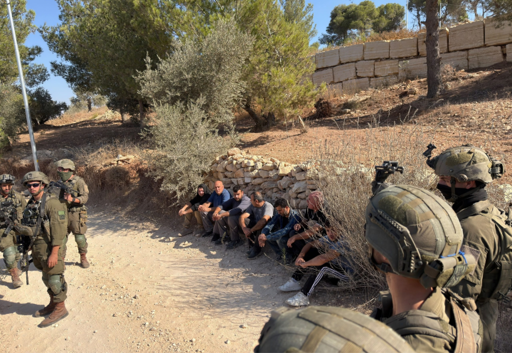
On 3 October, at about 8am, farmers and solidarity activists were denied access to the olive groves on the Beita side of Jabal Qamas, south of Nablus. Soldiers said it was because they had not coordinated their visit in advance. Yet, the land lies in Area B, where Palestinians do not need ‘Israeli’ permission to enter.
https://www.thecanary.co/wp-content/uploads/2026/10/beita-invasion.mp4
If coordination is required, this means Palestinians must get a permit from the army to access their land and harvest. This only works in favour of ‘Israel’, not the Palestinian land owners.
Israeli human rights non-profit, Yesh Din, says the “coordination mechanism” is “a highly effective tool for preventing the harvest for many years”.
The olive harvest season will begin next week. While many Palestinians are forced to wait for military coordination in order to harvest on their own land, settlers are stealing their olives.
In just the past 24 hours, together with local village councils, we documented 5… pic.twitter.com/g8Hj2xEKby
— Yesh Din ييش دين יש דין (@Yesh_Din) October 5, 2026
During the incident, six farmers were detained. Hatem Bdeir, 46, was arrested and held for several hours. Once released, he needed hospital treatment after being badly beaten.
 Settlers from the Mevaser Shalom outpost then climbed Jabal Qamas and descended towards olive pickers on the Ossarin side. They severely beat four Palestinians.
Hussam Adily was critically injured and bleeding heavily. He suffered a fractured skull, an intracranial haemorrhage and a broken arm.
 His brother, Ghassan Adily, suffered a fractured spine and multiple other injuries while their mother suffered a fractured cheekbone and back.
https://www.thecanary.co/wp-content/uploads/2026/10/os2.mp4
In nearby Jamma’in, settlers accompanied by the IOF also attacked Palestinian farmers as they were harvesting olives. Trees were damaged, farmers injured and dozens of Palestinians detained.
Four international solidarity activists, who accompanied the farmers, were also deported. These activists play an essential role, providing essential protective presence while also bearing witness to the occupation’s crimes against Palestinians.
At the time of publication (6 October), Palestinian journalists Mohammad Abed and Mohammad Atiq, and several Palestinian landowners, are under the IOF’s detention at the entrance of Anza village, south of Jenin. They had been covering the uprooting of olive trees in the area by settlers and the ‘Israeli’ army.
Theft caught on camera
Elsewhere, settlers have stolen olives from Palestinian-owned groves. In the Tel Rumeida area of Hebron’s Old City, in the south of the West Bank, ‘Israeli’ settlers, with the help of the IOF, stole the fruit.
A Hebron resident and human rights defender, Issa Amro, shared this footage with the Canary.
https://www.thecanary.co/wp-content/uploads/2026/10/heb-1.mp4
https://www.thecanary.co/wp-content/uploads/2026/10/heb-2.mp4
The same has happened in many other villages, including Attara and Sinjil, in the central West Bank, and Madama in the north. Here they also stole equipment before soldiers pushed Palestinian landowners back towards the village, stopping them from reaching their own land.
https://www.thecanary.co/wp-content/uploads/2026/10/mad-1.mp4
https://www.thecanary.co/wp-content/uploads/2026/10/mad-2.mp4
Olive trees broken, set alight or uprooted by settlers
Only weeks before the official start of this year’s olive season, large numbers of olive trees — many of them ancient — have been damaged or destroyed intentionally in many areas.
In villages such as al-Mughayyir and Burqa, settlers brought livestock into private Palestinian groves, trespassing on the land and damaging trees.
https://www.thecanary.co/wp-content/uploads/2026/10/burw.mp4
Settlers used bulldozers to destroy and uproot olive trees in Turmus Ayya.

In Nabi Saleh, northwest of Ramallah, the IOF uprooted more than 1,000 trees over several days. This destruction occurred while large numbers of settlers and soldiers forcibly displaced the Jahalin Bedouin community living near Nabi Saleh. The attackers stole sheep and raided tents, taking money, jewellery, phones and identity documents.
https://www.thecanary.co/wp-content/uploads/2026/10/nala.mp4
Fifty-five military orders were issued by ‘Israel’ between the start of 2026 and September to remove vegetation and trees from Palestinian land. The orders affected more than 2,500 dunams of land, roughly the size of 460 football pitches.
For Palestinian communities, uprooting olive trees is not just agricultural damage. It is an attack on a central source of annual income and food security. It strikes at people’s connection to land they have farmed for generations.
Record level of settler attacks, man loses his life
This violence against Palestinian farmers in their olive groves, which began even before the official start of the harvesting season, has come amid a period of record levels of settler attacks against Palestinians.
 The Wall and Settlement Resistance Commission has reported that more than 2,050 attacks were carried out against Palestinians, their land and property in September alone.
- The IOF was responsible for 1,404 attacks
- Settlers were responsible for 647
- A total of 9,334 olive trees were also damaged or destroyed during September
Malicious settlers wanted Mashour Yassin to die
This escalation has already claimed a life.
On 1 October, settlers from a nearby outpost attacked a cluster of homes in the al-Nasba area of Yasuf, east of Salfit. They opened fire on residents, fatally shooting 51-year-old Mashour Yassin and wounding another man.
When ‘Israeli’ forces arrived, they searched Yassin’s home. They then took the ambulance key and threw it away, delaying his evacuation.

https://www.thecanary.co/wp-content/uploads/2026/10/yas-2.mp4
Nearly 90,000 trees and saplings ruined
The olive harvest should be a season of work and family gatherings on Palestinian land. Instead, farmers are being beaten, shot at and barred from their groves. They are forced to watch trees that took generations to grow being destroyed.
The sole reason for ‘Israel’s’ violence and intimidation towards Palestinians is to forcibly displace them from their land, so ‘Israel’ can claim it for itself. There is no better way to do this than by preventing Palestinians from accessing their land and depriving them of their income.
Settler attacks and access restrictions have displaced more than 6,500 Palestinians between January 2023 and August 2026, the UN Office for the Coordination of Humanitarian Affairs (OCHA) stated.
A total of 49 communities have been fully displaced and 83 others partially displaced. About 88,000 trees and saplings were damaged or destroyed during this time.
Featured image via the Canary
By Charlie Jaay
From Canary via This RSS Feed.