

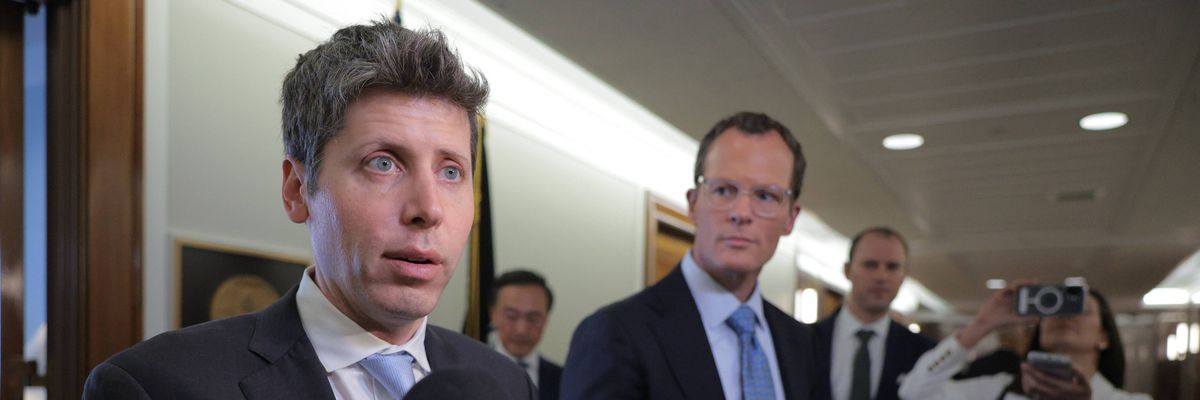
US Sen. Bernie Sanders asked OpenAI CEO Sam Altman precisely what “bad things” the world should accept for the sake of advancements in artificial intelligence, a question that came after the billionaire executive said people must be willing to tolerate some unspecified negative outcomes to enjoy the potential long-term benefits of the technology.
“Mr. Altman: What ‘bad things’ should we accept to advance AI?” Sanders (I-Vt.) wrote in response to the OpenAI CEO’s interview with Politico. “Losing tens of millions of jobs? A mass surveillance state? A mental health crisis for our kids? A global financial crisis? Mass extinction?”
“Let’s not wait to find out,” the senator added. “Pause advanced AI NOW!”
Altman told Politico in an interview released this past weekend that he believes the world “should accept some bad things happening for the benefits of this technology and people having the agency.” The OpenAI CEO didn’t elaborate on the kinds of “bad things” he views as an acceptable price to pay for AI development, which some researchers and industry insiders say poses an existential threat to humanity.
Altman was among the leading AI executives who met with US President Donald Trump at the White House last week and signed a commitment to self-police their respective companies’ AI models in the wake of recently uncovered security incidents and amid mounting concerns that—if left unrestrained and in the hands of profit-seeking firms—AI could have catastrophic impacts on humankind.
Sanders is calling for an immediate halt to advanced AI development as well as a permanent ban on artificial superintelligence, defined as “AI that exceeds human cognitive performance and capabilities across most domains, or has sufficient capabilities to destroy or disempower humanity, including by overthrowing the federal government.”
Sanders, Rep. Greg Casar (D-Texas), and other US lawmakers who support strict AI regulation are also calling on the Trump administration to pursue international agreements aimed at reining in artificial intelligence worldwide.
Volker Türk, the United Nations high commissioner for human rights, said in a speech on Monday that “the clock on AI regulation is ticking” and warned that unfettered AI “can undermine equality, freedom, privacy, and public debate in a million subtle, sophisticated ways—letting dystopia creep in unnoticed.”
“No country and no company can—or should—define the future of AI and people’s rights alone,” said Türk. “The clock on AI regulation is ticking. If we fail to move quickly, we risk unforeseeable consequences—for ourselves and future generations.”
From Common Dreams via This RSS Feed.