

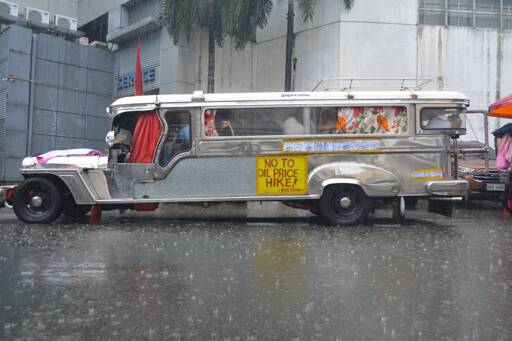
By Wendyl Geronimo and Roselle Ochobillo
For commuters, the recent P1 increase in jeepney fares may seem small. But for workers who rely on public transportation every day, the additional peso can add to an already tightening budget.
For jeepney drivers, meanwhile, the bigger burden is not the fare increase itself but the fuel prices behind it.
After several rounds of oil price increases, diesel prices have continued to eat into drivers’ daily earnings, leaving some struggling to provide food, pay rent and keep their children in school.
The pressure was among the reasons transport groups, including the Pagkakaisa ng mga Samahang Tsuper at Opereytor Nationwide (PISTON), held a nationwide strike on Sept. 29 and 30, calling for lower petroleum prices and relief from fuel taxes.
For 52-year-old jeepney driver Teody Bermejo, National Capital Region and Alabang Pasay President said that the additional peso in fare does little to address what drivers actually spend to keep their vehicles running.
Bermejo, who has been driving for around 30 years, said he now spends much of his working day trying to recover the cost of diesel.
He drives from around 4:00 a.m. until 9:00 p.m., or as long as 16 hours a day. When diesel was around P50 to P55 ($0.80 to $0.88) per liter, he said he could take home around P1,000 ($15.98), sometimes reaching P1,500 ($23.97).
Now, he said, his take-home income has fallen to around P500 to P600 ($7.99 to $9.59), despite the long hours on the road.
“That is really not acceptable to us because diesel prices have increased by around P52 to P55 ($0.83 to 0.88), while they only added P1 to the fare. There is a huge difference. It really won’t be enough for us.”
For Bermejo, the impact of rising fuel prices has reached his household. He has four children in school, but his income can no longer cover their needs at the same time.
One of his children who was in college had to temporarily stop studying and find work to help the family.
“My child in college had to stop studying for now. In a way, they also had to find a job to help me because my income now is not enough to support all of them in school at the same time.”
He said the family is now trying to continue the education of his other children while making ends meet with his reduced income.
When fuel costs reach the household
The same struggle is felt by 50-year-old Janet “Arja” Tumbaga Pocsidio, a member of Piston Women who helps operate a Cubao-Divisoria route.
Pocsidio is a mother of five and helps provide for her children and grandchildren. When diesel prices reached around P140 to P145 ($2.24 to $2.32) per liter, she said their earnings from driving became too small to sustain the family.
On some days, her husband would earn only P70 to P80 ($1.12 to $1.28).
The family eventually stopped operating their jeepney for periods because the cost of fuel outweighed what they could earn from passengers.
Pocsidio then worked as a barker, earning around P250 to P400 ($3.99 to $6.39) a day, which she used for food and her children’s school expenses.
The rising cost of basic necessities also changed what the family could afford to eat.
She said they often relied on dried fish and eggs, while even small increases in food prices became noticeable in their daily budget.
Housing became another burden. Pocsidio said their family was paying P6,000 ($95.88) in monthly rent, aside from electricity and water.
Eventually, they were forced to leave their rented home because they could no longer keep up with the payments.
“We were evicted, and we ended up sleeping in our jeep. Yes, we were evicted because we couldn’t afford to pay,” Pocsidio told Bulatlat.
The family later stayed at the Piston San Juan office for about four months, where they paid for electricity.
For her, depending on the organization for shelter was difficult.
“I feel ashamed. I’m extremely ashamed. I’m quite self-conscious, but I have no other choice. I just told myself that I would leave it in the Lord’s hands.”
A fare increase does not solve the fuel problem
While drivers struggle with operating costs, commuters are also adjusting their budgets.
Bench Cuabo, a government worker, said that the P1 ($0.02) fare increase may appear minimal but still affects his daily transportation expenses.
He said his usual P15 ($0.24) fare has increased to P17 (0.27), and when drivers cannot provide change, he sometimes ends up paying P20 ($0.32).
“Although the increase is P1, it will still affect the daily budget of transportation.” He added.
Cuabo also said rising fuel prices also affect his transportation choices. When jeepneys become unavailable or drivers stop operating because of high fuel costs, he sometimes resorts to taking a taxi, which costs significantly more.
However, he highlighted that fare increase should not be treated as the only solution.
He said transportation services have not necessarily improved alongside the higher fare.
“The fare increases because of the rising cost of fuel but the transportation remains the same, no changes.”
Beyond fares, Cuabo said the government should consider measures that would reduce fuel prices and help workers cope with the rising cost of living. Among his suggestions are the temporary suspension of fuel excise taxes and an increase in workers’ wages.
His concern reflects the larger gap facing both commuters and drivers: transportation costs are rising, but household incomes do not necessarily rise at the same pace.
For Bermejo, lowering the price of diesel remains the more immediate solution.
“First and foremost, we really need the price of diesel to be rolled back. Second, if it really cannot be rolled back, perhaps the VAT and excise tax on fuel could be temporarily removed.”
The fuel crisis has also fueled continued protests from transport groups. During the September 29–30 strike, Piston members and other groups marched in Metro Manila to demand government action on petroleum prices.
On September 29, seventy-eight-year-old Piston driver Elmer “Tatay Elmer” Cordero was rushed to a hospital after suffering a heart attack during the protest, according to the group.
For drivers like Bermejo and Pocsidio, the issue goes beyond whether passengers can afford another peso in fare.
It is about whether the income from a day on the road can still cover the basic needs of the families waiting at home.
And as fuel prices continue to affect transportation, food, education and housing, the question for many jeepney families is no longer simply how much a passenger can afford to pay—but how much longer a driver’s income can keep a household afloat. (AMU, RVO)
The post Fuel hikes squeeze jeepney drivers, commuters dry appeared first on Bulatlat.
From Bulatlat via This RSS Feed.