

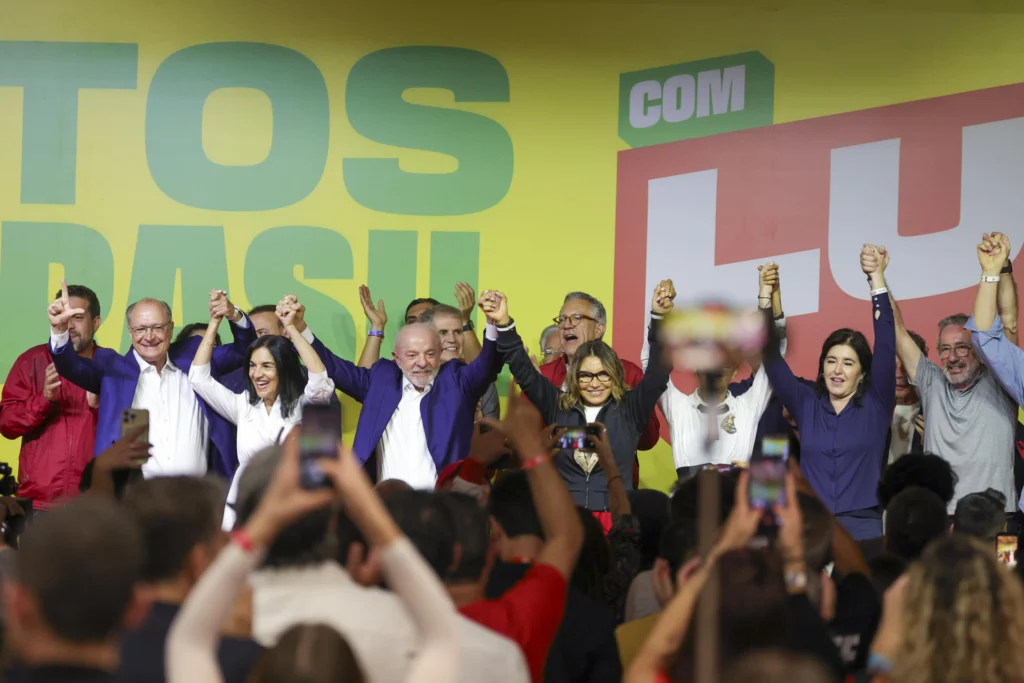
Brazil’s Workers’ Party will rebuild its campaign operation after a difficult first round, recruiting veteran strategists and widening its coalition as President Luiz Inácio Lula da Silva orders a tactical reset ahead of the October 25 runoff.
The meetings were split into two parts: a restricted session of the campaign leadership at the Alvorada Palace, and a broader gathering at the San Marco hotel with allied parties, governors and lawmakers.
The changes were confirmed at a restricted coordination meeting in Brasília. There, the Brazilian President ordered a broad tactical review and instructed the inner circle to rethink its working scheme from the ground up.
RELATED: Brazil Runoff Wide Open: Lula Closes Gap on Flávio Bolsonaro
Participants included Workers’ Party (PT) national president Edinho Silva, Social Communication Secretary Sidônio Palmeira, Entrepreneurship Minister Paulo Pereira, former finance minister Fernando Haddad and former education minister Camilo Santana.
Reelected governors Jerônimo Rodrigues of Bahia and Rafael Fonteles of Piauí also attended, along with several senators-elect and allies, a base seen as essential to mobilize the party’s territorial structure.
🔴 AO VIVO Lula faz reunião de coordenaçãohttps://t.co/l8Wf8EELCp
— PT Brasil (@ptbrasil) October 5, 2026
Text reads: “Lula holds coordination meeting.”
The plan includes a bigger role for Lula in debates, wider political alliances and a revamped communication strategy aimed at undecided voters and at reducing abstention.
New Campaign Team
The Lula’s campaign is reworking its communication strategy, with an expanded team and outreach to young people, women and centrist voters.
Party’s leaders judged that problems seen in the first round require operational changes, so they decided to reorganize roles and bring in new professionals for the communications area headed by Sidônio Palmeira, the minister of social communication, who continues to work alongside strategist Raúl Rabello. Names joining the strategic core include publicist Otávio Antunes and, possibly, veteran publicist João Santana, who designed winning Workers’ Party presidential campaigns.
The strategic core will now absorb more allied parties and heavyweight figures from the Northeast. Vice President Geraldo Alckmin’s Brazilian Socialist Party enters the room, along with Camilo Santana, the PT’s leader in the Senate, whose assignment is to intensify territorial organizing and win over moderate voters.
Winning Back Abstainers
Abstention sits at the center of the problem. With 21.08% of the electorate staying home, 33.4 million of the country’s 158.7 million registered voters were absent. The campaign will prioritize direct contact with workers and orient its message around concrete proposals for the next four years.
At the same time, the party aims to assemble a coalition even broader than the one that prevailed in 2022, one capable of uniting workers, business owners, social movements and centrist voters. It is, in effect, an attempt to rebuild the broad front that carried the party to victory three years ago and extend it further.
The decision-making core will add more allied parties, such as Vice President Geraldo Alckmin’s Brazilian Socialist Party (PSB), and key Northeast figures, to intensify territorial outreach and appeal to moderate voters.
Ver esta publicación en Instagram
Una publicación compartida de teleSUR English (@telesurenglish)
Debates at Center Stage
The strategy also demands a firm contrast with Bolsonaro to lay bare the consequences of his program. In the first round, Lula chose not to attend televised debates because of the number of candidates and the format, which made a sustained exchange with his main rivals impossible. Workers’ Party (PT) national president Edinho Silva affirmed that this will change. “President Lula has always defended debate and will attend the runoff debates. I can’t tell you here how many. But within that possibility, he will attend as many debates as possible,” he said.
With only two candidates in the runoff, Workers’ Party leaders expect a firm, face-to-face confrontation with Flávio Bolsonaro. “Now, since there will be no such thing in the second round, President Lula will do it,” Silva said.
The runoff leaves little room for error. The reshaped team now faces the task of converting a thin first-round margin into ground-level mobilization, with the Northeast and the moderate center identified as the decisive battlegrounds.
From teleSUR English via This RSS Feed.