

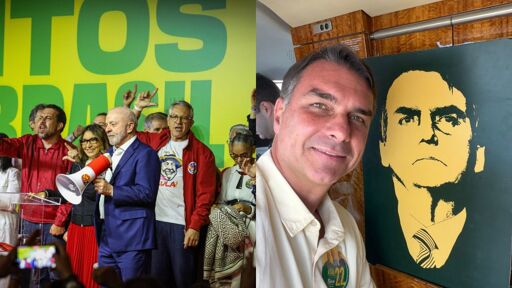

On October 4, over 150 million Brazilians were called to the polls to elect their president, deputies, and governors, and to replace the majority of senators. The elections, for many, brought a major surprise. Although polls indicated a lead for the incumbent president, progressive Luiz Inácio “Lula” da Silva, far-right Senator Flávio Bolsonaro clinched first place. Flávio is the son of former President Jair Bolsonaro who is currently serving a 27-year sentence for his involvement in an attempted coup against Lula in 2022.
According to the final tally, Bolsonaro received 47.03% of the vote (56 million votes) while Lula received 45.16%, nearly 54 million votes. Thus, Bolsonaro’s lead amounts to just over 2 million votes. In third place is Augusto Cury, with 2.89%. He is followed by Renan Santos and Ronaldo Caiado, with 2.24% and 2.18%, respectively. The remaining candidates received less than 0.3%.
A look at how the different regions of the country voted, a clear political divide between the north and the south of the country becomes apparent. The north (including states such as Amazonas, Pará, Amapá, Maranhão, Piauí, Bahia, Sergipe, Alagoas, Pernambuco, Paraíba, and Rio Grande do Norte) supported the continued presence of the state and the welfare policies proposed by Lula.
For its part, including the northern state of Roraima, the south of the country clearly backed Bolsonaro’s neoliberal and pro-Trump agenda: Acre, Rondônia, Mato Grosso, Tocantins, Goiás, Mato Grosso do Sul, Minas Gerais, Espírito Santo, Rio de Janeiro, Paraná, Santa Catarina, and Rio Grande do Sul voted for Bolsonaro.
On his X account, the far-right senator from the Liberal Party (PL) said: “Together, we’re going to build a new Brazil. A Brazil of prosperity! Tomorrow, you’ll stand before the ballot box and choose the future of our country, the future of our children, of this generation and the next. Change is in your hands. Brazil is going to win!”
For his part, the president and candidate of the Workers’ Party (PT) said: “The result is often unexpected. You never get everything you want.” Yet, Lula, who has fought dozens of political battles, said: “[The runoff] is the time to show the true picture of Brazil today and of the Brazil we want.”
To secure victory, Bolsonaro hopes to win over the votes of the candidates who finished behind the finalists – the majority of whom undoubtedly hold right-wing ideologies. Lula, however, can still turn the situation around if he manages to form the right alliances and win over voters who cast invalid ballots (about 3%), as well as those who abstained, who account for 21.08% of the total electorate.
Senate, house of representatives, and governors
And while Lula has expressed optimism about the possibility of turning the tide in the presidential runoff to be held on October 25, the political reality in Brazil has changed. Bolsonaro’s PL party has managed to double its number of senators: it won 19 of the 54 seats up for election out of a total of 81 senators. Among them, immediate family members of the former president, such as Michelle Bolsonaro and Carlos Bolsonaro, won seats. In total, the PL will hold more than a third of the Senate, while Lula’s PT will hold 9.
This institution is particularly important because it approves or rejects the judges of the Federal Supreme Court (the country’s highest court) who are nominated by the president. This gives Bolsonaro significant ideological leverage, as he claims his father is being held in custody due to a conspiracy between political powers and a biased judicial system.
In the elections for the Chamber of Deputies, which has 513 seats, the Bolsonaro camp also secured a significant victory. With 100% of the votes counted, the PL won 121 seats, while the Brazil of Hope Federation coalition (which includes Lula’s PT, the Green Party, and the Communist Party) won 88 seats.
However, due to the method of seat allocation, Brazil favors a Chamber of Deputies with representation from many political forces. This is how the Progressive Union secured 87 seats, the Social Democratic Party 43, the Republicans 41, the Brazilian Democratic Movement 36, Podemos 27, the PSOL 15, as well as the Brazilian Socialist Party, among others.
Thus, while the right has the numbers to secure a numerical advantage in the Chamber of Deputies, it will have to contend with deep-seated and historic internal contradictions that could complicate a potential Bolsonaro presidency. Similarly, if Lula manages to prevail in the runoff, he will face a highly complex Senate and Chamber of Deputies that could potentially oppose him.
In the gubernatorial elections, the PL is also the biggest winner. Of 27 states, the Liberal Party has won six so far, while the PT, the Social Democratic Party, the PP, and the Republicans have each won three. Other states will have to elect their governors in a runoff election.
The most talked-about result is the decisive victory in São Paulo by Tarcísio de Freitas, Jair Bolsonaro’s former Minister of Infrastructure, who defeated Fernando Haddad, Lula’s right-hand man. São Paulo is Brazil’s most populous state (46 million people) and home to the South American country’s most powerful economic hubs.
A political future in doubt
It has been repeatedly emphasized that, due to its economic and geopolitical importance, the elections in Brazil are of enormous significance for the future of Latin America. It is no coincidence that former US Secretary of State Henry Kissinger (who promoted a series of dictatorships in the region) said: “Whichever way Brazil leans, Latin America will lean that way.”
The South American far right, which has enjoyed unprecedented electoral success in recent years, knows that without Brazil, its poker hand will always be incomplete. Uruguay indeed remains the only country in the region that does not share the views of Milei in Argentina, Kast in Chile, or De la Espriella in Colombia, but Brazil alone accounts for more than 50% of the region’s total GDP.
Similarly, the left and the center know that a potential victory for Lula would be one of the last battles to be fought against the formidable advance of a right wing aligned with the foreign policies of Trump and Israel, with the most orthodox neoliberalism, and with the economic interests of capital magnates, including the big tech companies. And if Lula manages to recover from this defeat, it would mark a major shift in course for the legendary union leader – not only for Brazil but for the entire region.
As Lula said, “now a different kind of campaign begins.” Both candidates will pull out all the stops to win control of South America’s most populous and powerful country. It certainly won’t be a “clean” campaign, but if one pays attention to the finalists’ statements, every means at their disposal will be used to achieve the coveted goal.
US influence on the elections
Political analysts have expressed concerns about alleged foreign interference in the elections. In July 2025, Trump had imposed 50% tariffs on Brazil over what he considered an unfair ruling against Jair Bolsonaro – whom the US president calls “his friend”.
In August 2026, the United States revoked the visa of Brazil’s ambassador to Washington, a move denounced by Brasília as a violation of international law.
Just last week, US Secretary of State Marco Rubio ordered the closure of the US embassy in Brazil during the elections due to alleged “threats,” a move viewed by some political commentators as a tactic to create tension during the elections.
During the first round of the presidential campaign, Trump did not make any direct statements of support for Flávio Bolsonaro. However, once the results were known, the US president told the press: “It’s a great victory – a close one, but a very, very great, incredible victory.”
In this regard, it remains to be seen whether Trump will make some kind of direct statement in support of Bolsonaro’s candidacy – as he has done in past elections in Colombia, Argentina, Honduras, and elsewhere – in favor of far-right candidates who support his agenda. Or, even more importantly, whether he will make any kind of promise to the Brazilian people if Bolsonaro wins – or, worse yet, threaten them if they vote for Lula.
From BT News via This RSS Feed.