

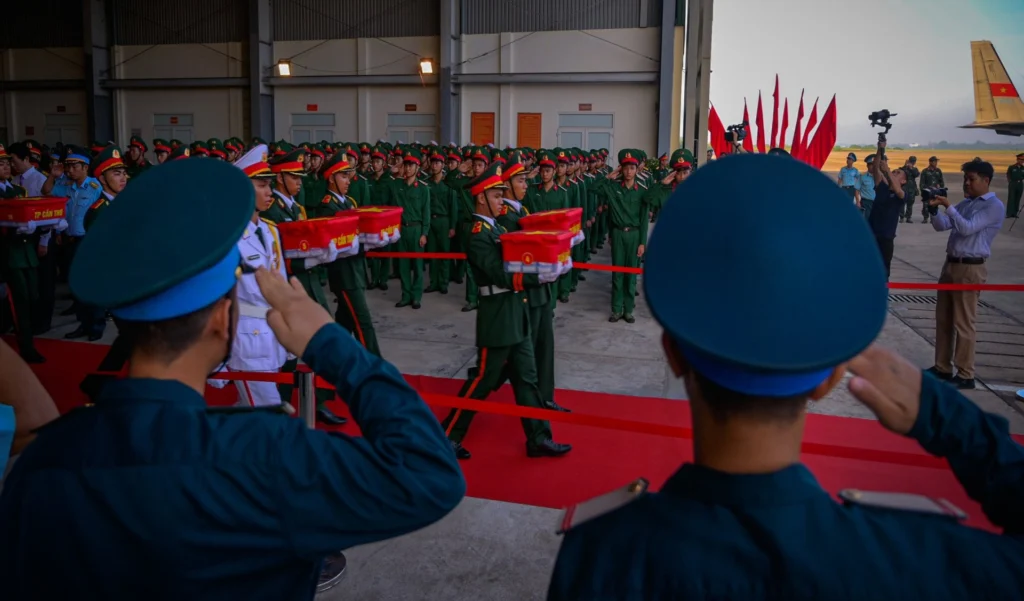
Vietnam has transported 15,401 biological samples by military aircraft from the southern city of Can Tho to Hanoi for DNA testing this Monday, a move designed to restore the identities of soldiers who fell in the country’s wars of national liberation.
A plane from the Air Defense and Air Force carried the samples north as part of the “500 days and nights” campaign, which seeks to accelerate the search, recovery and identification of fallen soldiers’ remains.
Before the flight departed, officials from the People’s Committees and political-military structures of Can Tho, Dong Thap, An Giang, Vinh Long, Ca Mau and Soc Trang held ceremonies with incense and floral offerings.
RELATED: Venezuela Honors Vietnam’s Ambassador with the Hightest Order Rank
The material is now in the custody of the Military Forensic Medicine Institute under the Ministry of Defense, the Institute of Criminal Sciences under the Ministry of Public Security and the Vietnam Academy of Science and Technology. Those institutions are applying protocols for digitizing records and processing DNA in order to match biological profiles against databases of relatives.
The initiative aims to address a historic debt five decades after the victory over U.S. military aggression and the reunification of the country. Authorities estimate that 175,000 bodies have yet to be found and 230,000 graves still lack identification.
Vietnam’da kimliği henüz belirlenemeyen askerlerin kalıntılarından elde edilen 15 bin 401 biyolojik örnek, DNA analizi için askeri uçakla ülkenin güneyinden başkent Hanoi’ye taşındı.
Bugün gerçekleştirilen sevkiyat, bu alandaki şimdiye kadarki en büyük sevkiyat.
Peki bu… https://t.co/rRC9ugL13x pic.twitter.com/sMY5l28jVy
— Erkin Öncan (@erknoncn) October 5, 2026
Text reads: “15,401 biological samples obtained from the remains of soldiers whose identity has not yet been determined in Vietnam were transported from the south of the country to the capital Hanoiye by military aircraft for DNA analysis. The shipment performed today is the largest ever shipment in this area.”
Forensic Coordination Effort
The recovery work does not stop at Vietnam’s borders. Officials confirmed that search and collection operations extend into frontier areas of Laos and Cambodia. Teams are also reviewing historical archives, gathering testimonies and cooperating with other nations to locate roughly 7,000 combatants’ remains before July 27 of next year.
In Soc Trang province, samples were taken from 45 unidentified graves. Colonel Pham Ngoc Quang, political commissar of the Can Tho Military Command, said the scientific identification process carries deep political, social and humanitarian significance.
Military authorities stressed that the deployment represents a State duty to restore popular memory and answer thousands of families who have waited decades for their heroes to return. Commanders ordered units at every level to maintain close coordination to guarantee scientific rigor, proper preservation of the biological material and operational security through each phase of analysis.
The fallen correspond mainly to the First Indochina War (1945-1954) against French colonial rule and, to a very significant degree, to the War of Resistance Against U.S. Aggression (1955-1975). That conflict was marked by military invasion, mass bombing and chemical warfare.
Documentary information continues to be gathered to complete pending historical sovereignty files, while the DNA campaign advances toward its deadline and families await results that could finally attach names to the nation’s unknown graves.
From teleSUR English via This RSS Feed.