

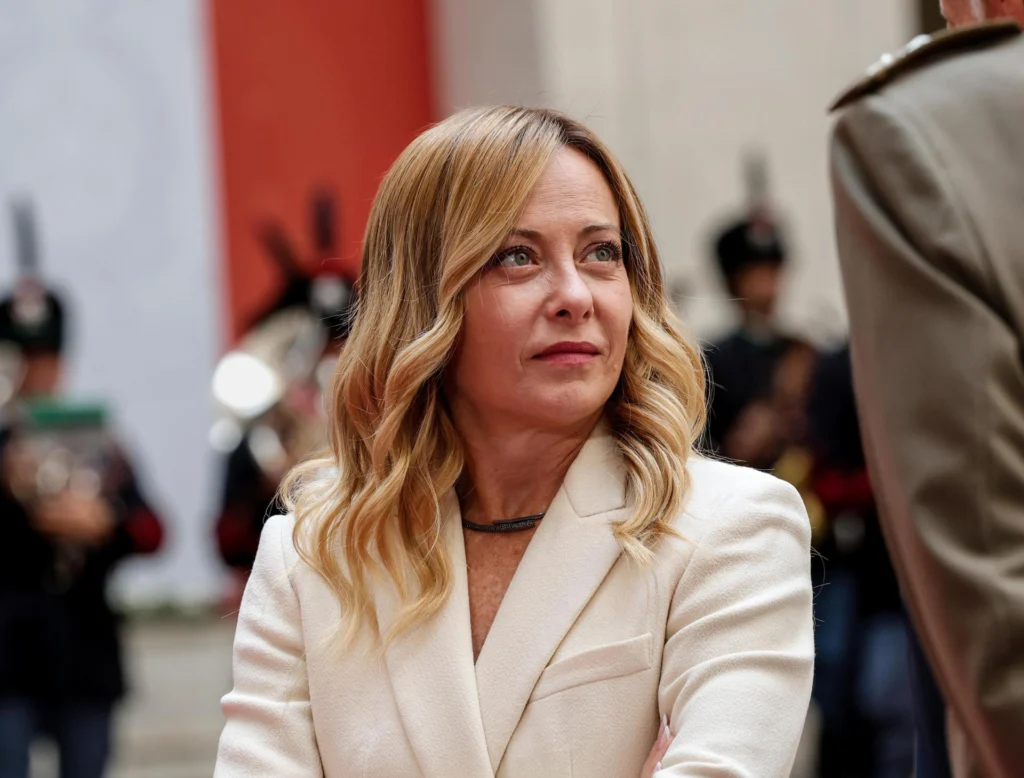
Italy’s Prime Minister Giorgia Meloni has registered her voice before the European Union Intellectual Property Office (EUIPO) this Monday, filing for commercial trademark protection of a four-second audio clip to shield herself from AI-generated clones and falsifications.
The far-right leader filed a trademark application for a four-second audio file in which she says her signature phrase, “io sono Giorgia Meloni” (“I am Giorgia Meloni”), a phrase echoes the title of her 2021 autobiography and a 2019 rally speech that was later turned into a viral disco remix.
Through the filing, Meloni aims to shield the timbre and inflections of her voice from possible AI-generated clones and counterfeits.
RELATED: Trump Announces Super Intelligence Task Force
The far-right leader’s move follows a series of digital manipulations that targeted her personally and her public image. Recent defamation campaigns included the circulation of deepfake photo montages and the unauthorized appropriation of her image by even more radical sectors of Italy’s far right, among them reactionary European Parliament member Roberto Vannacci.
The Italian PM warned in a Facebook post that deepfakes can “deceive, manipulate and target anyone.” “I can defend myself. Many others cannot,” she wrote.
Meloni tries to protect her voice from AI & deepfakes — Politico
Italian PM applied for a sound trademark covering a 4-second clip of her saying ‘Io sono Giorgia Meloni’
Meloni’s likeness has been used for fakes in the past, including alleged sexual images
AI-generated video pic.twitter.com/JErnGzguuc
— RT Intl (@RT_on_X) October 5, 2026
The EU’s amended AI Act, adopted in July, requires deepfakes to be clearly disclosed and bans AI systems that generate non-consensual sexualized images, video or audio of identifiable people, and it also prohibits systems that generate child sexual abuse material.
The sound mark could give Meloni additional legal grounds to challenge unauthorized commercial uses of the protected recording, depending on the goods and services covered by the application.
Deepfakes Fuel Decision
Meloni previously promoted state-level regulations placing AI oversight in the hands of security forces. Her decision to instead turn to corporate patent mechanisms exposes what critics describe as a contradiction among governing elites confronting the uncontrolled advance of global technology platforms.
Those platforms, the argument runs, transform fundamental rights into commodities and private property. The individual shield that Meloni now claims contrasts sharply with the systematic vulnerability faced by working classes and popular sectors before Big Tech monopolies engaged in data extraction and computational manipulation.
Rather than advancing a collective, sovereign framework that would protect the civilian population from espionage, the manipulation of public opinion and the repressive use of algorithms, European leadership has chosen a mercantilist path. It is legally privatizing its own biological attributes, critics charge.
The internal disputes playing out within the far-right spectrum through fake images and algorithm-generated avatars also reflect a broader degradation of political debate inside the European Union’s centers of power. In this asymmetric information war, artificial intelligence ceases to function as a tool serving social welfare or scientific research.
Instead, the technology consolidates as an opaque commodity and an instrument of ideological manipulation at the service of capital and hegemonic factions. The European measure did not emerge in isolation, however. AI governance and control of digital infrastructure formed part of the agenda at the 81st session of the United Nations General Assembly, held from September 22 to 28 in New York.
During those proceedings, leaders from several nations laid out their positions on the accelerated development of algorithmic technologies and the concentration of their infrastructure in a small group of transnational corporations.
Meloni’s move turns a personal trait into an object of industrial property, at a time of growing regulatory gaps over citizens’ digital sovereignty and the ease with which AI enables impersonation of a person’s image and identity.
From teleSUR English via This RSS Feed.