

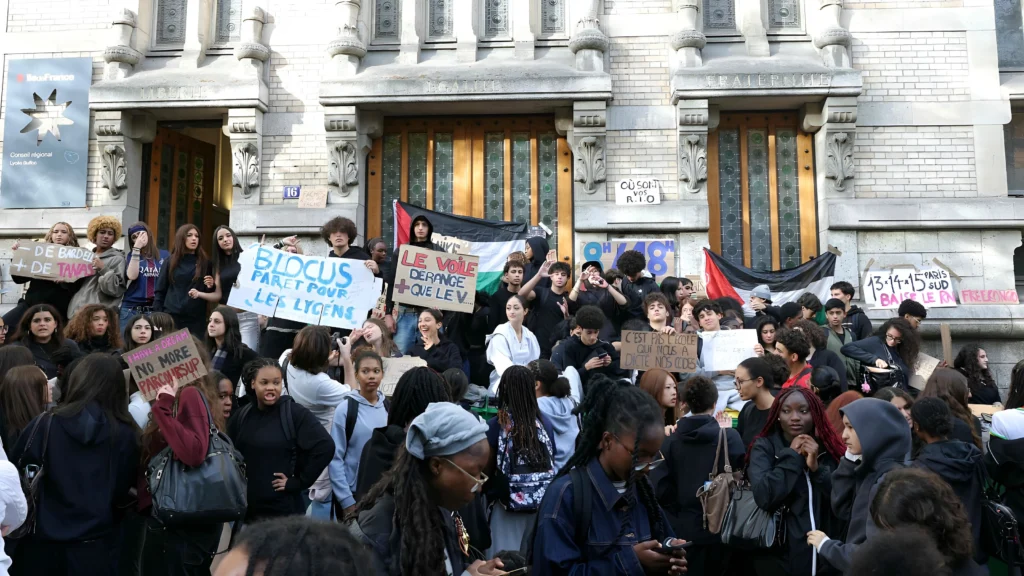
Deepening anger over crumbling facilities, staff shortages, and police heavy-handedness drives nationwide classroom blockades.
From September 21 to October 05, 2026, a widespread student protest movement erupted across France. Demonstrations and blockades have affected more than 500 high schools and multiple universities nationwide.
RELATED:
Student Protests Spread Across France Amid Repression, Nearly 2,000 Detained
What began as localized actions over school working conditions evolved into a national crisis involving youth organizations, trade unions, and political parties.
Triggered by deep-seated movement issues within the French public education system. These grievances coincided with broader public-sector labor strikes and fiscal policy debates under Prime Minister Sébastien Lecornu and President Emmanuel Macron.
Security forces have made over 5,000 arrests between late September and early October 2026. The French Interior Ministry reported that approximately 85 percent of those detained were minors.
Origins, Spread, and Strategic Locations of the Movement
The student protest movement began in France on September 21 and intensified on September 29, with isolated school blockades in the Brittany region, notably at the Théodore-Monod High School near Rennes, as well as in Villeneuve-d’Ascq and Caen. Students initially mobilized to highlight class schedules and resource limitations.
The student movement gained national visibility on September 21, 2026, at the Saint-Exupéry High School in Créteil, a suburban area southeast of Paris. Following a local teachers’ strike, students blocked the entrance to the building to draw attention to unfilled teaching posts, lack of administrative staff, and crumbling infrastructure.
Cheick Sanogo, a 17-year-old student at Saint-Exupéry, stated that students decided to join their teachers after understanding the extent of staff shortages in their school.
Social media platforms played a crucial role in accelerating the spread of the movement. Student interviews filmed outside the Créteil high school received over 1.5 million views on TikTok, prompting similar blockades in other suburban and urban districts.
High school students used platforms like Snapchat and Instagram to coordinate actions, share footage of police deployments, and call for nationwide solidarity.
By September 29, protests had spread to major cities across France, including Paris, Lille, Marseille, Rennes, Nantes, Lyon, Toulouse, and Strasbourg.
In Paris, students set up barricades using trash bins and metal barriers outside prominent institutions such as Claude-Monet High School, François-Truffaut High School, and Arago High School.
By October 1, 2026, the movement expanded into higher education. University campuses, including Sorbonne University and Paris Cité University in the capital region, as well as Sciences Po Rennes and Paul-Valéry University in Montpellier, experienced blockades and student assemblies organized in support of high school demands.
Regional authorities in Île-de-France reported that hundreds of schools were fully or partially closed, with property damage across institutions estimated at hundreds of thousands of euros.
FRANCE IS LOSING CONTROL OF ITS SCHOOLS
What started as clear student demands in France has turned into a national crisis within days.
High school students are protesting teacher shortages, overcrowded classrooms, deteriorating buildings, a lack of resources, and long school…
— China pulse 🇨🇳 (@Eng_china5) October 3, 2026
Causes, Demands, and Structural Issues
The primary cause of the student demonstrations lies in systemic deficiencies across the French national education system.
High school and university organizations have emphasized that the movement is rooted in material degradation, operational understaffing, and structural policies that affect student well-being.
Student demonstrators highlighted crumbling school infrastructure, leaking roofs, and classrooms ill-adapted to changing climatic conditions.
During recent heat waves, temperatures inside uninsulated classrooms reached between 35°C and 40°C, rendering learning environments intolerable and hazardous to health.
Additionally, many facilities face persistent sanitary issues, including non-functional restrooms and a lack of proper heating during colder periods.
Staffing shortages represent another major grievance. Figures from the Ministry of National Education indicate that 9.8 percent of secondary teaching hours were left unfulfilled during the previous academic year due to unreplaced teacher absences.
This shortage is compounded by an acute deficit of support staff, including administrative personnel, school nurses, and social workers. Students also cited severe psychological stress caused by the algorithmic platform Parcoursup, which governs post-secondary admissions, and demanding, poorly structured weekly schedules.
Socioeconomic and regional inequalities further fuel student frustration. Institutions in working-class suburban zones, particularly in the Île-de-France region, suffer disproportionately from underfunding and staff high turnover rates compared to institutions in higher-income urban centers.
The primary demands of the protesting students include:
• Immediate reallocation of state budgetary resources toward public education.
• Mass hiring of permanent teachers, substitute personnel, school nurses, and social workers.
• An end to structural budget freezes and an expansion of school renovation programs.
• Reform of class schedules and the elimination or overhaul of the Parcoursup selection system.
Supporting Organizations, Unions, and Political Movements
The student movement in these protests relies on structured support from high school and university unions, major labor federations, and left-wing political figures.
High school organizations, particularly the National High School Student Union (Union Nationale Lycéenne, USL), have served as key organizers of the blockades and rallies.
USL leaders issued calls for coordinated actions, published guides on organizing peaceful school blockades, and coordinated messaging across regional chapters.
Higher education organizations, such as The Student Union (L’Union Étudiante), expanded the movement to university campuses, linking high school demands to broader concerns regarding student poverty, housing shortages, and academic selection.
Trade union federations representing education workers aligned themselves with the student protests. Organizations such as FSU and CGT Éduc’action backed the students’ demands, noting that teacher strikes and student blockades address the same fundamental decline in public resources.
Teachers and educational support staff joined student picket lines and formed human lines outside school entrances to facilitate peaceful rallies and safeguard underage demonstrators from external clashes.
Political support has come primarily from the left-wing coalition, with prominent involvement from France Unbowed (La France Insoumise, LFI). On September 21, 2026, LFI National Assembly members Louis Boyard and Clémence Guetté visited the blockade at Saint-Exupéry High School in Créteil to offer public support.
Boyard shared footage of the visit online, reaching over 520,000 viewers and helping draw national media attention to the movement. LFI leader Jean-Luc Mélenchon and Bally Bagayoko, Mayor of Saint-Denis, endorsed the student mobilizations, describing the blockades as a legitimate civic response to the state’s neglect of public services in working-class neighborhoods.
Currently, there are protests in France to fund education, in Spain to fund decent housing for all, and in Germany to oppose military expansion. People in Europe are waking up and realizing their governments serve capital and war, not people. Time for Americans to wake up too. pic.twitter.com/9AxdREy1CD
— Power to the People ☭🕊 (@ProudSocialist) October 5, 2026
State Response, Repression, and Human Toll
The French government’s response to the growing student movement has focused primarily on law enforcement intervention and legal measures.
Prime Minister Sébastien Lecornu convened an interministerial crisis meeting to address the disruptions. The executive branch attributed the escalation to external political influences, describing the demonstrations as an operation organized by left-wing political groups.
Law enforcement agencies deployed specialized anti-riot units, including the CRS and mobile intervention brigades, to clear blockades outside secondary schools and university sites. Police forces utilized tear gas canisters, stingballs, and rubber bullets, known as LBDs (lanceurs de balles de défense), to disperse crowds.
Paris Police Prefect Patrice Faure issued decrees prohibiting public gatherings near designated educational institutions, while prefectures in other regions enacted local curfews and restrictions on public assemblies.
Official figures reflect the significant physical and legal impact of the state crackdown across the country. The Ministry of the Interior confirmed that over 5,000 individuals were arrested between late September and early October 2026, with approximately 85 percent of those taken into custody being minors.
The physical toll of these dispersals resulted in dozens of injuries among demonstrating youth. Reported student injuries included severe facial trauma, limb fractures, and head injuries caused by rubber bullets or stun grenades. In Saint-Ouen-l’Aumône, a 14-year-old student suffered a double jaw fracture, while a student in Tours suffered permanent vision loss after being struck in the eye during a confrontation.
Casualties were also reported among public service personnel and law enforcement. The Ministry of National Education reported that 65 education staff members, including 40 school principals, suffered injuries while attempting to manage school perimeters.
In addition to physical security enforcement, the state weaponized legal mechanisms against political figures who publicly supported the movement. Police Prefect Patrice Faure referred Bally Bagayoko, the Mayor of Saint-Denis, to the Bobigny public prosecutor under Article 40 of the Code of Criminal Procedure, alleging that his public statements constituted an incitement to commit offenses.
In France, over 400 schools will remain closed on October 5th due to ongoing protests by high school students across the country.
In Paris alone, 77 law enforcement officers have been injured as a result of the protesters’ actions. Since the beginning of the week, more than… pic.twitter.com/6KtnSJHjdp
— 𝕊𝕡𝕣𝕚𝕟𝕥𝕖𝕣 𝕻𝕣𝕖𝕤𝕤 (@SprinterPress) October 4, 2026
Institutional Dynamics and Broader Implications
For the student mobilizations, the Ministry of National Education ordered affected institutions to transition to remote instruction where physical safety could not be guaranteed.
Education Minister Édouard Geffray announced the closure of over 400 schools in early October to prevent further damage and property destruction.
The proposed 2027 education budget allocates 65.53 billion euros to public education, representing a 1.7 percent increase over the previous year. However, labor unions and student organizations pointed out that this allocation falls below the projected inflation rate, effectively amounting to a real-terms reduction in resources.
The government’s stance remains centered on preserving public order and preventing damage to public property. Prime Minister Lecornu emphasized that while grievances regarding learning conditions may be examined, school blockades, arson, and violence against security forces remain unacceptable.
Conversely, opposition leaders and human rights advocates argue that the heavy security response risks alienating a generation of young citizens and failing to address the underlying degradation of public services.
As high school and university organizations maintain their calls for expanded mobilizations alongside broader labor strikes, the ongoing crisis underscores the fragile state of institutional trust in France’s public education system.
Sources: TeleSUR – Al Jazeera – Kure Ansiklopedi – BBC – France 24 – EFE – RFI – RTVE – El Salto – La Jornada – El Mundo – Euronews – CNN – DW – El País – Página 12 – AFP
From teleSUR English via This RSS Feed.