

By Mohammed Altaj – Oct 3, 2026
The world did not lack knowledge of what was happening to Palestinians.
It knew.
It knew that a people had been living under occupation for decades; that land was being confiscated, settlements expanding, homes demolished, and checkpoints cutting cities and villages off from one another.
The United Nations knew. Governments knew. Parliaments and international courts knew.
The shift now visible across significant parts of Western public opinion did not begin because the world suddenly discovered new facts about Palestine.
The facts were already there.
What changed was the distance between the news and the human being.
People saw what war means when a child is trapped beneath rubble, what displacement means when a family carries whatever it can and walks away without knowing where it will go.
And the numbers began to acquire names, faces and voices.
One of those names was Hind Rajab.
I do not mention Hind because her story encompasses everything that happened in Gaza. I mention her because some tragedies become windows through which people see what numbers alone cannot reveal.
Hind was trapped inside a car in Gaza in January 2024 after members of her family had been killed. She called for help. Twelve days later, she was found dead inside the car. The two paramedics sent to rescue her were also found dead.
But Hind was no longer a number.
That is what changed.
The world also saw seven World Central Kitchen aid workers killed in Israeli strikes while carrying out humanitarian work. And even after the ceasefire announced in October 2025, the killing did not end. According to Palestinian Ministry of Health figures cited by the UN Office for the Coordination of Humanitarian Affairs, by September 23, 2026, 1,402 Palestinians had been killed and 4,881 injured since the ceasefire announcement.
Bodies remained beneath the rubble, while families waited to reach loved ones not to save them this time, but to bury them.
But Palestinian history did not begin in Gaza.
And it did not begin on October 7, 2023.
In 1994, Baruch Goldstein, an Israeli settler and member of the Kach movement, opened fire on Muslim worshippers in the Ibrahimi Mosque in Hebron, killing at least twenty-nine people. In 2014, sixteen-year-old Mohammed Abu Khdeir was abducted from Shuafat, beaten and burned alive. A year later, the Dawabsheh family home in Duma was set on fire while the family slept; toddler Ali and later both his parents died.
So when a Palestinian is asked to begin the story on the morning of October 7, he is effectively being asked to erase what came before.
None of this makes the targeting of civilians acceptable, whoever they are.
It means something else:
Justice cannot begin halfway through history.
Now look at the West Bank.
By September 14, 2026, the United Nations had documented more than 1,600 settler attacks resulting in Palestinian casualties, property damage, or both, across 275 Palestinian communities since the beginning of the year. More than 1,500 Palestinians had been displaced because of demolitions of structures lacking Israeli-issued permits, while more than 2,600 had been displaced in the context of settler violence and related access restrictions.
And the pattern did not slow.
Between September 15 and 21 alone, the UN documented 51 settler attacks resulting in casualties, property damage, or both. At least 800 olive, fruit and palm trees were damaged, uprooted or burned. In the same week, demolitions displaced 147 Palestinians, including 73 children.
These are not isolated incidents.
This is land being transformed, communities disappearing, families being pushed out.
And this is where the phrase “extremist settlers” is no longer enough.
Who plans the settlements? Who allocates the land? Who builds the roads, extends the infrastructure and provides the protection?
At what point does settler violence cease to be merely the act of an individual and become a problem within the system itself?
In September 2026, UN Secretary-General António Guterres warned that settlement expansion was accelerating, outposts were proliferating and settler violence was rising to alarming levels. He also warned that advancing the E1 settlement plan would deal a “deathblow” to the prospect of a contiguous and viable Palestinian state.
How, then, can the world continue to declare its support for a two-state solution while the geography on which one of those states is supposed to exist is being transformed?
The problem is not confined to land.
In Jerusalem, Christian clergy have repeatedly reported being spat at, insulted and harassed. In April 2026, a Catholic nun was violently assaulted in the Old City. A Jerusalem court later found that the defendant had committed the acts described in the indictment but acquitted him on grounds of mental illness and ordered his psychiatric hospitalization.
One incident cannot define an entire society.
But neither should repeated incidents of hostility be dismissed without asking what political and social currents allow intolerance to grow.
It is easy to say: the problem is Netanyahu. Or Ben-Gvir. Or Smotrich.
But what if the problem runs deeper?
In 2018, Israel enacted the Nation-State Law, a Basic Law declaring that the exercise of national self-determination in the State of Israel is exclusive to the Jewish people and that the state views Jewish settlement as a national value.
In the 2025 Israeli Democracy Index, 71.5 percent of Jewish respondents opposed the inclusion of Arab parties in the government.
My subject is not Judaism, nor Jews around the world. My subject is the Israeli system, its laws, its policies and the political currents that allow this reality to continue.
There are Israelis who oppose occupation, settlement and racism.
But the question is not whether dissent exists.
The question is: Which ideas become laws? And which laws become policy?
When extremism moves from the margins to parliament, from parliament into government, from government into law, and from law onto the land, we are no longer talking only about individuals.
We are facing a question about the system itself.
And here, too, Gaza changed something.
What once reached the world as scattered incidents is now seen every day on a screen people carry in their pockets. The effect can be measured in public opinion.
In a Pew Research Center survey conducted in spring 2026, unfavorable views of Israel stood at 79 percent in Australia, 78 percent in Spain and Sweden, 76 percent in the Netherlands, 75 percent in Italy, 73 percent in Germany, 65 percent in Canada and 60 percent in the United States.
Perhaps Gaza did not change the values of millions of people.
Perhaps it made them realize that the values they already believed in were not being applied equally.
I do not ask the West to love Palestine.
Nor do I ask it to hate Israel.
I ask it to apply the principles it says it believes in.
If taking land by force is unacceptable, let it be unacceptable here too. If self-determination is a right, do not make the Palestinian the exception.
‘Israeli’ Occupation Troops Clear 10 Million Tons of Rubble in Gaza To ‘Erase Evidence’ of Genocide
The law is already there.
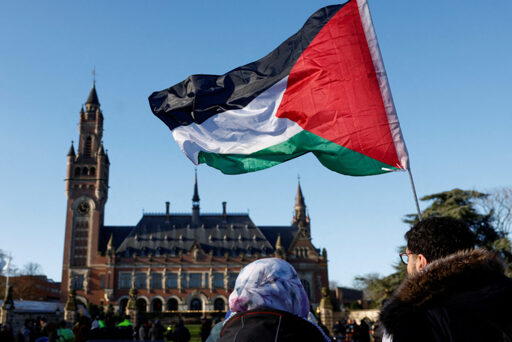
On July 19, 2024, the International Court of Justice concluded that Israel’s continued presence in the Occupied Palestinian Territory was unlawful, that it was obliged to bring that presence to an end as rapidly as possible, and that it must immediately cease all new settlement activity.
The Court also said that states must not recognize as legal the situation arising from that unlawful presence, nor render aid or assistance in maintaining it.
On September 18, 2024, the United Nations General Assembly adopted a resolution by 124 votes to 14, with 43 abstentions, demanding that Israel end its unlawful presence in the Occupied Palestinian Territory within twelve months.
Those twelve months passed.
The unlawful presence did not end.
Settlement did not stop.
More than two years after the Court’s opinion, international warnings have become more direct.
On September 22, 2026, as world leaders gathered in New York, the UN Secretary-General said that the conditions for an independent, democratic, contiguous, viable and sovereign Palestinian state were being “systematically erased.” He said support for two states must go beyond words and be reflected in policies, decisions and actions.
Two days later, the UN High Commissioner for Human Rights said that the steps taken by the international community were clearly not enough and called on states to apply real political pressure to prevent the entrenchment of Israel’s unlawful presence in the Occupied Palestinian Territory.
The General Assembly’s high-level week has ended.
The world knows.
The law has spoken.
International warnings have grown sharper.
Yet the reality on the ground continues to move in the opposite direction.
So when do words become action?
Some states have taken measures against individual settlers and settlements. But if the settler alone is the problem, who built the settlement, planned it, allocated the land and protected it?
If the problem is institutional, an individual response is not enough.
I call for peaceful and lawful international pressure on the policies and institutions responsible for perpetuating occupation and settlement, and for political, diplomatic, economic and military relations to be reviewed if non-compliance with international law continues, in accordance with the law and the obligations of each state.
That is my political position. I do not attribute it to the International Court of Justice.
The Court said what it said.
I am asking a different question:
If the law determines that a situation is unlawful, and that situation continues anyway, what is the value of law if defying it carries no consequences?
This is not a call for war. It is not a call to punish someone for being Israeli, nor to target a Jew for being Jewish.
It is a call to use peaceful and lawful means to end an unlawful reality.
Palestinians waited for negotiations, for a final-status agreement, for the state they were told would come.
And while they waited, settlements grew, the land changed, and communities were displaced.
How much longer can they be asked to wait while the land meant for a future solution is transformed beneath their feet?
That is why the title of this article is not a slogan:
Israel Above the Law… Palestine Beyond Justice.
The problem is not the absence of law.
It is the distance between a ruling and its enforcement, between a principle and its application, between condemnation and consequence.
I do not ask the West to become Palestinian.
I ask only that Palestinians not be made an exception to its humanity—or to its law.
That the life of Hind Rajab be treated as a human life.
That the life of Mohammed Abu Khdeir be treated as a human life.
That the life of Ali Dawabsheh be treated as a human life.
That the lives of the twenty-nine worshippers in the Ibrahimi Mosque be treated as human lives.
Because a justice that must first know the identity of the body before deciding its worth is not justice.
If occupation is unlawful, its continuation cannot be allowed to carry no consequences.
If human rights are universal, they cannot stop at the borders of Palestine.
And when the facts are clear, when the law is clear, and when the Court has spoken, the question becomes larger than Palestine and Israel:
Can any state remain above the law?
And if the answer is no, why does Palestine remain, to this day, beyond justice?
MA/OT
From Orinoco Tribune via This RSS Feed.